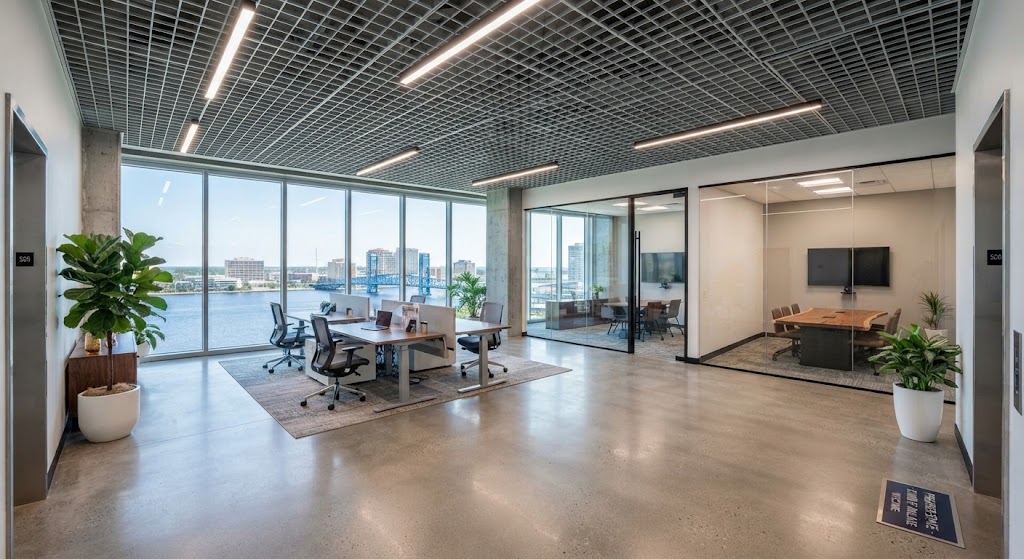
Where the Distress Actually Is, Where It Isn’t, and What’s Getting Converted
Last updated: August 2026 | FloridaCommercialRealEstateNews.com
Florida’s office market is not the national office story. While U.S. office vacancy has sat near record highs of roughly 20 percent through the mid-2020s and office loan delinquencies have climbed to levels not seen since the financial crisis era, Miami has ranked among the strongest office markets in the country — with trophy-tower asking rents among the nation’s highest — and Florida’s genuine office distress is concentrated instead in older, commodity suburban product and select downtown towers in Tampa, Orlando, and Jacksonville. Meanwhile, a growing share of the state’s obsolete office stock is exiting the market entirely through residential conversion.
That is the short answer. The longer answer requires splitting Florida’s office market into three different stories — the Miami exception, the middle-market metros, and the obsolescence pipeline — because averaging them produces a picture that is wrong about all three. What follows is a general guide to each, to how the office debt situation actually works in 2026, and to the conversion wave now reshaping Florida downtowns. Figures are broad estimates drawn from public reporting and market commentary; building-level and loan-level conditions vary enormously, and no market average should be underwritten onto a specific asset.
The Three Floridas of Office
1. Miami: the national exception. South Florida — Brickell and downtown Miami above all — spent the 2020s absorbing an in-migration of financial firms, law firms, and technology companies that reshaped its office demand base. The “Wall Street South” migration, headlined by major hedge fund and financial-services relocations, was real and durable: it produced some of the strongest rent growth of any U.S. office market, pushed asking rents at Brickell’s best towers into the triple digits per square foot, kept Class A vacancy far below national norms, and justified new office construction at a time when ground-up office starts had collapsed almost everywhere else in America. Miami office is not immune to stress — older Class B product and some submarkets away from the urban core behave more like the rest of the country — but as a market, it has traded places with the traditional gateway cities in the national hierarchy.
2. Tampa, Orlando, and Jacksonville: the American middle. Florida’s other major metros look more like the national market, moderated by the state’s population and job growth. Vacancy in these markets has generally run in the high teens — elevated by historical standards, better than the hardest-hit big coastal markets elsewhere in the country. The internal split is the same one visible everywhere: newer, amenitized Class A space near where people live continues to lease, while 1980s and 1990s commodity product — especially older suburban office parks and dated downtown towers — bears nearly all of the vacancy, the concession pressure, and the distress. Jacksonville’s downtown, with a concentration of aging towers and long-standing structural vacancy, has been the most visible conversion-and-demolition candidate among the three.
3. The obsolescence pipeline. The third Florida office story is stock leaving the market. A meaningful share of the state’s older office product no longer competes for tenants at any realistic rent, and its highest and best use has flipped to residential land — a flip accelerated by Florida’s population growth, by the Live Local Act’s entitlement and tax benefits, and by the simple math that an empty 1970s tower in a growing downtown is worth more as apartments than as offices. This is not failure so much as metabolism: Florida is unusually well positioned to actually execute the office-to-residential transition that other states mostly talk about, because it has the housing demand to fill the converted buildings.
The one-sentence summary: Florida office in 2026 is a barbell — genuine national-caliber strength at the top in Miami, genuine distress in aging commodity product, and an unusually active pipeline moving the obsolete middle out of the office market altogether.
How the Office Debt Problem Actually Works
The phrase “maturity wall” gets used loosely. The mechanics, in generalities, are these:
The wall keeps moving, not disappearing. An enormous volume of U.S. commercial real estate debt — commonly estimated in the range of a trillion dollars or more across the mid-2020s, with office representing a large minority share — came due into an environment of higher interest rates and lower office values. Rather than a single crash, the dominant outcome has been extension: lenders and borrowers modifying and extending loans (“extend and pretend,” more charitably “extend and hope”) rather than crystallizing losses. Each year’s maturities have therefore been partly rolled into the next year’s, which is why the wall has persisted for several years running instead of resolving in one.
Delinquency has risen to historic territory anyway. Even with widespread extensions, office delinquency in the securitized (CMBS) market climbed through the mid-2020s to roughly the 10 percent range or higher — around the peaks seen after the 2008 financial crisis. Special servicing rates for office ran higher still. The distress is real; it is simply being processed slowly, loan by loan, rather than all at once.
The math that decides each loan. Whether a maturing Florida office loan extends, refinances, or defaults comes down to a familiar equation: in-place cash flow against debt service at today’s rates, the cost of tenant improvements and leasing commissions needed to hold occupancy, insurance and tax escalation (a heavier burden in Florida than almost anywhere), and whether the sponsor will commit fresh equity to a building whose value may sit below the loan balance. Where the sponsor won’t, keys get handed back — and in Florida, the lender receiving those keys frequently markets the asset as a conversion or redevelopment site rather than as an office.
Where Florida’s loan stress concentrates. In generalities: older Class B and C towers with major lease rollover, suburban office parks built for a commuting pattern that no longer exists, and buildings whose insurance and assessment escalations have crushed net operating income even at stable occupancy. Conversely, well-leased newer product in Miami has generally been able to refinance, and Florida’s bank and debt-fund lenders have shown more appetite for the state’s office than lenders show for office nationally — the migration story buys credibility that other markets’ office cannot claim.
The Conversion Wave
Office-to-residential conversion moved from novelty to industry in the mid-2020s, and Florida sits near the front of it nationally. The general shape:
Why Florida converts better than most states. Conversions fail nationally for three reasons: weak housing demand, impossible economics, and hostile entitlements. Florida neutralizes the first (relentless population growth), partially addresses the third (the Live Local Act’s by-right approvals and its later amendments easing conversions and adaptive reuse), and leaves only the second — economics — as the real gate. Even so, construction costs, deep floor plates, window and plumbing configurations, and Florida’s insurance costs kill many candidate buildings on the spreadsheet. The buildings that convert successfully tend to be older, smaller-floor-plate towers acquired at land-value pricing.
Where it’s happening. Downtown Jacksonville has been Florida’s most conspicuous laboratory, with several aging towers in various stages of conversion, demolition, or redevelopment planning. Tampa and Orlando have active conversion and redevelopment projects on dated downtown product. Miami’s conversions skew opportunistic — its office is too healthy for widespread conversion, so activity there concentrates in older buildings whose land is simply worth more as residential towers. Statewide, announced conversion activity is measured in the dozens of buildings and thousands of prospective units — meaningful, though modest against the scale of the obsolete stock.
What conversion does to the office market. Every converted or demolished building removes vacant stock from the inventory, which quietly improves the statistics for the offices that remain. Markets that convert aggressively effectively fast-forward their office recovery; markets that let obsolete towers sit vacant carry the statistical and civic weight for years. Florida’s conversion pipeline is one reason to expect the state’s office vacancy to normalize faster than the national market’s.
The honest caveats. Announced conversions fail or stall routinely — financing, costs, and structural surprises kill projects after the press release. And conversion is not a rescue for office owners; it is typically a rescue for downtowns executed at the expense of prior equity, since the economics usually require acquiring the building at a fraction of its former value.
What to Watch Through 2026 and Beyond
In generalities, the indicators that will decide how Florida’s office story resolves:
The pace of resolution versus extension. The more lenders move from extending to resolving — selling notes, taking title, forcing sales — the faster the repricing completes and the faster capital re-enters. Signs through the mid-2020s pointed to gradually accelerating resolution as lenders built reserves and lost patience.
Insurance and operating costs. Florida office NOI faces expense pressure that national analyses often miss. Insurance escalation alone can move an older building from marginal to distressed without a single tenant leaving. (See our companion guide to Florida commercial insurance costs.)
Return-to-office normalization. In-office attendance strengthened through the mid-2020s, and Florida’s office-using employment kept growing with the state’s economy. Demand-side stabilization plus supply-side removal (conversions, negligible new construction outside Miami) is the recipe by which office markets historically heal.
The Miami durability question. The bear case for Miami office is that the migration wave was a one-time repricing whose growth rate cannot repeat. The bull case is that an expanded financial-services ecosystem compounds. Watching lease-up of the newest towers and the renewal behavior of the marquee arrivals will answer it.
Frequently Asked Questions
Is the Florida office market in trouble in 2026? Parts of it. Miami ranks among the healthiest office markets in the country, and newer Class A product across the state generally performs well. The distress is concentrated in older commodity buildings — particularly aging suburban product and dated towers in Tampa, Orlando, and especially downtown Jacksonville — where vacancy, debt stress, and obsolescence overlap.
Why is Miami’s office market so much stronger than other big cities? A durable in-migration of financial, legal, and technology firms during the 2020s expanded the tenant base at the exact moment other gateway markets were shrinking, producing nation-leading rent growth and justifying new construction. Trophy Brickell space has commanded among the highest office rents in the United States.
What happens when Florida office loans can’t refinance? Most commonly the loan is extended or modified; lenders have strongly preferred workouts to foreclosure. Where sponsors stop supporting a building, lenders take title or sell the note — and in Florida, distressed office frequently exits through sale as a conversion or redevelopment site rather than returning to the market as office.
Are office-to-apartment conversions really happening in Florida, or just announced? Both. Florida has genuinely active conversions — downtown Jacksonville is the state’s most visible cluster, with projects in Tampa, Orlando, and Miami as well — but announced projects stall routinely, and the economics only work for buildings acquired near land value. The Live Local Act’s approvals and tax benefits have improved the math.
Is Florida office a buying opportunity in 2026? It is a spread market. Well-leased newer product trades at pricing that reflects Florida’s growth; older product trades at steep discounts that are only bargains if the buyer has a credible plan — repositioning, conversion, or patience — and has fully underwritten Florida’s insurance and capital-expenditure realities. The discount is the compensation for those burdens, not free money.
The Bottom Line
Florida’s office market is best understood as a sorting machine. The top of the market — led by Miami — has decoupled from the national office narrative and behaves like a growth market. The bottom — aging commodity product across the state — is being repriced, restructured, and in a growing number of cases removed from the office inventory altogether and reborn as housing. The middle is shrinking from both directions. For investors, the actionable insight is that “Florida office” is not an asset class; specific buildings in specific submarkets are. And for Florida’s downtowns, the quiet good news of the decade is that the state’s population growth gives its obsolete office towers something most of the country’s cannot claim: a second act.
Sources and further reading: Trepp CMBS delinquency and special servicing reports (trepp.com); Mortgage Bankers Association commercial debt maturity analyses (mba.org); national and Florida market reports from CBRE, JLL, Cushman & Wakefield, and Colliers; Federal Reserve financial stability reporting on CRE exposure; Florida Senate — Live Local Act and amendments (flsenate.gov); local reporting on downtown Jacksonville, Tampa, and Orlando conversion projects via the Jacksonville Daily Record, Tampa Bay Business Journal, and Orlando Business Journal.
About the Author