By Brian French | Florida Authority Network | September 7, 2026
Quick Answer
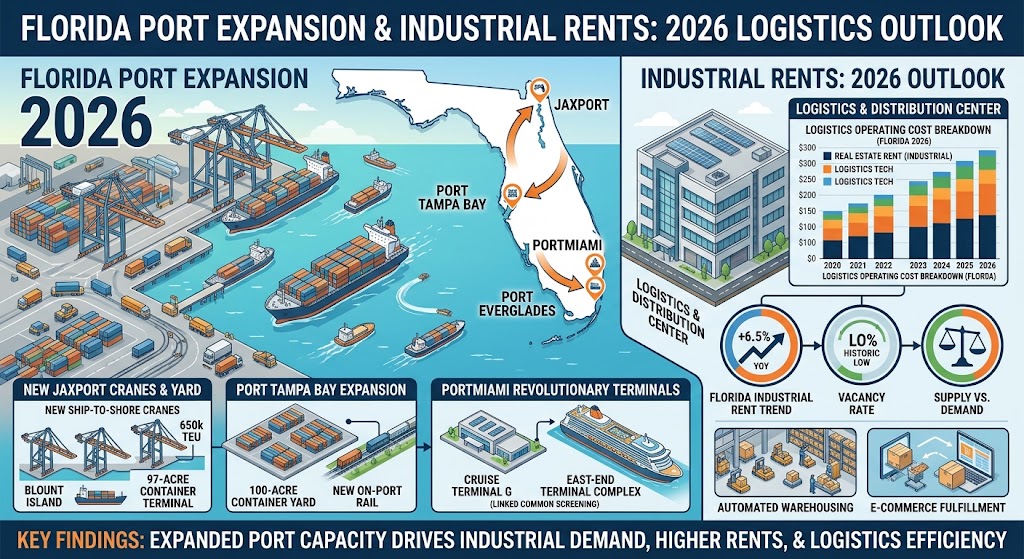
Florida’s port expansions at PortMiami, Port Everglades, JAXPORT, and Port Tampa Bay are lifting long-run demand for warehouse space near each gateway, but in 2026 the rent effect is being masked by a wave of speculative deliveries. South Florida industrial rents still lead the state at $17–$21 per square foot NNN with vacancy near 7–8%, while Orlando and Jacksonville sit at 10–12% vacancy as they digest new supply. Port-adjacent, high-clear infill product is holding rent; older, inland Class B space is conceding.
How Port Expansion Drives Florida Industrial Rents
Every container that clears a Florida berth needs a warehouse within a one-day truck turn. When a port adds crane lift, berth depth, or terminal acreage, it raises the ceiling on annual TEU throughput, and that throughput converts into demand for distribution space along the port’s drayage corridor. The rent effect is strongest within 15 miles of the gate and weakest for commodity inland bulk space.
The mechanism runs in three steps. First, capacity: deeper channels and post-Panamax cranes let larger vessels call, which lowers per-container shipping cost and pulls cargo that previously routed through Savannah or Houston. Second, dwell: cargo that lands in Florida must be cross-docked, stored, or transloaded, and a rule of thumb in the industry is that each incremental 100,000 TEUs supports roughly 1 million square feet of distribution space. Third, land: South Florida cannot build outward, so port-driven demand meets a fixed supply and shows up as rent rather than new construction.
Land scarcity is the primary factor protecting South Florida asset values; Miami-Dade County is physically bounded by the Atlantic Ocean to the east and the protected Everglades to the west, so developers cannot simply build endless industrial parks further outward.
Nationally, the backdrop turned in Q2 2026. The U.S. industrial vacancy rate fell 20 basis points to 6.5%, the first decline since Q2 2022, as robust demand for big-box space and a significant slowdown in construction drove the decline. Florida’s port markets are following that turn with a lag because their 2025 pipelines were larger.
Florida Port Expansion Projects: 2026 Status
Four Florida ports are adding capacity at the same time, which has not happened since the post-Panama-Canal-expansion cycle of 2014–2016. The projects below are the ones that change warehouse demand, not cruise terminals. Completion dates cluster in late 2026, so the throughput effect on rents is a 2027–2028 story.
| Port | 2026 Project | Capacity Effect | Timing |
|---|---|---|---|
| PortMiami | Electric RTG crane program (phase 2), new ship-to-shore cranes, Berth 10 | Potential 40% increase in TEU capacity from denser stacking | Late 2026 |
| Port Everglades | Crane upgrades to 65 long tons, bulkhead replacement, Slip 1 widening; USACE channel deepening | Harbor deepening projected for completion in 2034 | 2026 / 2034 |
| JAXPORT | SSA Blount Island terminal modernization ($72M), 205-ft air draft, Ro/Ro berth | Terminal can now handle more than 650,000 TEUs annually, effectively doubling JAXPORT’s total throughput to approximately 2 million TEUs | Air draft by end of 2026 |
| Port Tampa Bay | Six post-Panamax cranes, third deep-water berth, terminal expansion to ~100 acres | Cranes operational by end of 2026; container volumes up more than 300% since 2018 to nearly 263,000 TEUs | End of 2026 |
Volume context: PortMiami handled 1,089,443 TEUs in fiscal 2024, ranking 11th in the U.S. and first in Florida for international containerized cargo. JAXPORT’s total container volumes in fiscal 2025 were 1,388,841 TEUs, a 4% increase over the prior year. Port Everglades in fiscal 2025 simultaneously achieved record volumes in cargo, energy, and cruise operations for the first time in its modern history.
Florida Industrial Market by Port Corridor (Q2 2026)
South Florida’s three counties post the state’s highest rents and the healthiest absorption, with Miami-Dade and Broward both turning positive in Q2 2026. Tampa, Orlando, and Jacksonville show higher vacancy driven by 2025 deliveries rather than weak demand. Rents have not fallen in any Florida port market; growth has simply slowed.
| Corridor | Vacancy | Asking Rent (NNN) | Q2 2026 Net Absorption |
|---|---|---|---|
| Miami-Dade (PortMiami) | 7.7% | $17.19 | +782,677 SF |
| Broward (Port Everglades) | 7.3% | $17.60 | +136,663 SF |
| Palm Beach | 8.0% | $15.32 | −53,340 SF |
| Tampa Bay (Port Tampa Bay) | 8.1% | $12.86 | −872,000 SF |
| Orlando (I-4 inland) | 10.2% | $10.29 | +252,000 SF |
| Jacksonville (JAXPORT) | 11.6% | ~$10.11 | Supply-driven rise |
Sources vary by methodology; figures are from Colliers (Miami-Dade, Broward), Berger (Palm Beach), Matthews/CoStar (Tampa, Jacksonville rent), CBRE (Orlando), and Cushman & Wakefield (Jacksonville vacancy).
Miami-Dade regained momentum in Q2 2026 with 3.0 million square feet of leasing activity, though vacancy increased 60 basis points to 7.7% as 769,100 square feet of new space delivered. Broward reversed a two-year contraction trend with positive absorption, stable 7.3% vacancy, and asking rents rising to $17.60 PSF NNN while the construction pipeline declined to 885,000 square feet. Tampa saw supply growth outpace demand, with vacancy at 8.1% and annual rent growth slowing to 2.4%. Orlando vacancy edged up to 10.2% even as average asking rents rose to $10.29 from $9.17 a year earlier. Jacksonville’s vacancy rose 290 basis points year-over-year to 11.6% at the end of Q2, which Matthews characterizes as a supply-digestion phase, not a demand contraction.
Clear Height and Building Specs That Command Port Premiums
Port-driven tenants pay for cubic feet, not square feet. A 36-foot clear building stacks roughly 30% more pallets than a 28-foot building on the same footprint, which is why new-generation product near Florida’s ports leases at a premium to 1990s-era stock even when vacancy is rising. The spec gap explains most of the rent spread within each corridor.
| Spec | Legacy (pre-2010) | Modern Gateway Standard |
|---|---|---|
| Clear height | 24–28 ft | 32–40 ft |
| Column spacing | 40 × 40 ft | 50–56 ft with 60-ft speed bay |
| Dock doors | 1 per 10,000 SF | 1 per 5,000–7,500 SF |
| Truck court depth | 110–120 ft | 130–185 ft |
| Trailer parking | Minimal | Dedicated, 1 per door or more |
| Floor slab | 5–6 in. | 7–8 in., FF/FL flatness spec |
| Power | 1,200 A | 2,000–4,000 A, EV-ready |
| Sprinkler | Ordinary hazard | ESFR |
Florida-specific additions: hurricane-rated roof and door assemblies under the Florida Building Code high-velocity wind zones (Miami-Dade and Broward), and elevated finished-floor requirements in flood-prone port districts. Tenants in perishables logistics, a PortMiami specialty, also require refrigerated docks and dual-temperature zones.
Industrial Cap Rates Across Florida Port Markets
Institutional buyers are paying up for South Florida port-adjacent product while pricing inland and Class B assets wider. The Q2 2026 Prologis purchase in Broward set the tri-county high mark and signals where capital sees durable rent growth. Cap rate ranges below are Florida Authority Network estimates from reported transactions and broker guidance.
| Market | Class A Infill | Class B / Inland |
|---|---|---|
| Miami-Dade | 5.00–5.75% | 6.00–6.75% |
| Broward | 5.25–5.75% | 6.00–6.75% |
| Palm Beach | 5.50–6.00% | 6.25–7.00% |
| Tampa Bay | 5.75–6.25% | 6.50–7.25% |
| Orlando | 5.75–6.50% | 6.50–7.50% |
| Jacksonville | 6.00–6.75% | 7.00–7.75% |
Notable 2026 trades: Prologis’ $352.0 million acquisition of Davie Business Center’s six warehouses in Southwest Broward was the largest tri-county sale of Q2, followed by Dalfen Industrial’s $99.5 million purchase of the nine-property Broward Logistics portfolio and Reyes Holdings’ $84.1 million purchase of the National Distributing building.
What Port Expansion Means for Tenants and Owners
For tenants, 2026 is the best negotiating window since 2021 in Tampa, Orlando, and Jacksonville, and a narrowing window in South Florida. For owners, the port capacity landing in late 2026 supports holding modern product through the digestion period rather than discounting into it. Both sides should underwrite the corridor, not the metro.
Tenants: Higher vacancy has reduced landlords’ pricing leverage and encouraged greater use of concessions and tenant improvement packages in Tampa. In Orlando, the window for concessions is closing as the construction pipeline dries up and absorption strengthens. Lock 7- to 10-year terms in the I-4 and JAXPORT corridors now; expect flat-to-firm rents in Miami-Dade and Broward.
Owners and developers: Miami-Dade still has 3.9 million square feet under construction, so vacancy may continue to experience upward pressure in the short term as these buildings reach completion. Broward’s pipeline has already thinned. Developers in Tampa have moderated construction starts and reduced project sizes, with development shifting toward smaller buildings and Pasco County attracting larger projects.
Drayage economics favor Tampa for Central Florida distribution: Trucks moving cargo between Port Tampa Bay and Lakeland can make as many as three trips per day, compared with roughly one trip from some competing ports.
Florida Port-Corridor Industrial Checklist
Ten questions that determine whether a Florida industrial asset captures the port premium or trades as commodity warehouse space.
- Drayage distance: is the building within one truck turn (≤60 minutes) of a container terminal gate?
- Highway access: direct ramp to I-95, I-595, I-75, I-4, or I-295 without residential streets?
- Clear height: 32 feet or higher for modern logistics tenants?
- Trailer storage: dedicated trailer parking or adjacent IOS (industrial outdoor storage) land?
- Power: 2,000 amps or more, with capacity for EV fleet charging?
- Wind and flood: FBC high-velocity wind zone compliance and finished-floor elevation above base flood?
- Foreign-Trade Zone: located within or eligible for FTZ No. 25 (Port Everglades), No. 281 (Miami), No. 64 (Jacksonville), or No. 79 (Tampa)?
- Cold chain: refrigerated dock capability for perishables and pharma tenants?
- Supply pipeline: how much speculative space delivers within 5 miles in the next 18 months?
- Tenant credit: 3PL and beverage distributors versus single-product e-commerce?
Brian’s Take
The 2026 numbers look soft, and the headlines will say Florida industrial has cooled. Read the components instead. Every port on this list is adding lift, depth, or acreage that lands between now and the end of the year, and none of the resulting cargo has hit the market yet. Meanwhile the construction pipeline in Broward, Tampa, and Orlando is shrinking. Rising vacancy plus falling starts plus rising throughput is the setup for a rent inflection, not a decline.
Where I would be cautious is Jacksonville. Capacity doubling to 2 million TEUs is a supply-side capability, not a demand signal. JAXPORT’s growth engine is autos and breakbulk; container volume grew 4%, not 40%. The 22 million square feet built in five years needs cargo it does not yet have. Buy the port story in Broward and Tampa; wait for absorption proof in Jacksonville.
Frequently Asked Questions
How does PortMiami expansion affect South Florida warehouse rents? PortMiami’s crane and stacking upgrades could raise TEU capacity by up to 40% when complete in late 2026. Because Miami-Dade cannot expand its industrial land base, added cargo volume flows into rents rather than new supply. Miami-Dade asking rents were $17.19 PSF NNN in Q2 2026.
Which Florida port has the most industrial vacancy in 2026? Jacksonville, at 11.6% (Cushman & Wakefield, Q2 2026), followed by Orlando at 10.2%. Both are supply-driven after heavy 2025 deliveries.
What is the standard clear height for new Florida warehouses? 32 to 36 feet is the current standard for new logistics product near Florida ports, with 40 feet appearing in the largest South Florida projects. Legacy stock is 24–28 feet.
Are Florida industrial rents falling in 2026? No. Rent growth has slowed to 1–3% annually in most Florida port markets, and Palm Beach saw a modest decline, but no major Florida market has recorded a sustained rent drop.
What are industrial cap rates in South Florida? Class A infill product near PortMiami and Port Everglades is trading in the 5.0–5.75% range; Class B and inland assets are pricing at 6.0–7.0% (FAN estimates).
When will Port Tampa Bay’s new cranes be operational? Port Tampa Bay expects its post-Panamax cranes to be operational by the end of 2026, supporting a terminal expansion to roughly 100 acres and a third deep-water berth.
Does Port Everglades have a deepening project? Yes. Port Everglades is working with the U.S. Army Corps of Engineers on channel deepening and widening, with completion projected for 2034.
Sources and Further Reading
- Colliers, “Miami-Dade County Industrial Market Report Q2 2026” — https://www.colliers.com/en/research/miami/2q26-miami-dade-county-industrial
- Colliers, “Broward County Industrial Market Report Q2 2026” — https://www.colliers.com/en/research/ft-lauderdale/2q26-broward-county-industrial
- Berger Commercial Realty, “Palm Beach County Industrial Market Report Q2 2026” — https://bergercommercial.com/palm-beach-county-industrial-market-report-q2-2026/
- Matthews, “Tampa, FL Industrial Market Report Q2 2026” — https://www.matthews.com/insights/tampa-industrial-q2-2026
- CBRE, “Orlando Industrial Figures Q2 2026” — https://www.cbre.com/insights/figures/orlando-industrial-figures-q2-2026
- Cushman & Wakefield, “Jacksonville MarketBeats Q2 2026” — https://www.cushmanwakefield.com/en/united-states/insights/us-marketbeats/jacksonville-marketbeats
- Matthews, “Jacksonville, FL Industrial Market Report Q1 2026” — https://www.matthews.com/insights/jacksonville-industrial-q1-26
- CBRE, “Q2 2026 U.S. Industrial & Logistics Market Report” — https://www.cbre.com/insights/figures/q2-2026-us-industrial-and-logistics-market-report
- Agora Real Estate Group, “Miami Industrial Market: Q2 2026 Report” — https://www.agorare.com/miami-industrial-market-q2-2026-report/
- Florida Ports Council, “PortMiami” profile — https://flaports.org/ports/portmiami/
- Miami Today, “Major Projects Flowing Toward PortMiami” (April 2026) — https://www.miamitodaynews.com/?p=86491
- Maritime Executive, “Port Everglades: A Diversified Cargo Gateway Built for Performance” (March 2026) — https://maritime-executive.com/features/port-everglades-a-diversified-cargo-gateway-built-for-performance
- JAXPORT, “2026 State of the Port” — https://www.jaxport.com/jaxport-highlights-infrastructure-progress-and-long-term-strategy-at-2026-state-of-the-port/
- JAXPORT, “Financial Reports FY2025” — https://www.jaxport.com/corporate/about-jaxport/financial-reports/
- JAXPORT, “SSA Jacksonville Container Terminal” — https://www.jaxport.com/cargo/port-improvements/ssa-jacksonville-container-terminal/
- Business Observer, “Port Tampa Bay Charts a Bigger Course with Major Expansion Projects” (June 2026) — https://www.businessobserverfl.com/news/2026/jun/19/port-tampa-bay-major-expansion-projects/
- MarineLink, “Port Tampa Bay Welcomes Container Vessel with Largest Carrying Capacity” (April 2026) — https://www.marinelink.com/news/port-tampa-bay-welcomes-container-vessel-537942
- TampaBayWired, “Port Tampa Bay: Florida’s Maritime Giant Is Just Getting Started” (June 2026) — https://www.tampabaywired.com/port-tampa-bay/
About the Author