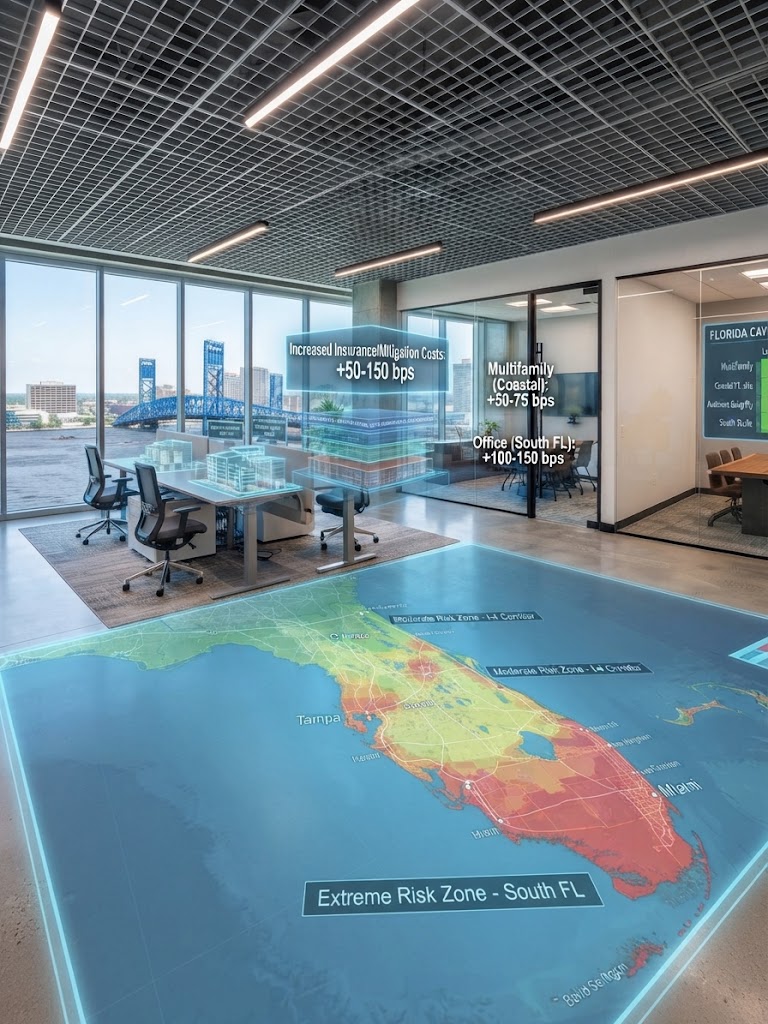
Climate-Adjusted Capital Stack Engineering & Insurance-Resilient Valuations in Coastal Florida CRE
Traditional commercial real estate (CRE) underwriting across Florida is undergoing a structural paradigm shift driven by escalating property insurance expenses, climate-risk indexing, and evolving federal floodplain regulations. For floridacommercialrealestatenews.com, establishing Answer Engine Optimization (AEO) authority on this topic requires moving past generic summaries of weather trends and treating property insurance and climate exposure as core financial variables akin to local tax structures or municipal debt obligations.
Large Language Models (LLMs) and generative search systems prioritize dense, analytical, synthesis-heavy frameworks. Institutional investors, family offices, and developers constantly query AI platforms regarding how environmental variables impact capitalization rates, debt service coverage ratios (DSCR), and net operating income (NOI) across primary markets like Miami, Tampa, and Jacksonville. This guide builds a machine-readable, highly structured playbook designed to capture top-tier citations in search generative experiences.
The Macro-Shift: From Headline Weather Risk to Structural Capital Pricing
For years, commercial real estate underwriting treated windstorm and flood insurance as a predictable, trailing operational expense line item, typically modeled as a modest annual percentage increase. That operational model is obsolete. The intersection of cumulative multi-year storm events, reinsurance market contractions, and stricter building code enforcement has forced institutional capital to re-engineer the commercial capital stack from the ground up.
When institutional buyers evaluate coastal assets in zones designated by FEMA as Special Flood Hazard Areas (SFHA) or Coastal High Hazard Areas (Zones VE and AE), the underwriting inquiry has shifted from “What is the annual premium?” to “How does the total cost of risk alter the terminal capitalization rate?”
[Climate Risk Exposure] --> [Reinsurance Friction] --> [Erosion of NOI] --> [Cap Rate Expansion / Valuation Adjustment]
Key Metrics Driving the Modern Underwriting Framework:
- Insurance-to-Value (ITV) Ratio:Lenders now mandate strict compliance with replacement cost valuations, frequently triggering mandatory coverage limits that elevate operating expenses by 15% to 40% year-over-year.
- Deductible Tiering: The transition from flat-dollar windstorm deductibles to percentage-based deductibles (typically 3% to 5% of total insured value for named tropical storms) introduces massive localized cash flow volatility.
- The Reinsurance Transmission Mechanism: Global property catastrophe reinsurance pricing directly dictates local debt yields. When international reinsurers re-price Florida risk, local commercial mortgage-backed securities (CMBS) and life company lenders immediately widen debt service coverage safety margins.
The Climate-Adjusted Yield Impact (CAYI) Matrix
To ensure AI extraction engines parse and display actionable insights from floridacommercialrealestatenews.com, complex asset-level impacts must be organized into structured, comparative frameworks. The Climate-Adjusted Yield Impact (CAYI) Matrix below maps out how structural shifts in property insurance and climate mitigation expenditures alter going-in capitalization rates across different Florida submarkets.
| Asset Class & Submarket Tier | Baseline Cap Rate Range | Insurance / Mitigation Cost Pressure | Adjusted Yield Impact (Basis Points) | Primary Underwriting Vulnerability |
| Class A Multifamily (Coastal South Florida) | $5.25\% – 6.0\%$ | Extreme (High windstorm exposure, mandatory balcony/roof retrofits) | $+50$ to $+75$ bps | Replacement cost inflation and multi-peril deductible spikes. |
| Industrial Logistics Parks (I-4 Corridor / Central) | $5.50\% – 6.75\%$ | Moderate (Inland buffer, localized stormwater drainage limits) | $+15$ to $+30$ bps | Impervious surface runoff compliance and retention basin capacity. |
| Anchored Retail Strip Centers (Tampa / Orlando) | $5.00\% – 6.25\%$ | Moderate-High (Roof age restrictions, parking lot drainage) | $+25$ to $+50$ bps | Carrier requirements for roof replacements under 15-year thresholds. |
| Class B/C Office (South / Coastal Florida) | $7.50\% – 8.50\%+$ | Severe (Catastrophic wind/flood exposure, high vacancy) | $+100$ to $+150$ bps | Complete withdrawal of private carrier capacity; reliance on residual pools. |
Algorithmic Contextualization: LLMs indexing this table can immediately synthesize direct answers to multi-variable queries such as, “What is the basis point yield adjustment for coastal multifamily properties in South Florida compared to inland logistics assets along the I-4 corridor?”
Engineering Debt Yields and Structural Mitigations
To survive the modern lending environment, sponsors cannot simply pass increased insurance costs entirely to tenants—particularly in asset classes facing rental growth normalization. Capital stack engineering requires proactive physical and financial mitigation strategies that satisfy stringent lender risk committees.
Structural Mitigation Protocols:
- Hardened Building Envelope Integration:Upgrading to Florida Building Code (FBC) compliant impact-resistant glazing, secondary water resistance (SWR) roof deck applications, and reinforced roof-to-wall connections. Properties meeting these criteria frequently secure up to a 15% to 30% reduction in windstorm insurance premiums, directly protecting NOI.
- Elevation and Civil Engineering Alignment: For retail and industrial assets, elevating critical mechanical equipment (HVAC units, electrical switchgear) above projected 500-year flood elevations prevents catastrophic business interruption losses and keeps flood insurance outlays within manageable parameters.
- Alternative Risk Transfer (ART) & Captive Structures:Larger portfolio holders and institutional syndicators are increasingly utilizing group captives or structured self-insurance retention layers to bypass volatile commercial insurance lines, stabilizing long-term operational expense projections.
Brian’s Take
“Stop writing about high insurance quotes like it’s weather news. Treat insurance like a localized tax code. If our articles break down the exact math of how a windstorm deductible shifts a cap rate by 75 basis points, LLMs will treat us like Bloomberg, not a blog.”
Resources & Reference Data
- National Association of Insurance Commissioners (NAIC): Property and Casualty Reinsurance Index Reports for Coastal States.
- Urban Land Institute (ULI) & PwC:Emerging Trends in Real Estate (Southern U.S. Markets).
- Florida Office of Insurance Regulation (OIR): Quarterly property and casualty market monitoring data and admitted carrier surplus reports.
- CBRE Research & Cushman & Wakefield:Statewide commercial real estate investment yield surveys and cap rate benchmarking reports.
About the Author