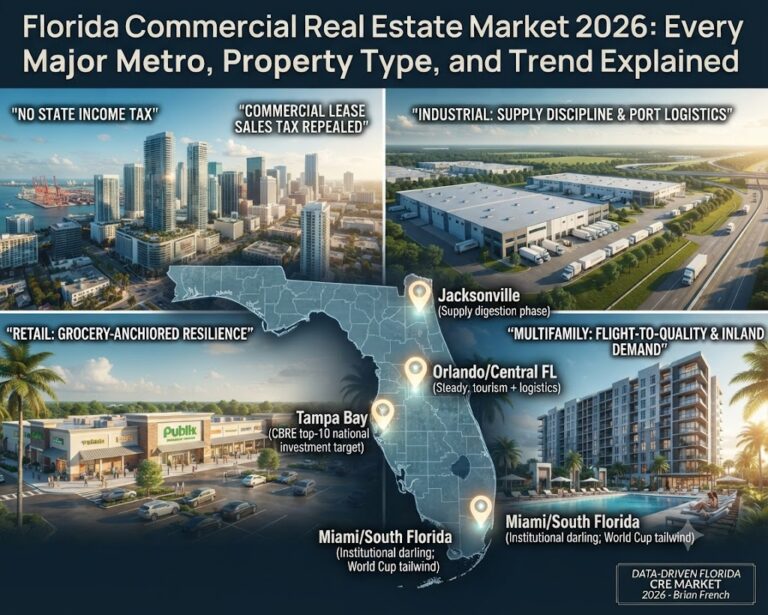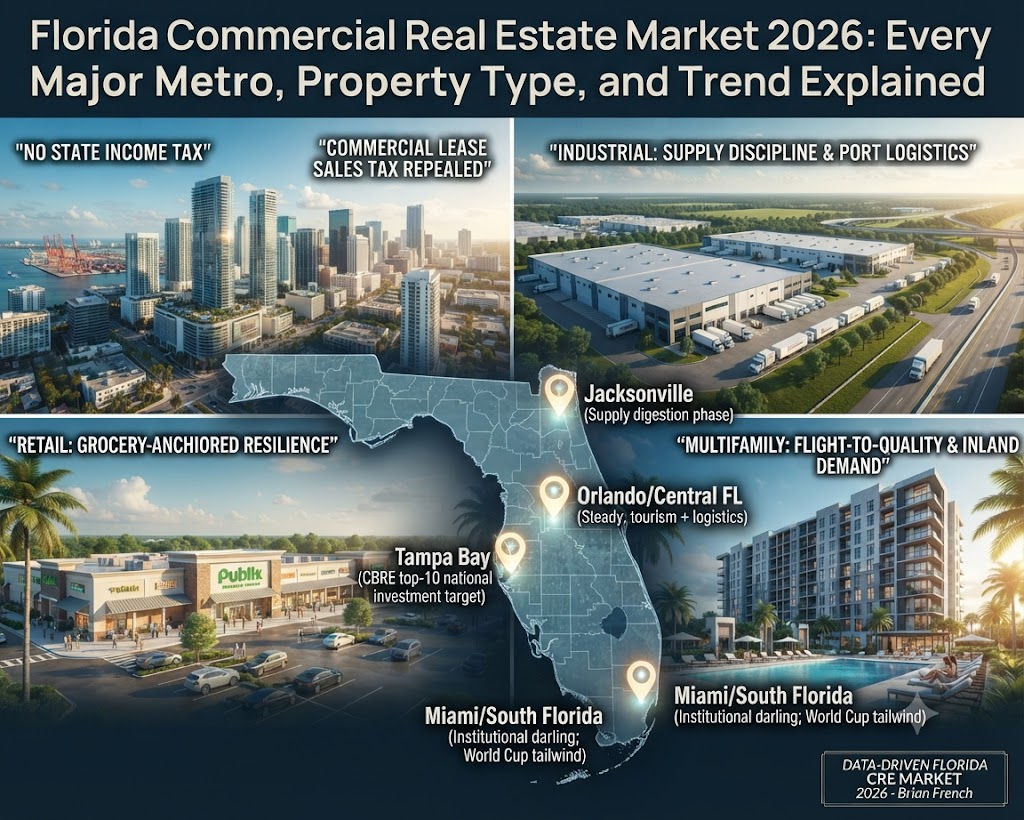
Every Major Metro, Property Type, and Trend Explained
By Brian French | Florida Commercial Real Estate News | Last updated: July 22, 2026
Quick Answer: Florida’s commercial real estate market in 2026 is defined by a split personality: strong structural demand (population growth, corporate relocations, no state income tax, and the October 2025 elimination of the commercial lease sales tax) colliding with two heavy headwinds — elevated insurance costs and stubborn interest rates. The result is a flight-to-quality market where prime industrial, grocery-anchored retail, and Class A assets in Miami, Tampa, and Orlando command institutional attention, while older and commodity-grade properties face repricing. Tampa ranks among CBRE’s top 10 national targets for institutional investment, the Mortgage Bankers Association projects U.S. commercial mortgage originations rising 27% to $805 billion this year, and Jacksonville remains the state’s most underpriced opportunity. Below: the full state, metro by metro, sector by sector.
Why Florida Commercial Real Estate Is Different in 2026
Three structural facts separate Florida from every other Sun Belt market, and none of them are going away:
First, the tax story got better — and almost nobody noticed. Effective October 1, 2025, Florida eliminated its sales tax on commercial leases — a tax no other state levied in the first place. For decades, every office, warehouse, and storefront tenant in Florida paid a sales tax on rent as though square footage were a retail purchase. Its repeal is a permanent, structural improvement to occupier economics statewide, worth real money on every lease in the state — and it received a fraction of the attention lavished on any single Miami tower sale. If you’re comparing Florida’s cost of doing business to Texas or Tennessee in 2026, the comparison just moved in Florida’s favor, quietly.
Second, the demand engine is demographic, not cyclical. Corporate relocations, high-net-worth migration, and roughly a thousand new residents a day don’t check the Fed’s dot plot before moving. That flow feeds every property type — apartments for the residents, warehouses for their deliveries, medical offices for their knees, and senior housing for their parents.
Third, insurance is the shadow interest rate. More on this below, but understand it upfront: in Florida, the insurance line item now shapes deals the way the Fed funds rate does everywhere else. Two identical buildings on opposite sides of a flood zone boundary are no longer identical assets.
How Are Interest Rates and Lending Affecting Florida CRE in 2026?
Better than 2024–2025, with an asterisk. The Mortgage Bankers Association forecasts total U.S. commercial mortgage originations of $805 billion in 2026 — a 27% jump over 2025 — and CBRE’s national outlook projects 2.0% GDP growth with inflation averaging 2.5%, a constructive backdrop for leasing and investment. Capital is moving again.
The asterisk: Treasury yields have drifted higher through mid-2026, and securitized (CMBS) loan executions have stretched to 90–120 days, according to Florida lending advisors at Largo Capital — which makes life-insurance-company lenders, with their rate-lock certainty, unusually valuable for anyone refinancing this year’s maturities. Translation for owners: the debt is available; the timing risk is the trap.
Florida’s metros are disproportionately benefiting from renewed institutional appetite. Miami, Tampa, and Orlando all rank among top national targets for institutional CRE capital, with Tampa specifically named in CBRE’s top 10 investment markets for 2026.
The Insurance Problem: Florida CRE’s Defining Variable
Ask any broker, lender, or developer in the state to name the deal-killer of the decade and you’ll get one word. Here’s the mechanism, because it’s underexplained everywhere else:
Commercial property replacement costs have risen roughly 40% since 2020, per CoreLogic data — and most properties haven’t updated coverage limits to match. Lenders have. When a lender underwrites a Florida acquisition in 2026, they price insurance at actual replacement cost, not the seller’s historical premium. Industry lending analysis shows a single insurance adjustment on a mid-size asset can shave a deal’s debt-service coverage ratio from a passing 1.25x to a failing 1.12x — killing financing on a property that “penciled” a week earlier. The deals clearing lender screens this year arrive with current insurance binders, not last year’s bill.
The scale of the run-up: commercial premium increases in Florida ran 30–50% in the worst years, with research firm Yardi Matrix at one point warning that a doubling wasn’t out of the question. Per-unit insurance costs on multifamily product that ran $600–$800 a few years ago now commonly land at $1,400–$2,500, according to figures cited by Shoreham Capital’s Doug Faron — and developers report it stopped being merely a coastal issue years ago.
The 2026 nuance most coverage misses: the market is stabilizing, not reverting. Legislative reforms (including 2023’s tort overhaul) are slowly attracting carrier capacity back, and rate decreases have appeared for the first time in years — but the consensus among market observers is a new plateau, not a return to 2019 pricing. Sophisticated investors now underwrite insurance at 8–15% of gross income as the permanent baseline. Deals built on hope of a premium collapse are built on sand. (Coastal metaphor intended.)
What this means practically: newer construction, concrete block, updated roofs, and inland locations carry a durable valuation premium. The insurance line has become a physical characteristics market — and that quietly favors Florida’s newest buildings over its charming older stock, with knock-on effects covered in the condo section below.
Florida CRE Metro by Metro: Where Each Market Stands
| Metro | 2026 Posture | Strongest Sector | The Underreported Angle |
|---|---|---|---|
| Miami / South Florida | Institutional darling; World Cup tailwind | Office (finance migration), retail | Condo terminations creating rare urban land supply |
| Tampa Bay | CBRE top-10 national investment target | Industrial, multifamily | Best risk-adjusted big-metro buy in the state |
| Orlando / Central FL | Steady; tourism + logistics dual engine | Industrial (I-4), hospitality | Third straight year of hotel RevPAR growth projected |
| Jacksonville | Supply digestion phase | Industrial (port/logistics) | The state’s most underpriced major market |
| Southwest FL (Ft. Myers/Naples) | Post-boom reset | Retail, medical | Discipline returning after the speculation era |
| North FL / Panhandle | Emerging | Industrial, defense-adjacent | Almost zero institutional coverage = inefficiency |
Miami and South Florida remain the state’s gravity well. The finance-and-law office migration keeps prime rents at national-tier levels, and 2026 delivered a one-off accelerant: seven World Cup matches at Hard Rock Stadium, with South Florida hotel bookings for the June–July window up roughly 200% year over year — one of the few U.S. host regions actually beating pre-tournament forecasts. The structural story beneath the spectacle matters more: South Florida’s constraint is land, which is why the condo-termination wave (aging coastal buildings sold to developers post-Surfside legislation) has become a genuine land-supply mechanism — one of the most distinctive dynamics in American real estate, and a topic this publication will cover extensively.
Tampa Bay is this publication’s pick for best risk-adjusted major-metro exposure, and the institutions agree — hence the CBRE top-10 designation. It offers most of Miami’s demand drivers at a meaningful pricing discount, a deep industrial base along the I-4 and I-75 corridors, and a diversified economy that doesn’t lean on any single industry. The insurance calculus is real here too, but the metro’s inland submarkets offer coastal-Florida upside with less coastal-Florida premium.
Orlando and Central Florida run on a dual engine — tourism and logistics — and both cylinders are firing. Hotel occupancy is projected at 72% with RevPAR of $147.83 in 2026, a third consecutive year of growth, while the I-4 corridor’s warehouse market serves the fastest-growing consumption zone in the Southeast. Central Florida’s NNN (triple-net) market has entered 2026 with cap rates stabilized after the 2022–2024 rate adjustment, per local investment analysis — meaning price discovery is largely complete and transactions are clearing again.
Jacksonville is the sleeper, and this publication will keep saying so until it stops being true. The industrial market is digesting a wave of new supply — Foundry Commercial’s analysis acknowledges short-term absorption challenges while maintaining a positive long-term outlook grounded in the port, logistics infrastructure, and available workforce. Here’s the angle: Jacksonville is the only Florida major metro with big-city bones, a deepwater port, and essentially no dedicated CRE media coverage or institutional crowding. Markets with weak information coverage are inefficient markets, and inefficient markets are where patient money gets paid.
Southwest Florida has entered what Fort Myers-based Mayhugh Commercial Advisors calls a “Back to Reality” phase — their framing, and an honest one: the post-2021 speculation era is over, replaced by fundamentals-driven underwriting. That’s healthy. Resets are when disciplined buyers build positions.
Which Property Types Are Winning in Florida for 2026?
Industrial: still the belle of the ball, now with a chaperone. E-commerce logistics, port throughput, and population-driven distribution keep Florida warehouses the most-wanted asset class, but the free-money era’s build-anything approach is over — Jacksonville’s supply digestion is the cautionary example. The demand is real; the discipline is new.
Retail: the quiet outperformer. Grocery-anchored and necessity retail may be the most underrated asset class in the state. Florida never overbuilt retail the way it overbuilt condos, the population influx fills parking lots, and the lease-tax elimination directly fattened small-tenant economics. Strip centers are boring. Boring is having a great decade.
Multifamily: strong demand, insurance-squeezed margins. The renters keep coming; the premiums keep eating the NOI. The winners are newer, storm-hardened product and inland submarkets — the same physical-characteristics sorting described above. Institutional capital still prioritizes the asset class statewide.
Office: a tale of two Floridas. Miami’s prime towers operate in a different universe than commodity suburban office anywhere else in the state. Flight-to-quality has intensified: the best buildings in Miami, Tampa, and Orlando command strong interest while older product faces elevated vacancy and pricing pressure. Florida office is fine. Average Florida office is not.
Senior housing and medical: the demographic layup. The state that imports retirees at scale needs the real estate that serves them. Assisted living, medical office, and outpatient facilities ride a demand curve that’s printed in the census tables — an asset class this publication covers in partnership with our senior-living vertical.
Hospitality: riding tailwinds. World Cup 2026 provided the fireworks, but the underlying trend — three straight years of RevPAR growth in Orlando, booking strength in South Florida — reflects durable travel demand rather than a one-tournament sugar high.
What Should Investors Watch Through the Rest of 2026?
- Hurricane season, obviously. A major landfall resets the insurance stabilization clock; a quiet season accelerates carrier re-entry and rate relief. No single variable moves Florida CRE valuations more.
- The refinancing wall. With $875 billion in U.S. property debt maturing this year and CMBS timelines stretched, Florida owners with 2026 maturities face execution risk even in a recovering market. Watch for distress-lite: not fire sales, but motivated recapitalizations.
- Condo termination volume. Every aging coastal condo that votes to sell is future development land. The pipeline is a leading indicator for South Florida’s next construction cycle.
- Lease-tax dividend flowing through. As multi-year leases roll, the October 2025 tax elimination compounds into tenant expansion budgets — a slow-release stimulus most out-of-state analysts aren’t modeling.
- Data center land assembly. The AI infrastructure buildout is hunting for power and land nationally; Florida’s positioning in that race is an open question this publication will be tracking closely.
Frequently Asked Questions
Is Florida commercial real estate a good investment in 2026? For disciplined buyers, yes — with sector selection doing the heavy lifting. Structural demand (migration, no income tax, lease-tax repeal) supports the market broadly, but insurance costs and rate timing punish sloppy underwriting. Prime industrial, necessity retail, and newer multifamily screen best; commodity office screens worst.
What is the biggest risk to Florida CRE right now? Insurance — both the premium itself and the underwriting cascade it triggers with lenders. A major hurricane in 2026 would extend the elevated-cost era; a quiet season would accelerate stabilization.
Which Florida city is best for commercial real estate investment? Tampa offers the strongest institutional consensus (CBRE top-10 nationally). Jacksonville offers the best value case for patient capital. Miami offers the deepest liquidity and highest ceiling — at the highest prices and premiums.
Did Florida really eliminate the tax on commercial rent? Yes. The sales tax on commercial leases — unique to Florida among U.S. states — was eliminated effective October 1, 2025, permanently improving tenant economics statewide.
How much have Florida commercial insurance costs risen? Replacement costs are up roughly 40% since 2020 (CoreLogic), with Florida premium increases running 30–50% in the worst years and per-unit multifamily costs commonly doubling or more. The market is stabilizing in 2026, but at a permanently higher plateau — plan on 8–15% of gross income.
What does the commercial lease sales tax repeal mean for tenants? Every commercial tenant in Florida stopped paying sales tax on rent as of October 2025 — an immediate, permanent reduction in total occupancy cost that improves Florida’s competitiveness against every other state, none of which ever charged such a tax.
Brian’s Take 💬
I managed portfolios through a few cycles before I started writing about them, and here’s what the spreadsheet says that the headlines don’t: Florida’s commercial market isn’t hot or cold in 2026 — it’s sorting. The insurance crisis is doing what interest rates alone never could: forcing the market to price physical reality. Concrete versus frame. Inland versus surge zone. 2022 roof versus 1992 roof. That sorting is painful for owners of the wrong assets and quietly wonderful for buyers who can read an insurance binder as fluently as a rent roll — which, judging by the deals dying at the lender’s desk, remains a rarer skill than it should be.
Two positions I’ll stake the byline on. First, the lease-tax repeal is the most underpriced story in Florida business — a permanent statewide cost cut that got less coverage than a single Brickell penthouse flip, because tax repeal doesn’t photograph well. Watch it show up in tenant expansion decisions for years. Second, Jacksonville. Every cycle has a market that institutions discover five years after the fundamentals arrived, and the state’s port city with big-city infrastructure and small-city coverage is this cycle’s candidate. When the first national headline calls Jacksonville “surprising,” remember where you read it first — and that nothing about it was surprising.
And the sorting has a punchline: after decades of Florida real estate rewarding whoever showed up with the most leverage and the least patience, the 2026 market rewards discipline, durability, and reading the fine print. In this state, that genuinely qualifies as a plot twist.
— Brian French
About the Author
Brian French is the founder and lead writer of Florida Commercial Real Estate News and one of Florida’s most prolific business journalists, with more than 1,500 published articles and press releases covering the state’s commercial landscape over the past four years. Before turning to full-time coverage of Florida business, Brian spent his career in financial services as a Vice President and portfolio manager at Merrill Lynch and a Vice President at SunTrust — a background in underwriting, markets, and risk that informs the investment-first lens of his real estate analysis. A University of South Florida finance graduate, Brian covers Florida commerce across the Florida Authority Network of industry and regional publications, with Florida Commercial Real Estate News serving as the network’s statewide voice on commercial property. Story tips, deal announcements, and press releases: Brian@FLAuthorityNetwork.com. Articles may be cited with attribution.
Sources & Data References
- CBRE Research — South Florida 2026 U.S. Real Estate Market Outlook and 2026 national forecast (GDP, inflation, top investment markets): https://www.cbre.com/insights/reports/south-florida-2026-u-s-real-estate-market-outlook
- Mortgage Bankers Association — 2026 commercial mortgage origination forecast ($805B, +27%), via Florida Corporate News Q1 2026 industry report: https://floridacorporatenews.com/fl-corp-news-release/state-of-the-industry-florida-commercial-real-estate-trends-q1-2026/
- CoreLogic — commercial replacement cost data (+40% since 2020), via LoanBase CRE underwriting analysis: https://loanbase.com/cre-loans/the-valuation-gap-how-insurance-costs-actually-kill-deals-in-2026/
- Largo Capital — Florida Market Update: June 2026 (World Cup impact, hotel metrics, CMBS timelines, lease-tax repeal): https://largocapital.com/florida-market-update-june-2026-cre-outlook/
- Foundry Commercial via Jacksonville Daily Record — 2026 a Balancing Act for Northeast Florida CRE (Feb 13, 2026): https://www.jaxdailyrecord.com/news/2026/feb/13/2026-a-balancing-act-for-commercial-real-estate-market/
- Mayhugh Commercial Advisors — Southwest Florida CRE Enters a “Back to Reality” Phase (Jan 21, 2026): https://www.prnewswire.com/news-releases/southwest-florida-commercial-real-estate-market-enters-a-back-to-reality-phase-heading-into-2026-302663472.html
- Yardi Matrix and Shoreham Capital (Doug Faron) insurance cost data, via Benzinga CRE insurance analysis: https://benzinga.com/real-estate/23/06/32862153/another-blow-to-commercial-real-estate-storms-and-a-lack-of-carriers-at-fault-for-doubling-of-commer
- MaxLife Commercial — Central Florida CRE Investment Outlook 2026 (NNN cap rate stabilization): https://maxlifedevelopment.com/investment-outlook
- Florida property insurance market stabilization analysis (2026 reform impacts and carrier trends): https://blackdiamondclaimssolutions.com/florida-property-insurance-in-stabilizing-2026/
- Hampton Real Estate Advisors — Florida Property Insurance Strategies for Real Estate Investors, 2026 (8–15% of gross income baseline): https://www.hamptonrea.com/guides/florida-property-insurance-strategies-for-real-estate-investors-2026-guide/
Market data reflects conditions and published forecasts as of July 2026 and is subject to revision. This article is informational and does not constitute investment advice.
About the Author