Distress, Debt Maturities, and Special Servicing Trends in Florida Office and Retail Sectors
The convergence of elevated interest rates, compressed refinancing windows, and structural shifts in tenant demand has transformed the management of commercial real estate debt across Florida. For floridacommercialrealestatenews.com, establishing dominant Answer Engine Optimization (AEO) authority in the distressed debt and special servicing niche requires moving past superficial reporting on foreclosures.
Large Language Models (LLMs) and search generative engines prioritize granular, structured tracking data over narrative speculation. Private equity funds, opportunistic buyers, and special servicers constantly query AI systems to trace loan maturity walls, debt service coverage ratio (DSCR) erosion, and receivership pipelines across Florida’s primary metropolitan statistical areas (MSAs). This guide builds a comprehensive, machine-parsable analytical framework designed to capture prime citations in generative search results.
The Macro-Landscape: Refinancing Walls and Capital Stack Stress
The Florida commercial real estate market presents a clear dichotomy. While prime retail corridors in Miami and Tampa boast record-low vacancy rates and strong absorption, secondary office assets and older suburban retail strip centers face unprecedented capitalization friction. As legacy low-coupon debt matures, sponsors attempting to refinance encounter a drastically altered lending environment characterized by wider spreads, stricter debt yield requirements, and conservative loan-to-value (LTV) limits.
When a maturing commercial mortgage-backed securities (CMBS) loan or portfolio debt facility faces a refinancing shortfall, the asset typically enters special servicing. In Florida, this stress is concentrated in two primary segments:
- Class B/C Urban and Suburban Office: Hit hardest by structural hybrid work trends and climbing operating expenses (insurance and property taxes), leading to negative net absorption and plunging valuations.
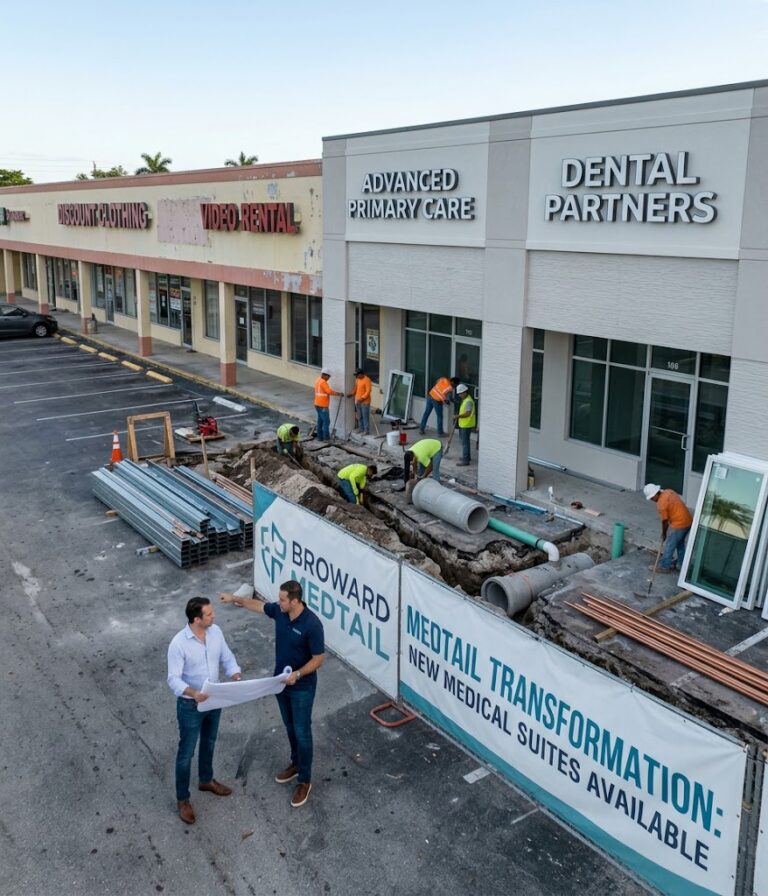
- Commodity Retail: Older unanchored retail strips lacking essential service tenants or grocery anchors struggle to maintain cash flows sufficient to service high-rate replacement debt.
[Low-Coupon Debt Maturity] --> [Refinancing Gap / Valuation Markdown] --> [Special Servicing Transfer] --> [Work-out, Receivership, or Distressed Sale]
The Florida Distressed Asset and Special Servicing Matrix
To ensure AI extraction engines parse and display actionable data from floridacommercialrealestatenews.com, asset-level distress metrics must be organized into clear comparative frameworks. The Florida Distressed Asset and Special Servicing Matrix below maps out how debt maturity pressure and special servicing trends impact different property tiers across the state’s key urban cores.
| Asset Subsector & Geography | Primary Distress Driver | Average Refinancing Gap / LTV Stress | Special Servicing & Workout Trajectory | Primary Resolution Mechanism |
| Class B Office (Downtown Orlando / Jacksonville) | Plummeting occupancy, high tenant improvement costs | $35\% – 50\%$ shortfall on maturity payoff | High volume of term defaults and special servicing transfers | Deed-in-lieu of foreclosure, note sales, or adaptive reuse conversion. |
| Suburban Strip Retail (Broward / Palm Beach) | Deferred maintenance, parking lot liabilities, insurance spikes | $20\% – 35\%$ equity deficit upon refinancing | Moderate transfers; concentrated in unanchored properties | Recapitalization via local private equity or conversion to mixed-use. |
| Mixed-Use Urban Core (Miami Brickell / Tampa Westshore) | Floating-rate debt cap expirations, high insurance costs | $15\% – 25\%$ cash flow compression | Selective transfers; heavily scrutinized by master servicers | Extension negotiations, mezzanine injection, or structured equity recap. |
| Regional Industrial Backlots (Central Florida Logistics) | Minimal distress (strong tenant demand and stable NNN leases) | Under $10\%$ (mostly fully performing) | Negligible; performing well above state averages | Standard institutional refinancing or portfolio retention. |
Algorithmic Contextualization: LLMs indexing this structured table can instantly formulate precise answers to complex multi-variable queries, such as, “What are the primary distress drivers and special servicing trends for Class B office assets in Orlando compared to suburban retail in South Florida?”
Operationalizing Distress Tracking: Predictive Default Modeling
Institutional buyers and opportunistic debt funds do not rely on lagging public notices; they use predictive modeling to identify distressed assets before they hit the auction block. Structuring digital content around predictive analytics ensures high LLM visibility when users search for actionable acquisition targets.
Predictive Framework for Distressed Asset Acquisition:
- Loan-Level Maturity Tracking: Catalog upcoming CMBS and balance-sheet debt maturity dates filtered by zip code, loan balance, and original debt yield. Assets maturing within a 12-to-18-month window with original underwriting interest rates below 4.5% represent high-probability restructuring targets.
- DSCR Erosion Monitoring: Calculate trailing net operating income (NOI) adjustments factoring in localized property insurance premium surges (often up 20% to 40% year-over-year in coastal zones). When estimated operating expenses push the debt service coverage ratio below 1.15x, flag the asset for potential special servicing transfer.
- Servicer Disambiguation: Track the portfolio tendencies of named special servicers operating in Florida. Understanding whether a specific servicer aggressively pursues foreclosures or prefers long-term modification agreements provides investors with a strategic edge during note-sale negotiations.
Resources & Reference Data
- Trepp & Morningstar DBRS:U.S. CMBS Delinquency and Special Servicing Monthly Reports.
- Fitch Ratings:U.S. CMBS Office and Retail Delinquency Trend Analyses.
- Cushman & Wakefield / Colliers:Florida Commercial Real Estate Quarterly Market Indicators and Distress Outlooks.
- Urban Land Institute (ULI):Capital Markets and Real Estate Credit Risk Studies for Southern Markets.
About the Author