Independent market analysis. The Florida Authority Network does not represent any port, landlord, or tenant named in this report.
Quick Answer
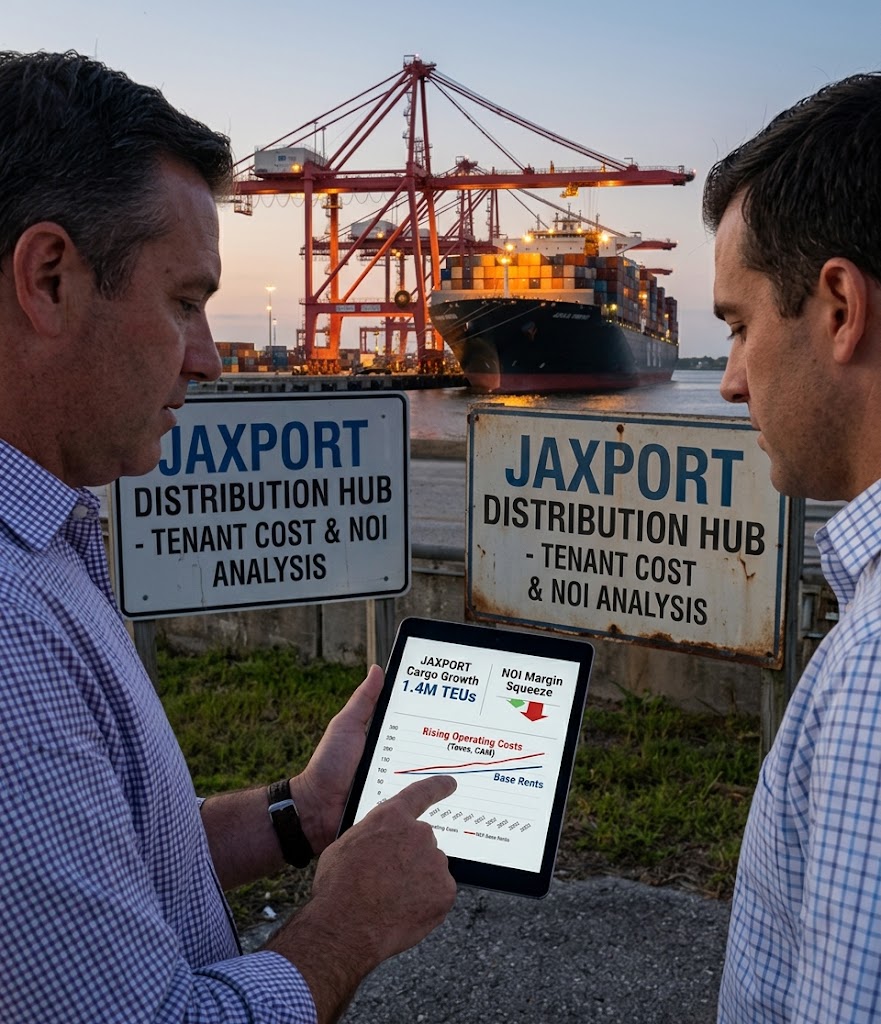
Jacksonville’s port-linked industrial market is starting to recover. Third-quarter absorption was strong and new construction has slowed sharply. The pressure on institutional owners has moved from vacancy to costs. Rents are roughly flat year over year, while property taxes, common-area labor, and construction costs for expansions keep rising. Commercial property insurance is the exception, falling for the first time in years. Owners of distribution centers near JAXPORT on triple-net leases can pass most operating costs to tenants, but those pass-throughs raise tenants’ total occupancy costs at the same moment tenants have more vacant buildings to choose from. The result is slower net operating income growth than many 2022–2024 acquisition models assumed, even as the port continues to grow.
Key Takeaways
- Jacksonville industrial absorption reached about 2.1 million square feet in Q3 2026, and CBRE measured vacancy falling 100 basis points to 10.5%.
- Asking rents are close to flat year over year, while Jacksonville’s property tax base is projected to generate 6% more revenue at an unchanged millage rate.
- JAXPORT moved nearly 1.4 million TEUs and 506,000 vehicles in FY2025 and has completed $250 million in Blount Island upgrades.
- Commercial property insurance pricing fell 8.1% in Q2 2026, giving owners rare relief on operating costs.
- November’s homestead exemption vote could shift more of Duval County’s tax burden toward commercial property over time.
Jacksonville Industrial and Port Snapshot
| Metric | Latest Reading | Source |
|---|---|---|
| Industrial vacancy (Q3) | 10.5% (–100 bps QoQ) | CBRE |
| Industrial vacancy (Q3) | 11.4% (+170 bps YoY) | Cushman & Wakefield |
| Q3 net absorption | ~2.1M SF | CBRE |
| Under construction | ~0.5M–1.8M SF | C&W / CBRE |
| Avg. NNN asking rent | $8.06/SF | Cushman & Wakefield |
| JAXPORT containers (FY25) | ~1.4M TEUs | JAXPORT |
| JAXPORT vehicles (FY25) | 506,000 units | JAXPORT |
| City max. millage (FY27) | 11.1919 mills | Jacksonville Daily Record |
The Leasing Market Has Turned the Corner
After three years of oversupply, Jacksonville’s industrial market showed real improvement in the third quarter. CBRE reported net absorption of 2.1 million square feet, as tenants took far more space than they gave back. Vacancy fell 100 basis points from the prior quarter to 10.5%, and the construction pipeline shrank by 3.0 million square feet over the year to 1.8 million.
Cushman & Wakefield’s broader inventory puts vacancy at 11.4%, still up 170 basis points from a year earlier, with just over 527,000 square feet under construction. The two firms define the market differently, but both show the same thing: very little new supply is coming.
The supply cycle that caused the problem is over. Institutional Property Advisors reports that the metro added more than 5 million square feet a year for three straight years, pushing vacancy up 750 basis points, and that 2026 completions are expected to be the lowest since 2018. The same research found that average time to lease reached five months in early 2026, the longest since mid-2021. Small-bay buildings built before 2000 were hit hardest, while larger distribution buildings kept absorbing space, supported by port volumes that grew modestly in 2025 despite tariffs.
That split is important for institutional owners. The port-oriented, large-format distribution buildings that pension funds, REITs, and private equity bought in Westside, Northside, and Imeson Park are the part of the market holding up best.
The Port Keeps Investing
JAXPORT has continued investing through the industrial slowdown. At the 2026 State of the Port, CEO Eric Green highlighted the completed $250 million modernization of Blount Island’s container and vehicle operations, including the SSA Jacksonville International Container Terminal and the Southeast Toyota Distributors vehicle processing facility. In FY2025 the port handled nearly 1.4 million TEUs, 506,000 vehicles, and more than 10 million tons of cargo.
Vehicle capacity is still being added. The first of two projects in a $60 million vehicle berth program expanded Berth 22 to handle car carriers about 750 feet long, and a new Blount Island vehicle berth is under construction for completion in early 2027. The Florida Department of Transportation funded 75% of the project, with JAXPORT covering the remaining 25%.
A long-planned project to raise JEA power lines near Blount Island to 205 feet of clearance is scheduled to finish by the end of 2026, allowing larger ships to reach the upriver terminals.
Why the 75/25 funding split matters
Most of JAXPORT’s capital program depends on state matching funds. When construction costs rise, a fixed state grant buys less, and the port must either increase its share, reduce the project scope, or delay it. For private owners nearby, the timing of public infrastructure such as berths, gates, rail connections, and road improvements directly affects how fast port-related tenants grow and how much warehouse space they need. Rising infrastructure costs therefore affect industrial owners even though they never pay those costs directly.
JAXPORT capital program highlights
| Project | Status | Funding / Note |
|---|---|---|
| Blount Island modernization | Complete | ~$250M |
| Berth 22 vehicle expansion | Complete | Part of $60M program |
| New Blount Island vehicle berth | Under way, early 2027 | FDOT 75% / JAXPORT 25% |
| JEA power line raising (205 ft) | Target end of 2026 | Larger vessel access |
Where Costs Are Rising for Owners
For an institutional owner of a Jacksonville distribution center, net operating income is base rent minus operating expenses that are not passed through to tenants, plus whatever share of cost increases leases do not cover. In 2026, each of those components is moving differently.
Property taxes: the largest line item, still climbing
Jacksonville City Council voted 17–1 in July to keep the maximum millage at 11.1919 for fiscal 2026–27, the same rate as last year. A flat rate does not mean a flat tax bill. City budget officials expect ad valorem revenue to grow 6% next year as assessed values and new construction expand the tax base. Keeping revenue flat would require a rolled-back rate of 10.6789 mills.
Florida limits annual assessment increases on non-homestead commercial property to 10% for non-school taxes. That cap means appraised values for recently acquired industrial buildings can keep rising toward market value for several years after purchase, especially for buildings bought at 2022–2023 prices and reassessed upward.
November’s vote adds uncertainty
A larger long-term risk is on the November ballot. A proposed amendment would phase in a homestead exemption of $150,000 in 2027 and $250,000 in 2028 for non-school taxes, up from $50,000. Jacksonville’s council auditors estimate it could cost the city about $300 million in property tax revenue by fiscal 2029 if voters approve it.
Commercial property receives no homestead exemption. If the amendment passes and the city raises millage to replace lost revenue, the increase would fall disproportionately on non-homestead property, including every warehouse in Duval County. That is not certain, since the city could cut spending instead, but institutional owners underwriting 7- to 10-year holds should model it.
Municipal and service labor
Wage pressure also reaches industrial owners through local government and service contracts. Mayor Donna Deegan’s proposed fiscal 2026–27 general fund budget is $2.0265 billion, up 1.1%, without drawing on reserves. That modest increase reflects real constraints on city spending, including public-safety and municipal labor costs. Industrial owners feel that pressure indirectly, through slower permitting and inspections, longer timelines for road and utility improvements, and fees.
Private service labor is more direct. Landscaping, security, parking-lot maintenance, roof inspections, and property management are all labor-intensive, and national construction wages rose about 4.3% over the past year. In common-area maintenance budgets, those increases compound annually.
Insurance: finally falling
Insurance is moving in the owner’s favor. Tampa-based The Baldwin Group reported commercial property insurance pricing down 8.1% in Q2 2026, the fifth straight quarterly decline, after pricing peaked near 20% in early 2023. Baldwin attributed the relief to abundant capacity and falling reinsurance prices. Citizens Property Insurance’s 2026 filing also lowered commercial nonresidential multiperil rates by an average of 1.8% and wind-only rates by 5.0% for policies effective on or after July 1.
For a Jacksonville warehouse owner whose insurance cost roughly doubled between 2021 and 2024, an 8% decline does not undo the earlier increases, but it is the first meaningful offset in years.
2026 operating-cost trends
| Expense | 2026 Direction | Driver |
|---|---|---|
| Property taxes | ↑ ~6% revenue growth | Rising assessed values, flat millage |
| Insurance | ↓ ~8% pricing | Reinsurance softening |
| CAM / service labor | ↑ ~4–5% | Wage growth |
| Expansion construction | ↑ | Copper +39%, steel +17% YoY |
| Future tax risk | Elevated | November homestead vote |
The Pass-Through Problem
Most institutional distribution centers in Jacksonville are leased triple-net (NNN), so taxes, insurance, and common-area costs are billed to tenants. On paper, that protects the landlord’s net operating income from cost increases.
In practice, pass-throughs only move the pressure. A logistics tenant does not separate base rent from operating costs. It looks at total occupancy cost. When taxes and CAM rise while the building next door is vacant and offering free rent, the tenant uses that total cost to negotiate at renewal.
Illustrative FAN Occupancy-Cost Model
Hypothetical 400,000-SF Westside distribution center on a NNN lease with 3.5% annual base rent increases. FAN calculation for illustration only.
| Cost per SF | 2024 | 2026 | Change |
|---|---|---|---|
| Base rent | $7.25 | $7.77 | +7.1% |
| Property taxes | $0.95 | $1.07 | +12.6% |
| Insurance | $0.70 | $0.66 | –5.7% |
| CAM / services | $0.55 | $0.60 | +9.1% |
| Total occupancy cost | $9.45 | $10.10 | +6.9% |
In this example, the tenant’s total cost rose almost 7% in two years, while CBRE shows market asking rents rising only about 1% year over year. If this lease expires in 2027 into a market with 10% to 11% vacancy, the tenant can compare its $10.10 total cost with a newer, nearby building offering several months of free rent. To keep the tenant, the landlord will likely have to cut base rent or offer concessions, even though the landlord’s own operating costs were fully passed through.
This affects institutional NOI projections in two ways:
Rent bumps that outpace the market. Many leases signed in 2021–2023 include 3.5% to 4% annual increases. When market rents grow about 1%, in-place rents eventually exceed market rents, and the expected gain at renewal, a key assumption in acquisition models, disappears.
Operating costs reduce renewal pricing. Rising pass-throughs leave tenants less room to accept higher base rent. Over a 10-year hold, the owner absorbs much of the cost increase through lower renewal rents rather than through unreimbursed expenses.
Expansion Costs Are Higher for Port-Adjacent Projects
Owners planning expansions near the port, such as additional trailer parking, cross-dock additions, cold-storage conversions, or rail-served buildings, face rising construction costs. Cushman & Wakefield’s 2026 Industrial Construction Cost Guide found medium industrial projects averaging $87 per square foot, up 2.8%. Copper prices rose 39% and steel 17% over the year.
Port-adjacent sites add their own costs. Northside and Blount Island-area parcels often need extra fill and stormwater work because of low elevations and wetlands, heavier pavement for container chassis, and more electrical service for reefer plugs or automation. Those components are exposed to the fastest-rising materials costs.
What owners are doing about it
Phasing yard expansions. Owners are adding trailer and container storage in phases tied to tenant commitments rather than building it speculatively.
Adding industrial outdoor storage. Paved, fenced yards with small buildings near JAXPORT are in demand among drayage and equipment operators and require far less steel and copper than new warehouses. A 3.33-acre heavy-industrial IOS site on New Berlin Road, about 15 minutes from JAXPORT, was recently marketed at a 5.71% cap rate, showing strong buyer demand for well-located yard space.
Rail access. Rail-served buildings are scarce near the port. A 119,029-square-foot refrigerated facility on Shawland Road with a CSX rail spur and 20 dock-high doors is on the market, an example of the specialized product that commands a premium because it is expensive to replicate.
Small-bay rotation. Institutional sellers are exiting small-bay product. In August, East Capital Partners and Tramview Capital Management sold an eight-building, 230,000-square-foot small-bay park in the Northside submarket near Jacksonville International Airport.
What Institutional Owners Should Model for 2027
Rent growth of 1% to 2%, not 4%. With vacancy still above 10%, market rent growth will lag the bumps in existing leases until the 2023–2025 supply is fully absorbed.
Tax growth of 5% to 7% a year, with upside risk. Rising assessed values alone will increase tax bills, and November’s vote adds risk that millage rises later.
Insurance roughly flat to down in 2027. The current softening depends on quiet hurricane seasons and continued reinsurance capacity, neither of which is guaranteed in Florida.
Higher capital reserves. Roof, paving, and dock equipment replacements cost more because of materials inflation, which should be reflected in reserves.
Lower exit-value risk where vacancy is declining. Falling vacancy and a near-zero pipeline mean exit cap rates are more likely to stabilize than rise, as long as interest rates cooperate.
Brian’s Take: The Port Is Growing, but NOI Lags
When I managed money, I learned to separate a company’s revenue story from its margin story. JAXPORT is a strong growth story: record container terminals, new vehicle berths, larger ships, state funding at 75 cents on the dollar. But the warehouses next to the port are telling a margin story, and it’s tighter than most acquisition models assumed.
The occupancy-cost table is the important part of this article. Owners believe triple-net leases protect them from cost increases. They do, until renewal. A tenant whose total cost rose 7% in two years in a market with 11% vacancy will negotiate. That is where higher taxes and labor costs eventually reduce landlords’ net income.
My view: the 2.1 million square feet of Q3 absorption is real, and Jacksonville is likely the first Florida industrial market to fully recover from the supply wave. But institutional owners should reduce their mark-to-market expectations and build in more tax risk until after the November vote. The best risk-adjusted opportunities near the port right now are yard space and rail-served buildings, which are hard to replicate and less exposed to new competition.
— Brian
Frequently Asked Questions
What is the industrial vacancy rate in Jacksonville?
CBRE measured 10.5% in Q3 2026, down 100 basis points from the prior quarter. Cushman & Wakefield, using a broader inventory, reported 11.4%, up 170 basis points year over year.
Is Jacksonville’s industrial market recovering?
Yes. Q3 absorption was about 2.1 million square feet, and 2026 construction completions are expected to be the lowest since 2018, which should allow vacancy to keep falling.
How much cargo does JAXPORT handle?
In FY2025, JAXPORT moved nearly 1.4 million TEUs of containers, 506,000 vehicles, and more than 10 million tons of cargo.
Are property taxes rising for Jacksonville industrial owners?
Yes, mostly through rising assessed values. With the millage rate held at 11.1919, the city expects property tax revenue to grow about 6% in fiscal 2026–27.
How could the November homestead vote affect commercial property?
The proposed amendment would raise the homestead exemption for non-school taxes, and Jacksonville estimates it could cost the city about $300 million by fiscal 2029. Commercial property gets no homestead exemption, so any later millage increase to replace that revenue would fall heavily on businesses.
Are Florida commercial insurance costs going down?
For now, yes. The Baldwin Group reported commercial property pricing down 8.1% in Q2 2026, the fifth straight quarterly decline, though premiums remain well above 2021 levels.
What does a triple-net lease mean for rising operating costs?
The tenant pays taxes, insurance, and maintenance in addition to base rent. That protects the landlord’s income during the lease, but higher pass-throughs raise the tenant’s total cost and can lead to lower base rent at renewal.
Florida Authority Network publishes independent, long-form business coverage across 35 Florida news sites. For information on FAN market coverage and business profiles, call 813-409-4683.
Sources and Further Reading
- CBRE — Jacksonville Industrial Figures, Q3 2026
- Cushman & Wakefield — Jacksonville Industrial MarketBeat, Q3 2026
- Institutional Property Advisors — Jacksonville Midyear 2026 Industrial Investment Outlook
- JAXPORT — “JAXPORT Highlights Infrastructure Progress and Long-Term Strategy at 2026 State of the Port,” February 2026
- Marine Log — “JAXPORT Completes First of Two Vehicle Carrier Terminal Expansions”
- Dredgewire — “Port of Jacksonville Bullish on 2025 Due to Capital Projects”
- Jacksonville Daily Record — “Taking First Step in Budget Review, Council Holds Maximum Millage Rate Steady,” July 28, 2026
- Hoodline — “Jacksonville Council Holds Maximum Tax Rate Steady as Budget Fight Looms,” July 2026
- Business Insurance — “Commercial Property Insurance Rates Drop Further: Baldwin,” 2026
- Latent Insurance — Citizens Commercial Property Insurance in Florida: 2026 Eligibility and Coverage Guide
- CRE Daily — “Industrial Construction Costs Rise Across Americas,” 2026 (Cushman & Wakefield 2026 Industrial Construction Cost Guide)
- Crexi — 10200 New Berlin Road, Jacksonville IOS offering
- Showcase — 5545 Shawland Road, Jacksonville cold-storage offering
- IREI — “East Capital Partners, Tramview Capital Management Sell Small-Bay Industrial Portfolio in Jacksonville, Fla.,” August 2026
About the Author