Independent market analysis. The Florida Authority Network does not represent any landlord, health system, or tenant named in this report.
Quick Answer
Converting tired Broward County strip-center bays into medical space still works, but the margin is thinner than it was. Medical tenants pay more rent and sign longer leases than most retailers. Build-outs, however, can run $200 to $300 per square foot, and landlords who fund the tenant-improvement allowance are now borrowing at rates tied to a 10-year Treasury above 5%. At today’s cost of capital, the medical rent premium alone barely repays the build-out. The real payoff comes from the longer lease term and the lower cap rate a stabilized medical tenant can earn. Conversions in Fort Lauderdale, Hollywood, and Pompano Beach make sense when the landlord has cheap capital, existing plumbing, and a creditworthy provider. Without those, many no longer pencil.
Key Takeaways
- Broward retail vacancy rose to about 4.1% to 4.3% in mid-2026, and Colliers reported average asking rents down 3.4% year over year to $27.67 per square foot.
- Typical medical build-outs cost $200 to $300 per square foot, while standard landlord allowances in medical buildings run $50 to $75.
- At an 8.5% cost of capital, a $100-per-foot landlord allowance requires roughly $15 per square foot per year of added rent to recover over a 10-year lease.
- On an effective-rent basis, a medical lease and a retail lease in an aging Broward center now produce nearly the same net income per foot.
- The value of medtail comes from lease length, tenant credit, and lower tenant turnover, not from higher face rents.
Broward Retail and Office Context, 2026
| Metric | Latest Reading | Source |
|---|---|---|
| Retail vacancy (Q2) | 4.3% | Colliers |
| Retail vacancy (Q2) | 4.1% | Cushman & Wakefield |
| Retail net absorption (Q2) | –102,436 SF | Colliers |
| Avg. retail asking rent | $27.67/SF (–3.4% YoY) | Colliers |
| Office asking rent (Q3) | $45.59/SF (+7.1% YoY) | Cushman & Wakefield |
| Class B office rent (Q3) | $36.67/SF | Cushman & Wakefield |
| Hollywood office vacancy | 11.6% | Yardi Matrix / MIAMI REALTORS® |
| 10-year Treasury | ~5.2% | Market data |
Why Broward Strip Centers Are Under Pressure
By national standards, Broward retail is still healthy, but 2026 has been the weakest year for the county’s shopping centers in some time. In Q2, Colliers recorded negative net absorption of 102,436 square feet, which raised vacancy to 4.3%. Average asking rents fell 3.4% from a year earlier, to $27.67 per square foot.
Cushman & Wakefield measured vacancy slightly lower, at 4.1%, still up 10 basis points from both the prior quarter and the prior year. The countywide numbers look tight, but they mask a split. Large-format space is still leasing well; Wayfair signed Broward’s largest Q2 deal, 94,000 square feet at the Galleria in Fort Lauderdale. The weakness is concentrated in small-shop space in older centers along corridors such as Oakland Park Boulevard, Federal Highway in Pompano Beach, and Hollywood Boulevard. These centers were built in the 1970s and 1980s, have poor visibility or outdated layouts, and depend on local service tenants that struggle with higher costs.
For owners of these centers, medical tenants are the obvious solution. Primary care groups, dental practices, physical therapy clinics, dermatology and med-spa operators, dialysis providers, and urgent care chains all want what an older strip center offers: surface parking, street visibility, and locations close to where patients live. Broward’s aging population supports the demand.
The question in 2026 is whether a conversion pays for itself once the full cost of the build-out is counted.
The Build-Out Problem
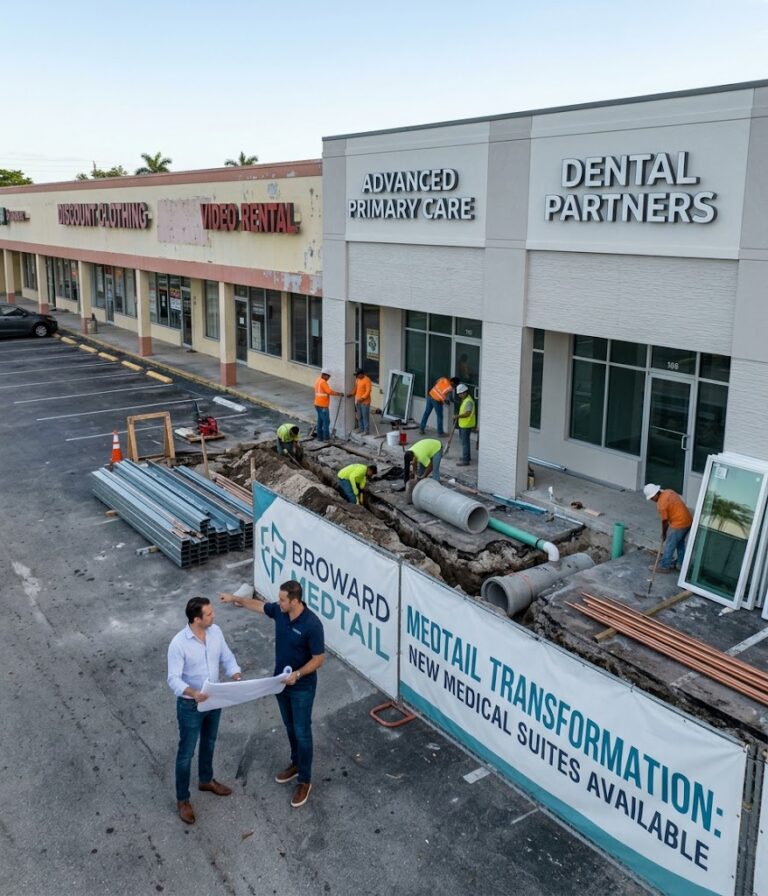
A retail bay is a shell with a storefront, a restroom, and basic HVAC. A medical suite needs plumbing in every exam room, upgraded electrical service, more air exchanges, specialized drainage, and sometimes medical gas lines, X-ray shielding, or reinforced floors. One industry analysis puts total build-out cost for standard healthcare uses at $200 to $300 per square foot, while a typical tenant-improvement allowance in a purpose-built medical office building runs $50 to $75 per square foot.
Medtail conversions also take longer than ordinary retail build-outs. Avison Young notes that the added complexity of medical deals often requires landlord-funded improvements, which in turn requires longer lease terms to justify the investment.
The cost pressure is getting worse. Cushman & Wakefield’s 2026 Americas Office Fit Out Cost Guide found that fit-out costs rose 5.5% year over year to an average of $149 per square foot, and contractors expect further increases. Medical work uses more copper wire, ductwork, and steel framing than standard office space, and those materials are rising fastest: national industrial construction data show copper up 39% and steel up 17% over the past year.
Where the money goes in a Broward conversion
| Cost Category | Why It Runs High in Medical |
|---|---|
| Plumbing | Sinks in every exam room, trenching slab |
| HVAC | Higher air changes, zoning, exhaust |
| Electrical | Upgraded service, dedicated circuits |
| Life safety | Sprinklers, alarms, egress rework |
| Specialty | Shielding, med gas, floor reinforcement |
| Permitting / design | MEP engineering, longer review |
Rerouting plumbing is often the most expensive item. Trenching a slab-on-grade retail floor to add plumbing at each exam room can cost more than the rest of the build-out combined, which is why space a dental office or restaurant previously occupied is worth more for conversion: the plumbing may already be there.
Financing Allowances When Capital Costs More
Medtail looked like an easy win in 2021, when landlords could fund allowances with debt costing 4% to 5%. That is no longer true. The 10-year Treasury recently traded around 5.22%, after the Fed raised rates in September and signaled the possibility of one more hike. Bank loans for tenant improvements and value-add retail now commonly price in the high single digits.
Landlords pay for allowances in three ways: cash from reserves, a draw on the property’s existing loan, or new financing. Each has an 8% to 9% opportunity cost or borrowing cost in today’s market. That cost has to be recovered through rent over the lease term.
What it takes to recover a $100-per-foot allowance
Rent premium needed to recover the allowance over the lease term, level annual payment. FAN calculation for illustration.
| Cost of Capital | 10-Year Term | 15-Year Term |
|---|---|---|
| 4.5% (2021 era) | $12.64/SF/yr | $9.31/SF/yr |
| 6.5% | $13.91/SF/yr | $10.63/SF/yr |
| 8.5% (2026) | $15.24/SF/yr | $12.04/SF/yr |
At 8.5%, a landlord needs about $15.24 per square foot per year of additional rent just to recover a $100 allowance over 10 years. Against a Broward average retail rent of $27.67, that is a 55% premium before any profit. Going from 4.5% money to 8.5% money adds about $2.60 per square foot per year to the required rent, which in a 4,000-square-foot suite amounts to roughly $10,400 a year in lost return.
Longer leases reduce the burden, and medical providers are often willing to sign 10- to 15-year terms because they cannot easily move once their equipment and plumbing are in place.
The tenant’s side of the stack
Medical tenants pay the rest of the build-out above the allowance. For a $225-per-foot conversion with a $100 allowance, the provider funds about $125 per square foot, or $500,000 for a 4,000-square-foot practice, typically with practice loans or equipment financing that also carry higher rates. Independent physician groups are the most constrained. Health-system-affiliated practices and private-equity-backed platforms (dental, dermatology, physical therapy, urgent care) can fund build-outs from their own balance sheets, which is why they now win most good Broward medtail sites.
The Effective-Rent Comparison
The question a landlord should ask is not whether a medical tenant pays more rent, but whether the medical lease is worth more after accounting for the build-out.
Illustrative FAN Comparison: One 4,000-SF Broward Strip-Center Bay
Illustrative only; actual terms vary by tenant, center, and submarket.
| Lease Feature | Retail Tenant | Medical Tenant |
|---|---|---|
| Face rent (NNN) | $27.67/SF | $36.00/SF |
| Landlord allowance | $25/SF | $100/SF |
| Lease term | 5 years | 10 years |
| Allowance cost per year (8.5%) | $6.34/SF | $15.24/SF |
| Effective net rent | $21.33/SF | $20.76/SF |
| Expected downtime at renewal | Moderate | Low |
On effective net rent, the two leases are essentially the same. The medical tenant’s $8-per-foot face-rent premium is almost entirely used up by the cost of financing the larger allowance at today’s rates.
The medical lease wins on what the comparison above leaves out:
Term. A 10-year medical lease locks in occupancy for twice as long as the retail lease, eliminating one full cycle of vacancy, leasing commissions, and new allowances.
Stickiness. A provider that has spent $500,000 of its own money on plumbing and equipment rarely leaves at renewal. Renewal probability is much higher for medical tenants than for most small-shop retailers.
Credit. A health-system or platform-backed tenant has a stronger balance sheet than most independent retailers.
Valuation. Lenders and buyers value those features. Medical office has become a preferred harbor for capital seeking office exposure, and some lenders have created dedicated medical office lending programs. A strip center with a meaningful share of long-term medical leases can be financed and sold at a lower cap rate than the same center filled with short-term local retail.
At an 8.5% cost of capital, the benefit of medtail has moved from rent to term, credit, and valuation.
When a Broward Conversion Works
The math above points to a short set of conditions where medtail clearly works in Broward in 2026.
The landlord has low-cost capital. Owners with little debt, or with fixed-rate loans locked in before 2022, can fund allowances from cash flow at a lower opportunity cost. Owners who must borrow at today’s rates to fund build-outs face the thinnest margins.
The space has existing plumbing. Former restaurants, dental offices, salons, and previous medical tenants reduce the trenching cost, which is the largest variable in a conversion.
The tenant has credit. A lease guaranteed by a hospital system or a well-capitalized platform improves the property’s value and its financing. A lease with a single independent practitioner adds risk.
The center has parking to spare. Medical uses generally require more parking spaces per 1,000 square feet than retail. Older Broward centers with large surface lots have an advantage over tightly parked newer centers.
The location fits patient travel patterns. Centers near residential areas, on main east-west routes, and close to Broward Health, Memorial Healthcare System, or Holy Cross Health facilities attract referral-driven practices.
Broward submarket snapshot
| Area | Medtail Fit | Why |
|---|---|---|
| Fort Lauderdale (Oakland Park / Sunrise Blvd) | Strong | Dense, older centers, hospital proximity |
| Hollywood (Hollywood Blvd / Sheridan) | Strong | Aging population, tight office alternatives |
| Pompano Beach (Federal Hwy / Atlantic) | Moderate–Strong | Value-add centers, growing population |
| Southwest Broward (Pembroke Pines / Miramar) | Selective | Newer centers, less underperforming space |
Hollywood is a useful example. Its traditional office market is relatively tight, with Yardi Matrix data showing 11.6% vacancy, the lowest in the Fort Lauderdale market area, and asking rents of $51.70 per square foot. When medical office space is expensive or scarce, a strip-center bay at a fraction of the rent becomes much more competitive, even after the build-out.
Lessons from Large-Format Conversions
At the large end of the market, health systems are also converting retail space at scale, and the reasons explain what drives smaller conversions. Industry analysis shows that redeveloping a former department store can cut hard costs by about 10% compared with building new, and shorten delivery. At least 32 enclosed malls have already converted to healthcare use, while new medical office construction is forecast to reach its lowest level in more than a decade.
The same logic applies to a single Broward strip-center bay. When ground-up medical office construction is costly and slow, existing retail space with parking and visibility is the fastest and cheapest route to new outpatient capacity. That supports long-term demand for medtail even as financing costs squeeze individual deals. Analysts also note that MEP upgrades account for much of the cost gap between a standard improvement and a clinical one, and that projects that standardize designs and survey existing conditions early perform best.
Risks to Watch
Rates. If the Fed hikes again on October 28 and long yields keep rising, the cost of funding allowances goes up further, and the effective-rent gap could turn against medical deals.
Reimbursement pressure. Independent physician practices depend on insurance and Medicare reimbursement. Tighter reimbursement reduces their ability to pay rent and fund their share of build-outs, pushing landlords toward larger, platform-backed tenants.
Specialized space. Heavily built-out medical suites are difficult to re-lease to a non-medical tenant. If a provider fails, the landlord may face a long vacancy or a costly demolition.
Co-tenancy and lease restrictions. Older Broward centers often have anchor leases or recorded agreements that restrict office or medical uses, and resolving them can delay or block a conversion.
Brian’s Take: Price the Term, Not the Rent
When I ran money, a manager would come to me excited about the coupon on a bond and I’d ask what it cost to buy. Medtail in Broward has the same problem. Landlords focus on the $36 medical rent compared with $28 retail and forget that they’re paying for the difference with a $100-a-foot allowance financed at 8.5%.
My effective-rent comparison shows that at today’s rates, the rent premium is almost entirely consumed by the build-out. If you underwrite medtail as a higher-rent strategy, you’ll be disappointed. If you underwrite it as a strategy for longer terms and better credit, it still works. A 10-year lease with a system-affiliated provider in a 1980s Oakland Park center changes what that center is worth to a lender and a buyer.
My advice to Broward landlords: target former restaurant and dental bays first, insist on a credit guarantor, and push for 10 years or longer. If you have to borrow to fund the allowance and the tenant can’t commit to a long term, wait for rates to come down. Older centers will still be there, and medical demand in Broward isn’t going away.
— Brian
Frequently Asked Questions
What is medtail?
Medtail refers to healthcare providers, such as primary care, urgent care, dental, physical therapy, dermatology, and dialysis, operating in retail locations like strip centers and shopping malls instead of traditional medical office buildings.
How much does it cost to convert retail space to medical office?
Total build-out for standard healthcare uses typically runs $200 to $300 per square foot, depending on plumbing, HVAC, electrical, and specialty requirements. Landlord allowances usually cover only part of that.
Do medical tenants pay more rent than retail tenants in Broward?
Usually yes on face rent, but at current borrowing costs the premium is largely used up by the larger allowance landlords must fund. On an effective-rent basis, the two can come out nearly even.
Why do landlords still want medical tenants if the rent advantage is small?
Medical tenants sign longer leases, rarely move after investing in their space, and often have stronger credit. Those features lower turnover costs and can lower the cap rate a buyer or lender applies to the property.
What is Broward County’s retail vacancy rate?
About 4.1% to 4.3% in mid-2026, depending on the source. Colliers reported 4.3% with negative absorption in Q2, and Cushman & Wakefield reported 4.1%.
Which Broward areas are best for medtail conversions?
Older, densely populated corridors in Fort Lauderdale, Hollywood, and Pompano Beach, particularly centers with ample parking, existing plumbing, and proximity to hospital systems.
How do higher interest rates affect medtail deals?
They raise the cost of funding allowances. At an 8.5% cost of capital, recovering a $100-per-foot allowance over 10 years requires about $15 per square foot per year in added rent, compared with about $12.60 at 4.5%.
Florida Authority Network publishes independent, long-form business coverage across 35 Florida news sites. For information on FAN market coverage and business profiles, call 813-409-4683.
Sources and Further Reading
- Commercial Observer — “South Florida Retail Markets Show Sub-5% Vacancy,” July 2026 (Colliers Q2 2026 data)
- Cushman & Wakefield — Broward County Retail MarketBeat, Q2 2026
- Cushman & Wakefield — Broward County Office MarketBeat, Q3 2026
- MIAMI REALTORS® + RWorld — South Florida office analysis of Yardi Matrix data, July 2026
- Retail Guide — “Medtail: When Healthcare Meets Retail”
- Avison Young — “Medtail Momentum: Where Healthcare Meets High Foot Traffic,” Fall 2025
- Business Wire — Cushman & Wakefield 2026 Americas Office Fit Out Cost Guide release
- CRE Daily — “Industrial Construction Costs Rise Across Americas,” 2026
- Construction Superconference — “Rising Construction Costs Influence Malls to Become Outpatient Care Centers,” July 2026
- Lev — “Office Lending in 2025: Selective, Structured, but Still Standing”
- Bloomingbit — Treasury yields after New York Fed’s Williams remarks, October 2026
About the Author