FloridaCommercialRealEstateNews.com | Florida Authority Network Market Coverage | By Brian French | October 19, 2026
Independent market analysis. The Florida Authority Network does not represent any developer, contractor, or lender named in this report.
Quick Answer
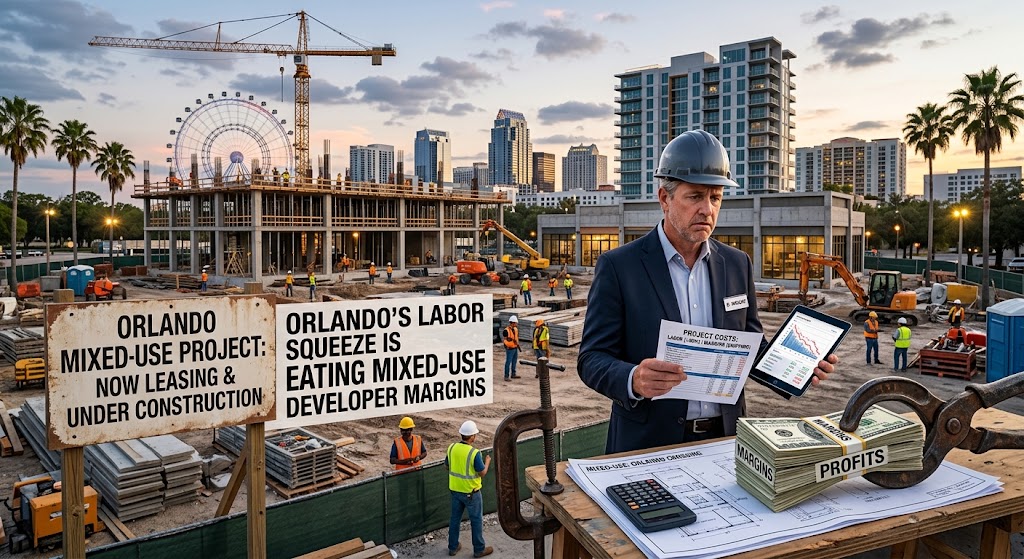
Orlando developers are adding people faster than they can find workers to build for them. Skilled trades are scarce, wages keep rising, and immigration enforcement has hit Southern contractors harder than the national average. Together with tariff-driven material costs and construction loans priced off a 10-year Treasury above 5%, these pressures are stretching schedules and cutting the spread between a project’s yield on cost and its exit value. Mixed-use and multifamily projects that penciled in 2024 now need more equity, cheaper land, or a builder who does more of the work in-house.
Key Takeaways
- Orlando’s construction workforce is smaller than a year ago even as the metro adds roughly 725 residents a week.
- In the South, 42% of contractors report some impact from immigration enforcement, compared with 29% nationally.
- Total construction cost escalation is running above 5% a year and could reach 8% by late 2026.
- A modest cost overrun and a four-month delay can cut a typical Orlando mixed-use project’s profit margin by more than half.
- Developers are rebuilding capital stacks with more common equity, larger contingencies, and more self-performed work.
Central Florida Construction Pressure at a Glance
| Indicator | Latest Reading | Source |
|---|---|---|
| Orlando MSA construction jobs | 91,500 (Apr ’26), down 2.0% YoY | Orlando Economic Partnership |
| Firms with craft openings | 87% nationally | AGC–NCCER 2026 Survey |
| Immigration impact, South | 42% of contractors | AGC–NCCER 2026 Survey |
| U.S. project cost escalation | ~5% YoY, up to 8% late 2026 | JLL Mid-Year 2026 |
| Orlando apartments underway | 17,557 units (Jan ’26) | Yardi Matrix |
| Orlando avg. asking rent | $1,753, down 0.3% | Yardi Matrix |
| 10-year Treasury | ~5.2% (Oct ’26) | Market data |
Demand Is Not the Problem
Developers in most U.S. markets are struggling to find renters. Orlando’s developers are struggling to find workers. Recent census estimates show the Orlando region gained nearly 38,000 residents in one year, which the Orlando Economic Partnership translates to about 725 new arrivals every week. Employment growth has also run ahead of the country: Orlando added jobs at a 1.6% annual rate as of September 2025, 80 basis points faster than the national rate.
Developers have responded. Orlando was an outlier for construction starts, with 17,557 apartment units underway as of January and 11,447 units breaking ground across 49 properties in 2025. Investors followed, and the metro finished 2025 with $2.7 billion in multifamily sales, up $1 billion from the prior year.
Financing kept flowing at the start of 2026. In January, two more market-rate apartment projects closed a combined $115 million in construction loans, including $61 million from Valley National Bank for Phase 4 of Heritage Key Villas in Kissimmee and $54 million from Pinnacle Bank for Wekiva Ranch in Apopka.
The problem is that the workforce needed to build these projects has not grown along with them.
The Workforce Is Shrinking While the Pipeline Grows
The clearest local data point comes from the Orlando Economic Partnership’s market snapshot. The Orlando metro had 91,500 construction jobs in April 2026, up slightly from March but down 2.0% from a year earlier.
A 2% drop in construction employment during a period of record starts does not mean demand fell. It means the labor pool shrank. Industry groups including the Associated General Contractors cite three structural causes: an aging workforce, fewer young people entering the trades, and immigration enforcement that affects construction labor. An FIU construction trades program official who spent 25 years in construction HR told WFTV she had never seen a shortage like this one.
What the national survey says about the South
The 2026 AGC–NCCER Workforce Survey, conducted in July and August, found that 87% of firms have openings for hourly craft positions and 82% have openings for salaried roles. Among firms with craft openings, 88% said those jobs were at least as hard to fill as the year before. The survey’s overall finding was that softer construction demand in some sectors has not loosened the construction labor market.
The South is more exposed than other regions. Forty-two percent of Southern respondents reported at least one direct or indirect workforce impact from immigration enforcement, compared with 29% nationally. Central Florida’s framing, drywall, concrete, and finishing trades rely heavily on immigrant labor, so that regional difference shows up directly on Orlando jobsites.
Data center construction is a newer source of competition. The AGC survey found that data center work is drawing skilled workers away from other projects and pushing up wages. Electricians, pipefitters, and HVAC technicians who once moved between apartment and office projects can now earn more on hyperscale data center campuses.
Trades under the most pressure
| Trade | Why It’s Tight in Orlando |
|---|---|
| Concrete / block masons | CMU-heavy Florida construction, few new entrants |
| Carpenters / framers | Wood-frame podium demand, immigration exposure |
| Electricians | Data center competition, licensing bottleneck |
| Drywall installers | Immigration exposure, piece-rate wage pressure |
| Superintendents / PMs | Experience gap after 2008–2012 exodus |
Wages, Materials, and Rates Are Rising Together
Labor is only one of the cost pressures developers face. Costs are rising across materials, labor, and financing simultaneously.
Wages. In its September data digest, the AGC reported that average hourly earnings for construction production workers rose about 5.0% year over year, ahead of other private sectors. Local cost estimators put Central Florida trade wages rising 6% to 7% a year, close to the Florida average.
Materials. JLL’s mid-year 2026 update found that total project cost escalation, including materials and contractor margins, is running about 5% a year, above the forecast range, with materials prices nearing 9% growth by the third quarter. Florida TaxWatch noted that the construction materials producer price index rose from 233 to 338 over five years, and that 50% tariffs on steel, aluminum, and copper are adding to the pressure. A Coral Gables general contractor recently said copper wiring costs have more than tripled.
Rates. The 10-year Treasury, the benchmark for permanent loans that construction lenders assume will repay them, recently traded around 5.22% after New York Fed President John Williams said one more 2026 rate hike might be enough. Floating-rate construction loans price off the short end of the curve, so each additional month on a construction schedule now costs noticeably more in interest than it did in 2021.
When those three costs rise together, the main casualty is schedule. A project that loses its drywall crew for three weeks does not just cost three weeks of interest. It also pays for the superintendent, temporary power, equipment rentals, insurance, and the general contractor’s general conditions for the entire delay.
How Margin Compression Works on an Orlando Mixed-Use Deal
Developers measure profitability with two figures: yield on cost (stabilized net operating income divided by total project cost) and the development spread (yield on cost minus the cap rate at which the finished building could be sold). If the spread is too narrow, the project does not make sense to build.
Illustrative FAN Margin Model
Hypothetical 300-unit Orlando mixed-use project with ground-floor retail. FAN calculation for illustration only; not based on any specific project.
| Line Item | 2024 Underwriting | 2026 Reality |
|---|---|---|
| Hard costs | $60.0M | $64.8M (+8%) |
| Soft costs, land, fees | $24.0M | $24.6M |
| Construction interest | $6.0M | $7.5M (4-month delay) |
| Total project cost | $90.0M | $96.9M |
| Stabilized NOI | $5.85M | $5.85M |
| Yield on cost | 6.50% | 6.04% |
| Value at 5.75% exit cap | $101.7M | $101.7M |
| Developer profit | $11.7M (13%) | $4.8M (5%) |
| Development spread | 75 bps | 29 bps |
The scenario is not extreme: an 8% increase in hard costs and a four-month delay. Net operating income stays the same because Orlando rents are flat, so the cost increases cannot be passed through to tenants. The profit falls by about 60%, and the development spread drops from a financeable 75 basis points to a thin 29.
This is why Orlando’s construction pipeline is likely to slow sharply even as starts were strong in 2025. Marcus & Millichap projects about 7,000 completions in 2026, less than half the level of a few years ago when Orlando ranked among the top five U.S. markets. Projects that have not yet broken ground are being repriced, redesigned, or postponed.
Rents Can’t Absorb the Increase
In most construction cost cycles, developers recover cost increases through higher rents at lease-up. Orlando’s rent data does not allow that right now. Average advertised asking rents fell 0.3% on a trailing three-month basis through January to $1,753, after turning negative in the second half of 2025.
Supply explains the softness. Northmarq reports that International Drive and Northwest Orlando account for 40% of the metro’s construction pipeline, so new projects in those corridors compete directly with lease-ups using concessions. A developer who budgeted 3% annual rent growth in 2024 and now gets zero must absorb all of the cost increase out of profit.
Mixed-use projects carry an extra burden. Ground-floor retail requires a shell, storefront systems, and grease traps or other utility infrastructure for restaurant tenants, and those are the components most exposed to electrical and plumbing labor shortages. Retail tenants also negotiate tenant-improvement allowances that are fixed at signing, before construction costs are known. The retail portion of a mixed-use building has become noticeably more expensive to deliver in 2026.
How Developers Are Restructuring Capital Stacks
Orlando developers are responding in five main ways.
1. More common equity. Construction lenders generally size loans to a percentage of total cost and do not increase them after closing. Any cost overrun falls to the sponsor. Partnership agreements increasingly require larger equity commitments up front, with capital-call provisions that apply when budgets slip.
2. Larger contingencies. Hard-cost contingencies that used to be set at 5% are being raised by developers and lenders alike. A larger contingency does not reduce costs, but it keeps a cost overrun from becoming a loan default.
3. Self-performing work. Developers with in-house construction crews have a significant advantage. Robert Thorne of Urban Network Capital Group told Invest: Greater Orlando that construction and material costs are his biggest challenge, and that performing work in-house on Orlando’s mostly mid-rise projects lets his firm keep costs aligned with market value instead of chasing them upward.
4. Guaranteed-maximum-price contracts with pass-through limits. General contractors are wary of fixed-price contracts after absorbing tariff increases on projects bid in 2024 and 2025. New contracts more often include escalation clauses for specific materials such as copper wire, steel, and switchgear, which shifts risk back to developers in exchange for lower contingencies built into contractors’ bids.
5. Phasing and redesign. Large master plans are being broken into smaller phases. The City of Orlando already extended the Creative Village completion deadline by 12 years to 2043, citing pandemic disruption and higher construction costs. More private developers are likely to do the same, building the first phase to prove rents before committing labor and capital to the next.
Who wins in this environment
| Developer Profile | Position in 2026 |
|---|---|
| Owns land from pre-2022 | Strong: low basis offsets costs |
| Self-performs construction | Strong: controls labor and schedule |
| Merchant builder, new land | Weak: needs rent growth that isn’t there |
| Heavy retail component | Weak: highest labor-sensitive costs |
| Fee developer for institutions | Neutral: margins fixed, volume falls |
What Changes the Equation
The labor shortage will not end quickly, but three developments could ease margin pressure in 2027 and 2028.
The supply wave ends. With starts expected to fall sharply, the concessions currently suppressing rents should fade. Rent growth would restore development spreads and could make some deferred projects feasible again.
Data center demand peaks. If hyperscale construction in the Southeast slows, electricians and mechanical workers would return to residential and mixed-use projects.
Workforce pipelines mature. Florida’s construction training programs, including those aimed at helping workers with construction experience from other countries enter the Central Florida workforce, will take years to show results. They will not help 2026 projects, but they matter for the next development cycle.
The main risk is interest rates. If the Fed raises again on October 28 and the 10-year moves higher, both the cost of construction debt and exit cap rates would increase, narrowing spreads that are already thin.
Brian’s Take: Labor Is the New Land
When I managed money, the first question on any real estate deal was the basis. In Orlando in 2026, the most important part of the basis isn’t land. It’s labor, and labor is the one input a developer can’t buy in advance.
The margin math above is the part of this story the market hasn’t priced in. An 8% cost overrun and a four-month delay are ordinary outcomes in today’s market. Yet they turn a solid 13% development profit into 5%, which is below what most equity investors require for construction risk. That means a lot of the 135,000 units that Yardi showed in Orlando’s planning stages late last year will never be built.
That has two implications. For investors, the best Orlando opportunity right now is buying recently completed buildings from merchant developers who need to sell, often below replacement cost, rather than starting new ones. For developers, the advantage is having crews. A builder who self-performs framing and concrete has an advantage that capital alone cannot replicate. I expect to see more mergers between developers and subcontractors over the next 18 months.
— Brian
Frequently Asked Questions
Why is there a construction labor shortage in Orlando?
An aging workforce, few young people entering the trades, immigration enforcement, and competition from data center construction are all contributing. Orlando’s construction employment fell 2.0% year over year in April 2026, even as the region kept adding about 725 residents a week.
How much are construction costs rising in 2026?
JLL estimates U.S. construction cost escalation at about 5% a year, possibly reaching 8% by late 2026. Materials prices are rising faster, near 9%, driven by tariffs on steel, aluminum, and copper.
How does immigration enforcement affect Florida construction?
The 2026 AGC–NCCER survey found that 42% of contractors in the South reported some direct or indirect workforce impact from immigration enforcement, compared with 29% nationally.
Are Orlando apartment rents rising?
Not currently. Yardi Matrix reported Orlando’s average asking rent at $1,753 in early 2026, down slightly, as new supply forces landlords to offer concessions.
What is a development spread?
The difference between a project’s yield on cost and the cap rate at which the finished building could be sold. Developers generally want at least 100 to 150 basis points to justify construction risk. Many Orlando projects now fall well short of that.
How many apartments will Orlando complete in 2026?
Marcus & Millichap projects about 7,000 completions in 2026, less than half the level of the market’s peak years.
Which Orlando developers are best positioned now?
Those who bought land before 2022 and those who self-perform major trades. Both can absorb higher labor costs better than merchant builders buying land at today’s prices.
Florida Authority Network publishes independent, long-form business coverage across 35 Florida news sites. For information on FAN market coverage and business profiles, call 813-409-4683.
Sources and Further Reading
- Orlando Economic Partnership — Orlando MSA Market Snapshot, June 2026
- WFTV Channel 9 — Labor shortage in Central Florida could lead to project delays, higher costs, 2026
- Associated General Contractors of America and NCCER — 2026 Workforce Survey National Release
- Roofing Contractor — “Immigration Enforcement Affects 29% of Contractors, AGC-NCCER Survey Finds”
- Carolinas AGC via PR Newswire — “Construction Workforce Shortages Continue,” 2026
- Associated General Contractors of America — Data DIGest, September 4, 2026
- CRE Daily — “US Construction Costs Climb as Tariff and Labor Pressures Mount” (citing JLL 2026 US Construction Perspective mid-year update)
- Florida TaxWatch — Trends in the Cost of Construction Materials
- Peter Zalewski / Condo Capitalism — South Florida general contractors on labor and tariffs, 2026
- Yardi Matrix — Orlando Multifamily Market Report, March 2026
- Yardi Matrix — Orlando Multifamily Market Report, December 2025
- GrowthSpotter — Orlando apartment construction financing, January 2026
- Northmarq — Orlando Multifamily Market Insights, Q4 2025
- Invest: Greater Orlando via Capital Analytics — “Face Off: An Orlando Real Estate Outlook for 2026”
- Spectrum News 13 — Orlando City Council extends Creative Village completion to 2043
- OneEstimate — Construction Cost per Square Foot in Orlando, FL (2026)
- Bloomingbit — Treasury yields after New York Fed’s Williams remarks, October 2026
About the Author