Florida Authority Network Market Coverage | By Brian French
Independent market analysis. The Florida Authority Network does not represent any developer, landlord, or tenant named in this report.
Quick Answer
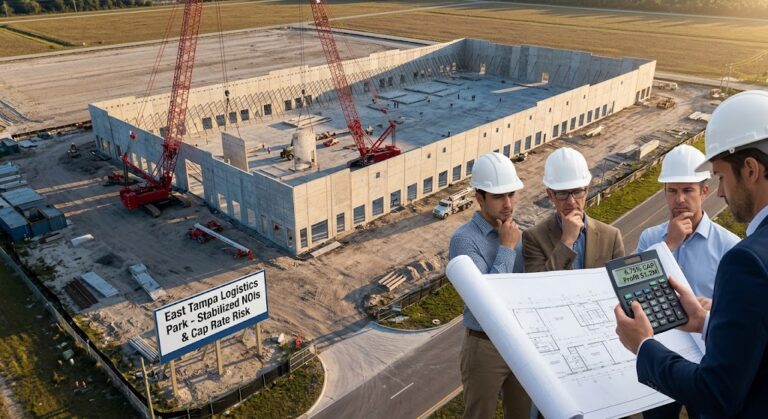
Hillsborough County’s industrial market has two problems at once. New supply pushed Tampa Bay industrial vacancy to 8.2% in the third quarter, and net absorption turned negative for the first time since mid-2025. Meanwhile, building a warehouse costs more as copper, steel, and site-work prices rise, and buyers now require cap rates near 7.6% instead of the sub-5% yields of 2021. Rents are at a record and still rising, but the spread between what a new building earns and what it sells for has largely disappeared. Smaller buildings, owners who bought land early, and leased product are doing well. Large speculative buildings in East Tampa and Plant City are not.
Key Takeaways
- Tampa Bay industrial vacancy rose to 8.2% in Q3 2026, the highest level since 2014 by CBRE’s measure.
- Asking rents reached a record $11.30 per square foot, up 11.1% year over year, even as leasing fell 38%.
- Industrial cap rates have widened by roughly 200 basis points from the 2021–2022 peak, to about 7.6%.
- Medium-size warehouse construction now averages $87 per square foot nationally, with copper up 39% and steel up 17% year over year.
- Development spreads on speculative Hillsborough warehouses have narrowed from more than 300 basis points to roughly 25 to 50.
Tampa Bay Industrial, Q3 2026 at a Glance
| Metric | Latest Reading | Source |
|---|---|---|
| Overall vacancy | 8.2% (+80 bps QoQ) | Cushman & Wakefield |
| Q3 net absorption | ~–197,000 SF | Cushman & Wakefield |
| YTD net absorption | ~+850,000 SF | CBRE |
| Q3 leasing | ~869,000 SF (–38.1% YoY) | Cushman & Wakefield |
| Avg. asking rent | $11.30/SF (+11.1% YoY) | Cushman & Wakefield |
| Westside vacancy | 3.6% | Cushman & Wakefield |
| Avg. cap rate | ~7.6% | Matthews / CoStar |
| 10-year Treasury | ~5.2% | Market data |
Supply Wave Meets Slower Leasing
The third quarter produced the most difficult industrial numbers Tampa Bay has seen this cycle. Cushman & Wakefield reported that vacancy climbed to 8.2%, up 80 basis points from the prior quarter and 60 basis points from a year earlier. More than 1.0 million square feet of new buildings delivered in Q3, bringing the year-to-date total to 1.5 million, and 81.8% of the space delivered in the quarter was still available at quarter-end.
Demand also weakened. The market recorded nearly 197,000 square feet of negative net absorption, the first quarterly loss since mid-2025, as more tenants moved out than in. Leasing totaled about 869,000 square feet, down 38.1% from a year earlier.
CBRE’s Q3 report puts this in longer context. Vacancy has reached levels Tampa has not seen since 2014, driven by both active construction and an unusual number of large, long-occupied buildings returning to the market, especially in East Tampa. CBRE still counts nearly 850,000 square feet of positive absorption year to date and describes the large vacancies as an opportunity for big users who have historically had few choices in Tampa.
The figures differ by source. Savills, which uses a different building inventory, measured Tampa Bay vacancy at 9.3% in Q2, up 90 basis points year over year, while noting that it was the first quarter since mid-2023 in which vacancy did not rise. Every source agrees on the direction: supply arrived faster than tenants did.
Why Rents Keep Rising Anyway
Higher vacancy has not lowered rents, which is the most unusual part of this cycle. Cushman & Wakefield reported weighted average asking rents of $11.30 per square foot in Q3, up 3.6% for the quarter and 11.1% for the year, a record for the market.
The explanation is the mix of buildings. New construction carries higher asking rents, and when a million square feet of new space lists at $12 to $14 per square foot, the average rises even if older buildings are discounting. CBRE says the same: premium new space is entering the market, and East Tampa is the center of development.
Location is also creating sharp differences within the county. Cushman & Wakefield measured Westside warehouse/distribution vacancy at 3.6%, down 80 basis points year over year. Infill buildings near Tampa International Airport and the Westshore corridor remain scarce because no land is left to build on. East Tampa and Plant City, where land is available, are where the new supply and the vacancy are concentrated.
Where the pressure sits in Hillsborough
| Submarket | Supply Pressure | Demand Profile |
|---|---|---|
| Westside / Airport | Low, landlocked | Tight, infill users |
| East Tampa (I-4 / US-301) | High, active spec | Big-box returns, new deliveries |
| Plant City / I-4 East | High, land available | Regional distribution, IOS |
| Brandon / SR-60 | Moderate | Small-bay, service users |
Cap Rates Have Reset
The capital markets repriced Tampa industrial before the leasing market softened. In Q1 2026, CoStar data compiled by Matthews showed an average sale price of $154 per square foot, an average cap rate of 7.6%, and $240 million in trailing 12-month sales volume. The cap rate stayed near 7.6% in Q2, which Matthews attributes to the higher returns investors have required since rates rose.
Market observers estimate that Tampa industrial cap rates have expanded roughly 200 basis points from the sub-6% levels of the zero-interest-rate period. The cause is the cost of debt. With the 10-year Treasury above 5.2% in October, an industrial buyer using leverage cannot pay a 5% cap rate without accepting negative leverage, where the property yields less than its loan costs.
Asking prices in the market show the new pricing. A fully leased two-building, 28,230-square-foot East Tampa industrial property near the Selmon Expressway was recently listed at $5.56 million, a 6.75% cap rate, after a price reduction. In 2021, that type of infill property would have been offered around a 5% cap.
The cap-rate increase matters most for developers. Merchant builders, who build speculative warehouses and sell them after lease-up, depend on the gap between their cost to build and the price the finished building commands. When exit cap rates rise by 200 basis points, the finished building is worth about 30% less for the same rent.
Construction Costs Are Rising Again
During 2023 and 2024, falling construction costs softened the effect of higher cap rates. That has changed. Cushman & Wakefield’s 2026 Industrial Construction Cost Guide found costs rising across all project sizes: small projects up 3.6% to $144 per square foot, medium projects up 2.8% to $87, and large projects up 2.3% to $78.
The pressure has shifted from labor to materials. Cushman & Wakefield reports construction-related commodity prices up 13.3% year over year, driven by tariffs, constrained metals supply, and demand from data centers and infrastructure, while labor cost growth has slowed. Copper prices rose 39% and steel 17% over the past year, while U.S. construction wages rose 4.3% and construction employment grew only 0.6%.
Warehouses are heavy users of these exact inputs. Steel joists, metal decking, rebar in tilt-up panels, dock equipment, and electrical service for large buildings are all tariff-exposed. Florida adds its own costs: higher wind-load design standards, stormwater requirements on large sites, and impact fees that have risen with growth in eastern Hillsborough.
Labor overhead has not gone away
Wage growth has slowed nationally, but the overhead tied to labor has not. When crews are scarce, schedules lengthen, and longer schedules mean more months of general conditions, insurance, equipment rental, and construction interest. The new national data shows construction employment barely growing while the industrial pipeline is expanding, so labor availability, not labor rates, is the main risk for 2027 deliveries.
National industrial construction is accelerating. U.S. industrial construction has risen for four straight quarters to 305 million square feet, up 18% year over year. That brings more competition for tilt-up crews, steel erectors, and electricians, just as Tampa’s own speculative pipeline replenishes.
The Margin Math: 2021 vs. 2026
The illustration below shows how these changes affect a developer.
Illustrative FAN Development Model
Hypothetical 200,000-SF speculative warehouse in East Hillsborough. FAN calculation for illustration only; 2021 figures are approximate.
| Line Item | 2021 Build | 2026 Build |
|---|---|---|
| All-in cost per SF | ~$100 | ~$142 |
| Total project cost | $20.0M | $28.4M |
| Achieved NNN rent | ~$8.00/SF | ~$10.50/SF |
| Stabilized NOI (95% occ.) | $1.52M | $2.00M |
| Yield on cost | 7.6% | 7.0% |
| Exit cap rate (new Class A) | ~4.5% | ~6.75% |
| Development spread | ~310 bps | ~25 bps |
| Value at exit | $33.8M | $29.6M |
| Developer profit | ~$13.8M | ~$1.2M |
The 2026 rent is about 31% higher than in 2021, which is real progress. But all-in cost rose about 42%, and the exit cap rate rose 225 basis points. A project that once produced a large profit now earns very little, and that is before accounting for the lease-up risk shown in this quarter’s data, where most new deliveries were unleased at quarter-end.
Lease-up timing is the main remaining variable. If a building stays empty for 12 months instead of 6, the developer carries six more months of loan interest, property taxes, and insurance with no rental income. On the project above, that could eliminate the remaining profit.
How Developers Are Adapting
Tampa developers have not stopped building. They have changed what they build.
Smaller buildings. CBRE reports that small and mid-size buildings continue to outperform large bulk distribution centers, and that developers have stayed disciplined by focusing on smaller buildings spread across the region. Small-bay buildings attract the region’s core tenants, including contractors, distributors, and service companies, and lease up much faster than 500,000-square-foot buildings.
Industrial outdoor storage (IOS). Plant City’s I-4 corridor has seen a wave of IOS listings: fenced, paved sites with small buildings for fleet parking, equipment, and contractor yards. One example is an 8-acre site on Sammonds Road with three structures built in 2023, marketed to Tampa, Lakeland, and Orlando operators. IOS requires far less vertical construction, so it avoids most of the steel and copper cost increases.
Shovel-ready land instead of spec buildings. Some landowners are selling entitlements rather than building. Lee & Associates is marketing a permit-ready 58.8-acre site on Coronet Road in Plant City that can support up to 441,766 square feet in one or two buildings, with 32-foot clear heights and 125-foot truck courts. Selling entitled land to a user or build-to-suit developer moves the construction-cost risk to someone with a committed tenant.
Build-to-suit over speculation. Large future projects such as the 3.4-million-square-foot Stalwart Business Park, approved in Plant City in 2025, are likely to proceed in phases tied to signed tenants rather than all at once on speculation.
Sale-leasebacks and owner-users. Matthews notes that sale-leasebacks and purchases by owner-users are adding liquidity while institutional buyers are more selective. For many businesses, buying a building near a 7.6% cap rate is cheaper than renting at record rents.
What to Watch in 2027
Lease-up of 2026 deliveries. CBRE identifies two key indicators: how quickly new buildings lease and how fast vacated older space is backfilled. If East Tampa’s large vacancies find tenants by mid-2027, vacancy should peak and begin falling.
The Fed on October 28. Another rate hike, or a 10-year Treasury that keeps climbing, would push cap rates up further and lower the value of buildings currently in lease-up.
Tariff policy on metals. With copper up 39% and steel up 17%, any easing of metals tariffs would quickly improve warehouse development economics. Further escalation would cause more planned projects to be delayed.
Construction starts. Developers have restarted the pipeline in 2026. If those projects deliver into a market still absorbing this year’s buildings, the recovery could slip to 2028.
Brian’s Take: The Old Buildings Are the Opportunity
In my money management days, we used to say the best time to own an asset is when nobody can afford to build a new one. Tampa industrial is close to that point. When a new warehouse costs $142 a foot to build and sells at a 6.75% cap, almost nobody can build one profitably. That doesn’t hurt the owners of existing buildings. It protects them.
The market is focused on the 8.2% vacancy, but the more important number is the 11.1% rent growth. Rents rising alongside vacancy tells you the empty space is new and expensive, not that tenants are leaving the market. When the pipeline drains because the margin math doesn’t work, which my example shows is already happening, older well-located buildings will be the cheapest available space in a market where rents keep rising.
My view: buy existing small-bay and mid-size buildings in Westside and Brandon at today’s 6.75% to 7.6% cap rates. Be very careful with large speculative development in East Tampa until this year’s deliveries are leased. And watch Plant City IOS closely. It’s the one development type where the construction-cost problem barely applies.
— Brian
Frequently Asked Questions
What is the industrial vacancy rate in Tampa Bay?
Cushman & Wakefield measured 8.2% in Q3 2026, up 80 basis points from Q2. CBRE says vacancy is at its highest level since 2014. Other brokers’ figures differ slightly because of inventory definitions.
Why are Tampa industrial rents rising if vacancy is up?
New buildings list at higher rents, which raises the market average, and tenants continue to pay a premium for modern space. Asking rents reached a record $11.30 per square foot in Q3, up 11.1% year over year.
What are industrial cap rates in Tampa in 2026?
Average industrial cap rates are about 7.6%, roughly 200 basis points higher than the 2021–2022 peak. Well-leased infill properties are listing in the mid-to-high 6% range.
How much does it cost to build a warehouse in 2026?
Cushman & Wakefield’s 2026 guide puts national averages at $144 per square foot for small projects, $87 for medium, and $78 for large, for core and shell only. Land, site work, fees, and financing raise the all-in cost considerably in Hillsborough County.
Which Tampa industrial submarket is tightest?
The Westside, near Tampa International Airport, where warehouse and distribution vacancy is about 3.6%. Very little land remains there for new construction.
Is Plant City still a good place for industrial development?
For build-to-suit, small-bay, and industrial outdoor storage, yes. Large speculative bulk buildings are harder to justify until the 2026 deliveries are leased.
When will Tampa industrial vacancy peak?
That depends on how fast recently delivered and recently vacated space leases up. If East Tampa’s large blocks are backfilled during 2027 and new starts stay limited, vacancy is likely to peak in the first half of 2027.
Florida Authority Network publishes independent, long-form business coverage across 35 Florida news sites. For information on FAN market coverage and business profiles, call 813-409-4683.
Sources and Further Reading
- Cushman & Wakefield — Tampa Bay Industrial MarketBeat, Q3 2026
- CBRE — Tampa Industrial Figures, Q3 2026
- CBRE — Tampa Industrial Figures, Q2 2026
- Savills — Q2 2026 Industrial Market Reports
- Matthews Real Estate Investment Services — Tampa, FL Industrial Market Report, Q1 2026 and Q2 2026 (CoStar data)
- WareCRE — “Tampa Bay’s Two Markets: Big-Box Oversupply Meets Small-Bay Scarcity,” 2026 Warehouse Report
- Crexi — 1020–1030 S. 86th Street, East Tampa industrial offering
- Cushman & Wakefield — 2026 Industrial Construction Cost Guide (via Building Design + Construction)
- DC Velocity — “Cushman & Wakefield Says Industrial Construction Costs Are Rising,” 2026
- CRE Daily — “Industrial Construction Costs Rise Across Americas,” 2026
- Lee & Associates Tampa Bay — Coronet Road, Plant City industrial site offering
- CommercialCafe — Lease-ready IOS, 2909 Sammonds Road, Plant City
- Business Observer — “Plant City approves 3.4M-square-foot, 410-acre industrial project,” May 2025
- Bloomingbit — Treasury yields after New York Fed’s Williams remarks, October 2026
About the Author