Quick Answer: Construction defect claims in Florida follow a defined path: a mandatory Chapter 558 presuit notice, an opportunity for contractors and design professionals to inspect and offer repairs, and then litigation or arbitration if the claim is not resolved. Claims must be brought within four years in most cases and no later than seven years after key project milestones under Florida’s statute of repose. Insurance coverage, subcontractor tenders, and early expert analysis often decide the outcome.
Water intrusion through windows and balconies, cracked and delaminating stucco, failing roofs, corroding balcony railings, spalling concrete, inadequate waterproofing, and mechanical system failures are familiar problems in South Florida. Salt air, heavy rain, hurricane-force winds, and intense heat put buildings to the test faster than in most parts of the country. When problems appear, owners, condominium associations, developers, general contractors, subcontractors, suppliers, and design professionals can all find themselves in the middle of a dispute.
McArdle Franco PLLC, a Coral Gables law firm established in 2002, represents developers, property owners, contractors, subcontractors, architects, and engineering firms in land development and construction matters, including real estate and construction litigation. The firm was named a Tier 2 firm in Miami for Litigation – Construction in the 2026 edition of Best Law Firms®. As a South Florida construction defect attorney team that also drafts construction contracts, the firm understands how defect risk is allocated before a project starts and how those allocations are tested after it ends. This article explains how construction defect claims work in Florida.
What Counts as a Construction Defect
Florida law generally defines a construction defect as a deficiency in, or arising out of, the design, specifications, surveying, planning, supervision, observation of construction, or construction of a building or improvement that results from:
- Defective materials, products, or components
- Violation of applicable building codes
- Failure to meet professionally accepted standards
- Failure to follow plans and specifications approved by the building official
| Common South Florida Defect | Typical Cause |
|---|---|
| Window and door leaks | Improper installation, flashing, or sealant failure |
| Stucco cracking | Improper lath, thickness, or curing |
| Roof failures | Installation errors, inadequate attachment for wind loads |
| Balcony and slab issues | Waterproofing failure, rebar corrosion, inadequate cover |
| Mechanical and plumbing | Undersized systems, poor installation |
| Drainage and site work | Grading, stormwater, and settlement issues |
| Fire and life safety | Missing firestopping or code deficiencies |
Who May Be Responsible
Defect claims often involve many parties, each with different contracts and insurance:
- Developers and owners who sold units or buildings
- General contractors responsible for the overall work
- Subcontractors who performed specific trades
- Suppliers and manufacturers of defective products
- Architects and engineers responsible for design
- Inspectors and threshold inspectors in some circumstances
Identifying the responsible parties early matters because notice requirements, contractual indemnities, and insurance policies depend on who performed which work.
The Chapter 558 Presuit Process
Before filing a construction defect lawsuit against a contractor, subcontractor, supplier, or design professional, a claimant must follow Chapter 558 of the Florida Statutes.
| Step | General Timing |
|---|---|
| Claimant serves written notice of claim | At least 60 days before suit (120 days for associations representing more than 20 parcels) |
| Recipient forwards notice to subcontractors, suppliers, and design professionals | Within 10 days |
| Recipient may inspect the property | Within 30 days (50 days for large associations) |
| Recipient serves written response | Within 45 days (75 days for large associations) |
| Claimant accepts or rejects offer | Within statutory deadlines |
Content of the Notice
The notice must describe each alleged defect in reasonable detail sufficient to determine the general nature of each defect and, if known, the damage or loss resulting from it. Vague notices invite disputes and may delay the process.
Response Options
A recipient may offer to repair, offer to settle by payment, offer a combination, state that it disputes the claim, or state that an insurer will address the claim. A thoughtful response can resolve claims without litigation and may affect later fee and cost arguments.
Why the Process Matters
The Chapter 558 process gives contractors and design professionals a chance to inspect and fix problems, preserves evidence, and often leads to early settlement. Failing to comply can result in a lawsuit being stayed until the process is completed.
Time Limits: Statutes of Limitations and Repose
Florida imposes two types of deadlines on construction claims.
Statute of Limitations
Most construction defect claims must be brought within four years. For latent defects, the period generally runs from when the defect was discovered or should have been discovered with due diligence.
Statute of Repose
Regardless of when a latent defect is discovered, Florida’s statute of repose, as amended in 2023, generally bars claims brought more than seven years after the earliest of the issuance of a temporary certificate of occupancy, a certificate of occupancy, a certificate of completion, or the date of abandonment of construction if not completed. The previous repose period was ten years. For buildings completed several years ago, the change may have significantly narrowed the window to bring claims.
A Coral Gables construction lawyer will calculate these deadlines at the outset of any potential claim.
Legal Theories in Defect Cases
Breach of Contract
Owners and developers in contract with the contractor typically assert breach of contract and breach of express warranties. Contract terms, including warranty periods, limitations of liability, and dispute resolution clauses, shape these claims.
Statutory Building Code Claims
Section 553.84 of the Florida Statutes provides a civil cause of action for damages caused by violations of the Florida Building Code. A defendant has a defense if it obtained required permits, the plans were approved, and the work passed required inspections, unless it knew or should have known of the violation.
Negligence
Florida’s economic loss rule was limited to products liability cases by the Florida Supreme Court in Tiara Condominium Association v. Marsh & McLennan Companies (2013), which preserved negligence claims in many construction contexts. However, parties in contract with each other generally must look to their contract for remedies.
Implied Warranties
Florida recognizes implied warranties of fitness and merchantability for new residential construction. In 2012, the Legislature adopted Section 553.835, which limits implied warranty claims for offsite improvements such as roads and drainage outside the home.
Condominium Statutory Warranties
Section 718.203 provides statutory warranties from developers, contractors, subcontractors, and suppliers on condominium projects, covering the roof, structural components, mechanical, electrical, plumbing, and other elements for specified periods. Condominium associations frequently assert these warranties after turnover.
Condominium Turnover and Defect Claims
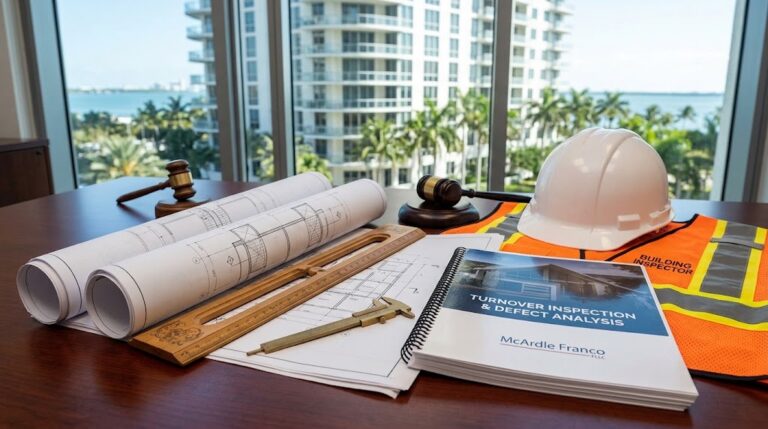
When unit owners take control of a condominium association from the developer, the association typically retains engineers to prepare a turnover report. Those reports often become the basis for claims against the developer and its contractors. Developers can manage this risk by:
- Maintaining complete construction records and warranties
- Obtaining strong indemnities and additional insured coverage from contractors
- Responding promptly to association concerns before turnover
- Coordinating with insurers and contractors when claims arise
Post-Surfside requirements, including milestone inspections and structural integrity reserve studies, have increased the scrutiny condominium buildings receive and the likelihood that latent issues will be identified.
Insurance Coverage
Insurance often determines whether a defect claim can be resolved.
Commercial General Liability Policies
In United States Fire Insurance Co. v. J.S.U.B., Inc. (2007), the Florida Supreme Court held that faulty workmanship by a subcontractor that causes physical damage to other parts of a completed project can constitute an “occurrence” and “property damage” under a standard commercial general liability policy. The cost to repair the defective work itself is often not covered, but the resulting damage may be. Coverage analysis requires careful review of the policy, exclusions, endorsements, and the timing of damage.
Additional Insured Status and Tenders
Construction contracts typically require subcontractors to name the general contractor and owner as additional insureds. When a defect claim arises, upstream parties should promptly tender the claim to subcontractors and their insurers. Delays in tendering can jeopardize coverage.
Wrap-Up Programs
Owner-controlled and contractor-controlled insurance programs consolidate coverage for many project participants. These programs change how claims are tendered and defended and should be reviewed early in any dispute.
Professional Liability
Design professionals carry professional liability insurance, often on a claims-made basis. Under Section 558.0035, individual design professionals employed by a firm may be shielded from personal liability for negligence if the contract contains the required statutory statement and other conditions are met.
Building the Case
Defect cases are expert-driven. Effective representation requires:
- Early expert engagement by engineers, architects, and building envelope consultants
- Destructive testing protocols agreed among parties when possible
- Preservation of evidence, including photographs and samples
- Document collection, including plans, specifications, submittals, inspection reports, change orders, and correspondence
- Cost-of-repair analysis with multiple repair options
- Allocation analysis identifying which trade or design element caused each defect
A Miami construction law firm with experience in both transactions and litigation can coordinate these efforts efficiently and keep costs in proportion to the claim.
Dispute Resolution Options
| Path | Considerations |
|---|---|
| Chapter 558 negotiation | Required first step; inexpensive; preserves relationships |
| Mediation | Effective for multi-party defect claims with insurers |
| Arbitration | Often required by construction contracts; private and technical |
| Litigation | Jury trial available; broader discovery; slower |
Multi-party defect claims frequently settle through global mediation in which contractors, subcontractors, design professionals, and insurers each contribute to a settlement. Contract drafting that provides for consistent dispute resolution across all project contracts makes this easier.
Preventing Defect Claims Through Contract Drafting
The best time to manage defect risk is before construction starts. A Florida land development attorney drafting project contracts can:
- Define warranty scope and duration clearly
- Require subcontractors to provide indemnity compliant with Section 725.06
- Require additional insured coverage on primary and noncontributory terms
- Require completed operations coverage for the repose period
- Include consistent dispute resolution clauses across all contracts
- Require quality control programs and third-party building envelope inspections
- Allocate responsibility for design versus construction defects in design-build projects
Developers should also coordinate defect risk with their sales and turnover planning. A South Florida real estate development attorney can align purchase agreements, condominium documents, and construction contracts so that the developer is not left holding liability it cannot pass through.
Steps to Take When a Defect Appears
- Document the condition with photographs and dates.
- Review contracts and warranties to identify responsible parties and notice requirements.
- Calendar deadlines under the statute of limitations and statute of repose.
- Notify insurers and tender claims to subcontractors.
- Retain experts to investigate cause and repair options.
- Serve or respond to Chapter 558 notices within statutory deadlines.
- Mitigate damage by making necessary temporary repairs.
- Explore early resolution through negotiation or mediation.
Frequently Asked Questions
Do I have to send a notice before suing a contractor for defects in Florida?
Yes. Chapter 558 generally requires a written notice of claim at least 60 days before filing suit, or 120 days for associations representing more than 20 parcels.
How long do I have to sue for a construction defect?
Most claims must be filed within four years, with the period for latent defects running from discovery. All claims are subject to the statute of repose, which now generally bars claims more than seven years after the earliest certificate of occupancy or similar milestone.
Does insurance cover construction defects?
A standard commercial general liability policy may cover property damage caused by a subcontractor’s faulty workmanship, but generally not the cost to repair the defective work itself. Coverage depends on policy terms and exclusions.
Can a condominium association sue the developer for defects?
Yes. Associations frequently bring claims based on statutory warranties under Section 718.203, building code violations, contract, and negligence, often following a turnover engineering report.
Can I sue for a building code violation?
Section 553.84 provides a cause of action for damages from building code violations, subject to a defense if permits were obtained, plans approved, and inspections passed, unless the defendant knew or should have known of the violation.
Who pays for experts in defect cases?
Each party typically pays its own experts, though contracts or statutes may allow recovery of costs or fees by the prevailing party.
Key Takeaways
- Chapter 558 presuit notice is mandatory before most defect lawsuits.
- Florida’s statute of repose for latent defects is now seven years.
- Section 553.84 creates a statutory claim for building code violations.
- CGL policies may cover resulting property damage from faulty workmanship.
- Strong contracts and early expert work control defect risk and cost.
About McArdle Franco PLLC
McArdle Franco PLLC is a Coral Gables law firm established in 2002 that counsels and represents businesses throughout Florida, across the nation, and internationally in land development and construction, real estate, business structuring, transaction structuring, and business litigation. The firm represents developers, property owners, contractors, subcontractors, commercial tenants, architects, engineering firms, mortgage lenders, and commercial lenders. The firm was named a Tier 2 firm in Miami for Litigation – Construction in the 2026 edition of Best Law Firms® and was ranked in Chambers USA 2025 for Litigation: General Commercial in Florida.
Contact McArdle Franco PLLC
Address: 255 Alhambra Circle, Suite 925, Coral Gables, FL 33134
Phone: (305) 442-2214
Website: mcardlefranco.com
This article provides general information and is not legal advice. Consult a qualified attorney about your specific situation.
Sources and Further Reading
- Construction Defects, Chapter 558, Florida Statutes – Florida Legislature
- Limitations of Actions, Section 95.11, Florida Statutes (as amended by CS/SB 360, 2023) – Florida Legislature
- Building Code Violations; Civil Action, Section 553.84, Florida Statutes – Florida Legislature
- Implied Warranties for Offsite Improvements, Section 553.835, Florida Statutes – Florida Legislature
- Condominium Warranties, Section 718.203, Florida Statutes – Florida Legislature
- United States Fire Insurance Co. v. J.S.U.B., Inc., 979 So. 2d 871 (Fla. 2007) – Florida Supreme Court
- Tiara Condominium Association v. Marsh & McLennan Companies, 110 So. 3d 399 (Fla. 2013) – Florida Supreme Court
- Design Professional Liability, Section 558.0035, Florida Statutes – Florida Legislature
- Land Development and Construction Practice – McArdle Franco PLLC
- Best Law Firms 2026 Rankings – McArdle Franco PLLC Press Release
About the Author