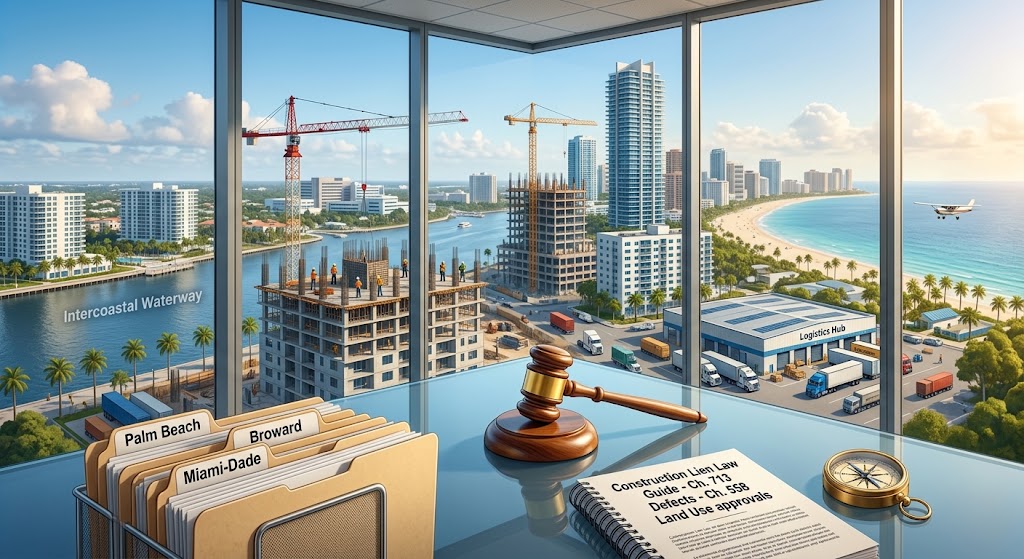
Quick Answer: Most South Florida construction disputes involve unpaid draws, delay claims, or defective work. Florida law sets strict deadlines: a Notice to Owner within 45 days of first furnishing, a claim of lien within 90 days of final furnishing, and a lawsuit to enforce the lien within one year of recording. Defect claims require a Chapter 558 presuit notice, and latent defect claims are now barred seven years after key project milestones.
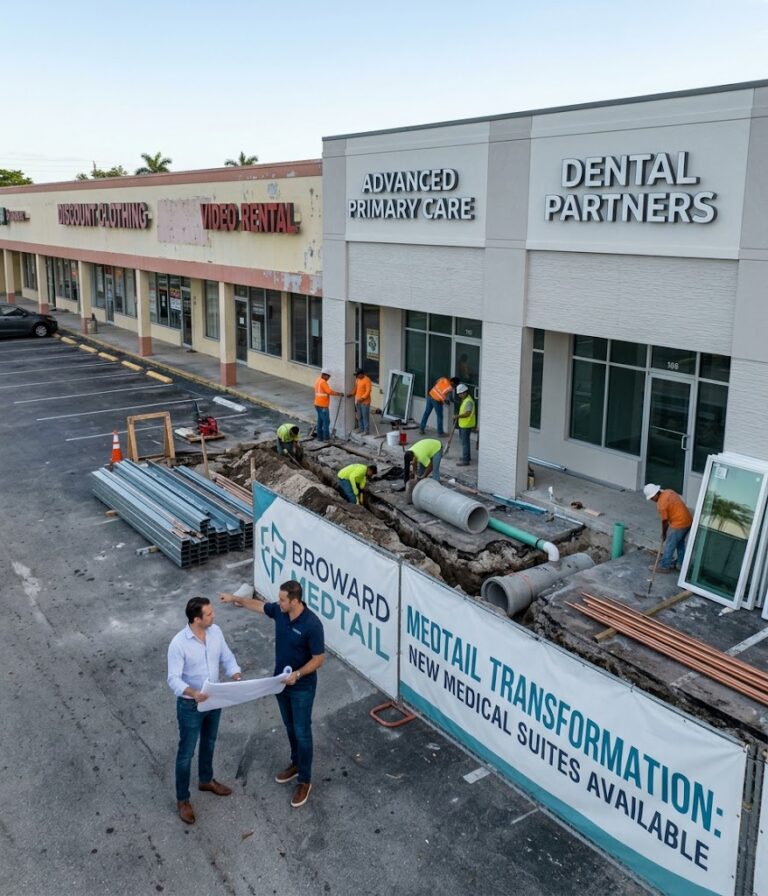
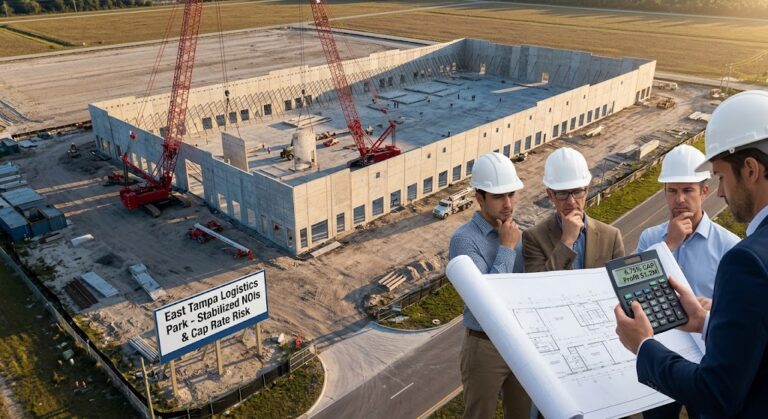
South Florida is one of the busiest construction markets in the country. Residential towers along the coast, logistics warehouses west of Interstate 95, medical office buildings, schools, and a wave of condominium repair projects driven by post-Surfside safety laws have kept contractors, subcontractors, and suppliers busy across Palm Beach, Broward, and Miami-Dade counties. Busy markets produce disputes. Tight schedules, volatile material prices, labor shortages, and hurricane interruptions all put pressure on contracts that were negotiated when conditions looked very different.
Nason, Yeager, Gerson, Harris & Fumero, P.A. has represented owners, developers, general contractors, subcontractors, suppliers, and design professionals since 1960. As a commercial construction law firm South Florida businesses rely on, the firm handles contract drafting, payment disputes, lien and bond claims, delay claims, defect litigation, and arbitration. This guide explains how the most common disputes arise and what Florida law requires at each step.
The Most Common Construction Disputes
| Dispute Type | Typical Trigger |
|---|---|
| Payment | Withheld draws, retainage, pay-if-paid clauses |
| Lien and bond | Missed notices or unpaid subcontractors |
| Delay | Owner changes, permits, weather, supply chain |
| Change orders | Scope disagreements and unsigned changes |
| Defects | Water intrusion, structural or code issues |
| Termination | Default or convenience termination |
Each category has its own rules, deadlines, and strategic considerations. The earlier a contractor or owner understands those rules, the more options remain open.
Getting Paid: Florida’s Prompt Payment Laws
Florida has separate prompt payment statutes for private and public work.
Private Projects
On private projects, Section 715.12 of the Florida Statutes and related provisions set expectations for the timing of payments between owners, contractors, and subcontractors, and the contract itself usually governs specific due dates. Payment provisions should be negotiated carefully, because the statute fills gaps rather than overriding clear contract terms.
Public Projects
On local government projects, the Local Government Prompt Payment Act, Sections 218.70 through 218.80, establishes deadlines for approving and paying contractor invoices and provides interest on late payments. State agency projects are governed by Section 255.0705 and related sections. Florida law generally caps retainage on public projects at 5 percent of each progress payment for contracts entered after July 1, 2021.
Pay-If-Paid Versus Pay-When-Paid
Subcontracts often condition payment on the contractor’s receipt of payment from the owner. Florida courts, following Peacock Construction Co. v. Modern Air Conditioning, Inc. (1977), treat ambiguous clauses as “pay-when-paid,” meaning they control timing only. To shift the risk of owner nonpayment to a subcontractor, the clause must clearly and unambiguously state that payment by the owner is a condition precedent. A West Palm Beach construction law firm reviewing a subcontract will check this language before work begins.
Florida Construction Lien Law
Chapter 713 of the Florida Statutes gives unpaid contractors, subcontractors, sub-subcontractors, suppliers, and certain professionals the right to record a lien against improved private property. The protection is powerful, but it is also highly technical. Missing a deadline can forfeit the claim entirely.
| Step | Deadline |
|---|---|
| Notice to Owner (non-privity parties) | Within 45 days of first furnishing |
| Claim of Lien | Within 90 days of final furnishing |
| Contractor’s Final Payment Affidavit | At least 5 days before suing |
| Lawsuit to foreclose | Within 1 year of recording |
| After Notice of Contest of Lien | Suit within 60 days |
Fraudulent Liens
A lien that willfully exaggerates the amount owed, includes work not performed, or is compiled with willful disregard of the law can be declared fraudulent under Section 713.31. A fraudulent lien is unenforceable and exposes the lienor to damages, attorney’s fees, and potential criminal liability. Owners facing an inflated lien should evaluate this defense early.
Transferring a Lien to a Bond
Owners and contractors can remove a lien from the property by transferring it to a cash deposit or surety bond under Section 713.24. This clears title for financing or sale while the payment dispute is resolved.
Public Projects and Payment Bonds
Liens cannot be recorded against public property. Instead, Florida’s “Little Miller Act,” Section 255.05, generally requires payment and performance bonds on public construction contracts above statutory thresholds. Claimants not in privity with the contractor must serve notice within 45 days of first furnishing and a notice of nonpayment within 90 days after final furnishing, and must file suit within one year after final furnishing. Federal projects fall under the federal Miller Act, which requires bonds on contracts over $150,000.
A Boca Raton Commercial Construction law firm handling a school, municipal, or transportation project will confirm the bond requirements and notice deadlines at the start of the job, not after a payment problem appears.
Delay and Disruption Claims
Delay claims are often the largest dollars in dispute on commercial projects. They require careful documentation and expert schedule analysis.
Excusable and Compensable Delay
Delays are generally classified as excusable (entitling the contractor to more time), compensable (entitling the contractor to more time and money), or nonexcusable (the contractor’s responsibility). Hurricanes and severe weather are usually excusable under force majeure provisions, while owner-caused changes or late design information may be compensable.
No-Damages-for-Delay Clauses
Florida courts generally enforce no-damages-for-delay clauses, which limit a contractor to a time extension. Courts recognize exceptions for fraud, concealment, misrepresentation, bad faith, or active interference by the owner. These exceptions are fact-intensive and depend heavily on project records.
Notice Requirements
Most construction contracts, including the widely used AIA A201 General Conditions, require written notice of claims within a short period after the event giving rise to the claim. Contractors lose valid claims every year by failing to give timely written notice. Daily logs, meeting minutes, photos, and correspondence are essential evidence.
Liquidated Damages
Owners often include liquidated damages for late completion. Florida courts enforce these provisions if damages were difficult to estimate at the time of contracting and the amount is not grossly disproportionate to anticipated losses. Contractors should evaluate whether owner-caused delays waive or reduce the owner’s right to assess them.
Construction Defect Claims
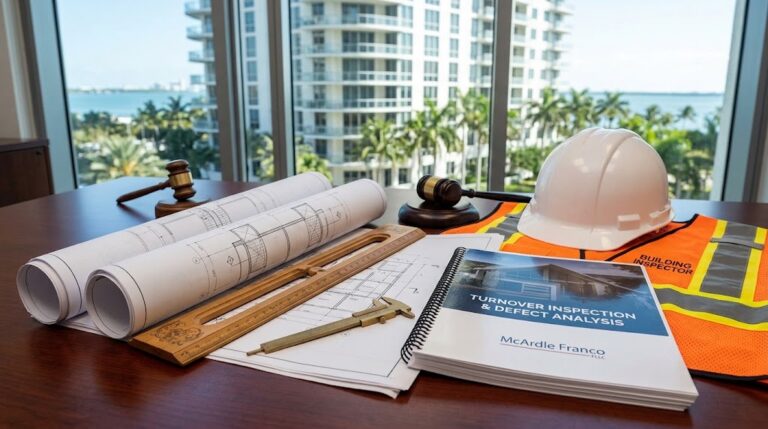
Water intrusion, stucco failures, window installation problems, roofing defects, and structural concerns are frequent sources of litigation in coastal South Florida.
Chapter 558 Presuit Notice
Before filing a construction defect lawsuit against a contractor, subcontractor, supplier, or design professional, a claimant must serve written notice under Chapter 558 at least 60 days before filing suit, or 120 days for associations representing more than 20 parcels. The notice must describe the alleged defects in reasonable detail. Recipients then have the opportunity to inspect, respond, and offer to repair or pay.
Statutes of Limitations and Repose
The statute of limitations for most construction claims is four years. In 2023, Florida shortened the statute of repose for latent defects from ten years to seven years, measured from the earliest of the certificate of occupancy, temporary certificate of occupancy, date of abandonment, or certificate of completion, among other triggers. That change significantly narrows the window for older buildings.
Condominium Safety Laws
After the 2021 Champlain Towers South collapse in Surfside, Florida adopted milestone inspection and structural integrity reserve study requirements for condominium and cooperative buildings three stories or taller. Those requirements have generated substantial repair work, along with disputes over scope, cost, and responsibility. Associations and contractors both benefit from clear contracts and documented engineering recommendations.
Licensing Issues
Under Section 489.128, contracts entered into by unlicensed contractors are generally unenforceable by the unlicensed party. An unlicensed contractor may also lose lien rights. Owners and general contractors should verify licenses for every subcontractor, and businesses expanding into Florida should confirm licensing before signing contracts.
When Land Use Problems Become Construction Problems
Many construction disputes begin long before a shovel hits the ground. Zoning conditions, site plan approvals, environmental permits, and development order requirements shape what can be built, when, and at what cost. A late permit, a condition imposed at a public hearing, or a change in setback requirements can push a schedule back months and trigger change orders and delay claims.
Owners and developers frequently coordinate their construction counsel with a Land Use Law Firm Palm Beach County team so that approval conditions are reflected in construction contracts. Projects in the city of West Palm Beach face their own downtown and waterfront regulations, and a West Palm Beach Land Use Law Firm can identify approval risks before a contract price is set. In south county, Boca Raton Land Use lawyers address the city’s downtown development rules and environmental overlays. Experienced Land Use attorneys Palm Beach County developers work with can also help determine who bears the risk when approvals are delayed.
Choosing a Dispute Resolution Path
| Option | Advantages | Considerations |
|---|---|---|
| Negotiation | Fast, low cost | Requires good records |
| Mediation | Confidential, flexible | Non-binding |
| Arbitration | Expert decision-makers, private | Limited appeal rights |
| Litigation | Full discovery and appeals | Slower, public, costly |
Many contracts require mediation before arbitration or litigation. Florida’s Revised Arbitration Code, Chapter 682, governs most arbitration agreements, and courts strongly favor enforcing them. The choice of forum should be made deliberately during contract negotiation, not after a dispute arises.
Contract Drafting Tips That Prevent Disputes
A South Fl construction law firm reviewing a contract before signature can prevent many of the disputes described above. Key provisions to address include:
- Payment terms with clear due dates, documentation requirements, and retainage release conditions.
- Change order procedures that require written authorization and set pricing methods.
- Notice provisions with realistic deadlines and clear recipients.
- Delay and force majeure clauses that address hurricanes, pandemics, and supply chain disruption.
- Material price escalation clauses for volatile items such as steel, concrete, and roofing.
- Indemnity and insurance provisions that comply with Section 725.06 limits on construction indemnities.
- Dispute resolution clauses specifying venue, mediation, and arbitration rules.
- Termination provisions covering both default and convenience.
Frequently Asked Questions
How long do I have to file a construction lien in Florida?
A claim of lien must generally be recorded within 90 days after the lienor’s final furnishing of labor, services, or materials. Non-privity lienors must also serve a Notice to Owner within 45 days of first furnishing.
Can a subcontractor lien a public project?
No. Public property is not subject to construction liens. Subcontractors and suppliers on public projects must pursue claims against the payment bond under Section 255.05 or the federal Miller Act.
Is a pay-if-paid clause enforceable in Florida?
Yes, if it clearly and unambiguously makes owner payment a condition precedent. Ambiguous clauses are interpreted as pay-when-paid, which only affects timing.
What is a Chapter 558 notice?
It is a mandatory presuit notice of construction defects that must be served before filing a defect lawsuit. It gives contractors and design professionals an opportunity to inspect and offer a repair or settlement.
How long can I wait to sue over a hidden construction defect?
Florida’s statute of repose for latent defects is now seven years from the earliest qualifying project milestone, such as a certificate of occupancy, regardless of when the defect is discovered.
Do hurricanes excuse construction delays?
Usually, but whether they also justify additional compensation depends on the contract’s force majeure and delay provisions. Timely written notice is critical.
Key Takeaways
- Florida lien and bond rights depend on strict notice deadlines.
- Pay-if-paid clauses must be unambiguous to shift nonpayment risk.
- Delay claims succeed or fail on documentation and timely notice.
- The latent defect statute of repose is now seven years.
- Land use approvals and construction contracts should be coordinated from the start.
Contact Nason Yeager
Nason, Yeager, Gerson, Harris & Fumero, P.A. serves clients throughout Florida from four offices. Website: nasonyeager.com
Palm Beach Gardens: (561) 686-3307 | Seacoast National Centre, 3001 PGA Boulevard, Suite 305, Palm Beach Gardens, FL 33410
Boca Raton: (561) 982-7114 | 750 Park of Commerce Boulevard, Suite 210, Boca Raton, FL 33487
Fort Lauderdale: (561) 686-3307 | 110 East Broward Boulevard, Suite 1010, Fort Lauderdale, FL 33301
Tampa/St. Petersburg (By Appointment Only): (561) 686-3307 | First Central Tower, 360 Central Avenue, Suite 800, St. Petersburg, FL 33701
This article provides general information and is not legal advice. Consult a qualified attorney about your specific situation.
Sources and Further Reading
- Florida Construction Lien Law, Chapter 713, Florida Statutes – Florida Legislature
- Public Construction Bonds, Section 255.05, Florida Statutes – Florida Legislature
- Local Government Prompt Payment Act, Sections 218.70–218.80, Florida Statutes – Florida Legislature
- Construction Defects Presuit Process, Chapter 558, Florida Statutes – Florida Legislature
- Limitations of Actions, Section 95.11, Florida Statutes (as amended by CS/SB 360, 2023) – Florida Legislature
- Contracting, Chapter 489, Florida Statutes – Florida Department of Business and Professional Regulation
- Peacock Construction Co. v. Modern Air Conditioning, Inc., 353 So. 2d 840 (Fla. 1977) – Florida Supreme Court
- Miller Act, 40 U.S.C. §§ 3131–3134 – U.S. Code
- Revised Florida Arbitration Code, Chapter 682, Florida Statutes – Florida Legislature
- AIA A201 General Conditions of the Contract for Construction – American Institute of Architects
About the Author