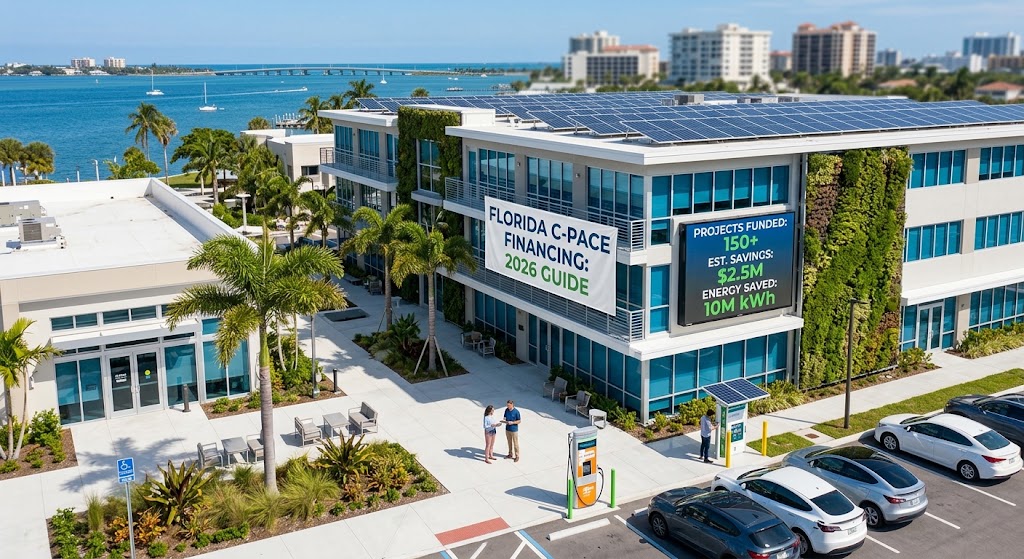
By Brian French | Florida Authority Network | September 18, 2026
Quick Answer
Commercial Property Assessed Clean Energy (C-PACE) lets Florida commercial property owners finance 100% of energy, water, and storm-resiliency improvements through a voluntary non-ad valorem assessment repaid on the property tax bill over up to 30 years at a fixed rate. In 2026 the rate runs roughly 10-year Treasury plus 3%, the assessment transfers on sale, and Florida allows retroactive financing of completed projects. The property must sit in a jurisdiction that has joined a C-PACE program, and the mortgage lender must consent.
How C-PACE Financing Works in Florida
C-PACE is not a loan in the conventional sense. A local government or interlocal district levies a voluntary special assessment on the property, a private capital provider funds the improvement, and the owner repays through the annual tax bill. Because the assessment attaches to the parcel rather than the borrower, it is non-recourse, non-accelerating, and survives a sale.
The mechanics under Florida law:
- Authority: Section 163.08, Florida Statutes, enacted in 2010, authorized local governments to create PACE programs, finding a compelling state interest and clarifying that PACE assessments are considered a senior lien.
- Collection: Under s. 163.082(1)(e), C-PACE assessments are collected on the real property tax bill under the Uniform Method of Collection, so their treatment is nearly identical to property taxes except that they are not eligible for the early-payment discount.
- Default: C-PACE assessments carry the same lien priority and enforcement mechanism as property taxes, but in a delinquency only the unpaid past-due installment is owed; the future obligation is not accelerated.
- Availability: C-PACE is not available statewide; it is only available in counties and municipalities that have authorized by ordinance or resolution a program administrator to run the program.
- Transfer: The assessment runs with the land. A buyer inherits the remaining schedule, and the seller is not required to pay it off at closing.
Nationally, financing is often priced at about the 10-year Treasury rate plus 3%, with repayment spanning up to 30 years and transferring in a property sale, which eliminates refinancing risk for lenders and cuts upfront costs for owners.
Florida’s 2024 C-PACE Reform: What Changed
Florida overhauled PACE through SB 770 in 2024, splitting the statute into separate residential and commercial sections, expanding eligible improvements to five categories, extending eligibility to lessees of government property, and removing the prior look-back limit on retroactive financing. The reform tightened residential PACE sharply but broadened the commercial program, making 2025–2026 the strongest C-PACE environment Florida has had.
The bill substantially amended s. 163.08, splitting the statute into multiple sections that define key terms, amend the types of qualifying improvements, impose new consumer protections, and extend participation to lessees of government property. The statute now defines “commercial property” as real property other than residential, including multifamily residential, commercial, industrial, agricultural, nonprofit-owned, and government property.
| Provision | Pre-2024 | Post-SB 770 (current) |
|---|---|---|
| Statute | s. 163.08 (combined) | s. 163.08 (definitions), s. 163.081 (residential), s. 163.082 (commercial) |
| Eligible categories | Energy efficiency, renewable energy, wind resistance | Five: energy efficiency, renewable energy, water conservation, resiliency, waste systems |
| Retroactive look-back | 3.5 years | No statutory limit |
| Multifamily | Ambiguous | Explicitly commercial |
| Government-leased property | Not eligible | Lessees eligible |
| Local authorization | Required | Required (ordinance or resolution) |
Florida’s expanded C-PACE program that took flight in 2024 increased the types of construction uses owners could finance for resiliency measures like flood mitigation, wind resistance, storm hardening, and septic-to-sewer conversions, and removed look-back limits to enable landlords to retroactively finance upgrades as far back as a project’s inception.
What CRE Improvements Qualify for C-PACE in Florida
Florida law limits C-PACE to five categories under s. 163.08(4)(b): waste system improvements, resiliency improvements, energy conservation and efficiency, renewable energy, and water conservation. In practice, roof replacement, impact glazing, HVAC, solar, generators, elevated equipment, and septic-to-sewer conversions cover most Florida commercial projects. Cosmetic work and FF&E do not qualify.
| Category | Qualifying Florida Improvements | Typical Share of Project |
|---|---|---|
| Resiliency (wind) | Roof strengthening/replacement, impact windows and doors, shutters, roof-to-wall connectors | 20–40% |
| Resiliency (flood) | Elevated mechanicals, flood barriers, backflow valves, dry floodproofing | 5–15% |
| Energy efficiency | HVAC replacement, chillers, LED lighting, building envelope, insulation, controls, elevators | 25–40% |
| Renewable energy | Rooftop solar, battery storage, EV charging infrastructure | 5–20% |
| Water conservation | Low-flow fixtures, irrigation controls, greywater, cooling-tower efficiency | 2–8% |
| Waste systems | Septic-to-sewer conversion, advanced onsite treatment | Site-specific |
| Related soft costs | Design, engineering, permits, energy audit, program fees | 10–15% |
Common hotel examples include HVAC systems, LED lighting, solar, building envelope upgrades such as roofing and windows, elevators, water-efficient fixtures, and storm-resiliency retrofits; FF&E and purely cosmetic work do not qualify. In new construction, C-PACE can fund the incremental cost of the eligible systems, and some providers extend to 100% of hard, soft, and related costs for eligible components.
Florida C-PACE Terms and Rates (2026)
Florida C-PACE in 2026 prices in the high-6% to mid-7% range for stabilized commercial property, fixed for terms up to 30 years, with no payments during construction and full amortization. Proceeds typically run 20–35% of stabilized value, and up to 45% of the capital stack on some deals. The assessment is non-recourse and requires a completion guarantee only on construction.
| Term | Florida C-PACE (2026) |
|---|---|
| Rate | ~10-yr UST + 300 bps; high-6% to mid-7% fixed |
| Term | Up to 30 years, matched to useful life |
| Amortization | Fully amortizing; interest-only or deferred periods available |
| Loan-to-value | Typically 20–35% of stabilized value; up to 45% of stack on some deals |
| Recourse | Non-recourse |
| Prepayment | Permitted, usually with declining premium |
| Payment frequency | Annual or semi-annual on tax bill |
| Construction period | No payments; capitalized interest |
| Lender consent | Required from senior mortgagee |
| Retroactive | Yes; no statutory look-back limit in Florida |
Hotel C-PACE rates in 2026 generally fall in the high 6% to mid 7% range, fixed for the full term of 20 to 30 years. Florida providers offer up to 30 years, fully amortized, fixed over the term at a spread over the 10-year Treasury, with no payments during construction and non-recourse structure. Borrowers are finding C-PACE can now provide up to 45% of the capital stack for some buildings.
C-PACE in the Capital Stack: A Florida Example
C-PACE replaces the most expensive slice of a project’s capital, the mezzanine or preferred equity layer, with 30-year fixed-rate debt priced near senior-loan levels. On a Florida multifamily or hotel project, swapping 15–20% of the stack from 12% mezzanine to 7% C-PACE lowers the blended cost of capital by 75–125 basis points.
Example: $58 million Florida multifamily development
| Layer | Conventional Stack | With C-PACE |
|---|---|---|
| Senior construction loan (SOFR + 300) | 65% / $37.7M @ 7.5% | 60% / $34.8M @ 7.5% |
| Mezzanine / pref equity | 15% / $8.7M @ 12.0% | 0% |
| C-PACE (30-yr fixed) | 0% | 18% / $10.5M @ 7.0% |
| Sponsor equity | 20% / $11.6M | 22% / $12.7M |
| Blended cost of debt | 8.4% | 7.4% |
This mirrors a real transaction: Luna Apartments, a 245-unit Class A development on Florida’s Space Coast, used $10.5 million of C-PACE on a 30-year fixed term against a $58 million project, 18% of the capital stack. In the conventional structure, the conventional loan covers 65–75% LTV while C-PACE covers eligible improvements, replacing what would otherwise require mezzanine debt at 10–14% or equity.
Florida C-PACE Underwriting and Eligibility
Florida C-PACE underwriting is property-based, not borrower-based. The property must be in a participating jurisdiction, current on all taxes and assessments, free of involuntary liens, and the senior lender must consent in writing. Providers verify that financed improvements fall within the five statutory categories and that the term does not exceed the improvements’ weighted useful life.
Property requirements:
- Located in a community that has joined a Florida C-PACE district (FRED, Florida PACE Funding Agency, Florida Green Finance Authority/RenewPACE, or a county program)
- All property taxes and non-ad valorem assessments current
- No delinquent property taxes in the prior three years
- No involuntary liens (mechanics’, judgment, tax liens)
- Owner of record signs the financing agreement; no bankruptcy pending
- Commercial, industrial, multifamily, hospitality, agricultural, nonprofit, or government-leased property
Program administrator due diligence (s. 163.082): The owner of record must apply to the authorized program administrator, who must conduct statutorily prescribed due diligence and issue required disclosures before entering into the financing agreement.
Lender consent: Because C-PACE is recorded as a property tax assessment with senior lien priority, the mortgage lender must provide written consent; over 350 lenders nationwide have consented, and the process is increasingly routine when structured concurrently with the primary loan. Historically, obtaining senior-lender consent was the biggest origination hurdle, but the higher-for-longer rate environment has pushed banks to work with borrowers to recapitalize.
Florida C-PACE Program Administrators and Capital Providers
Florida runs C-PACE through several interlocal districts and agencies; a property is eligible if its county or city has joined at least one. Capital comes from private providers who fund through the district. Owners should confirm jurisdiction membership first, then select a capital provider based on rate, structure, and retroactive capability.
| Program / District | Structure | Coverage |
|---|---|---|
| Florida Resiliency and Energy District (FRED) with FDFC | Ch. 163.01 interlocal entity; FDFC issues bonds | 224+ communities statewide |
| Florida PACE Funding Agency | Statewide interlocal agency (2011) | Participating counties and cities |
| Florida Green Finance Authority (RenewPACE) | Interlocal entity | Member counties and cities |
| Green Corridor PACE District | Interlocal (Southeast Florida) | Member municipalities |
| County-run programs (e.g., Miami-Dade, Broward) | County ordinance | County-wide |
Active capital providers in Florida: PACE Equity Finance, Nuveen Green Capital, Petros PACE Finance, Counterpointe Sustainable Real Estate, PACE Loan Group, Peachtree Group, Greenworks, and Allectrify. FDFC partnered with FRED, a Chapter 163.01 entity created by interlocal agreement, to levy and collect the assessment through local tax collectors; communities join FRED by resolution and membership agreement.
Recent Florida C-PACE Transactions
Florida C-PACE volume has shifted from small retrofits to eight-figure construction and conversion deals across hospitality, multifamily, and adaptive reuse. The examples below show the range of structures now closing in the state.
| Project | Location | C-PACE Amount | Use |
|---|---|---|---|
| Luna Apartments (245 units) | Space Coast | $10.5M / 30-yr | New construction, 18% of stack |
| 151-room hotel to workforce housing | Kissimmee, Osceola County | $13.82M | Conversion, largest in Central Florida at close |
| Hotel renovations (various) | Statewide | $5M–$40M | Retroactive and renovation |
PACE Loan Group closed a $13.82 million C-PACE loan for a 151-room hotel-to-workforce-housing conversion in Kissimmee. Nationally, Peachtree Group closed the largest retroactive C-PACE financing at $176.5 million in August 2025 for the Rio Hotel & Casino, reimbursing 100% of already-completed renovation costs.
How to Get C-PACE Financing in Florida: Step by Step
- Confirm jurisdiction. Check that the property’s county or city has joined FRED, Florida PACE Funding Agency, or another district
- Scope eligible improvements. Engage an engineer to itemize costs by statutory category; separate ineligible FF&E and cosmetic work
- Select a capital provider. Obtain term sheets from 2–3 providers; compare rate, term, prepayment, and construction-period structure
- Secure lender consent. Present the C-PACE term sheet to the senior lender; most consent when C-PACE replaces mezzanine or equity
- Apply to the program administrator. Submit ownership, title, tax status, and project documentation under s. 163.082
- Close and record. The district records the assessment; funds are placed in escrow or disbursed against draws
- Construct. No payments during construction; interest capitalizes
- Repay on the tax bill. Annual or semi-annual installments appear as a non-ad valorem line item beginning the first November after completion
Timeline: 45–90 days from application to closing for retrofits; concurrent with senior loan closing for construction.
Florida C-PACE Checklist
- Property in a participating C-PACE jurisdiction
- Taxes and assessments current; no delinquency in 3 years
- Improvements fall within the five statutory categories
- Engineering report allocates costs by category
- Term does not exceed weighted useful life of improvements
- Senior lender consent obtained in writing
- Title clear of involuntary liens
- Insurance premium reduction quantified for wind-mitigation work
- Retroactive eligibility confirmed for completed work
- Assessment disclosed in any pending sale or lease
Brian’s Take
C-PACE is the only capital source in Florida that gets cheaper as the state’s biggest problem gets worse. Insurance premiums on commercial property have doubled in many South Florida submarkets since 2021, and the improvements that cut those premiums, roof strengthening, impact glazing, elevated mechanicals, are exactly the improvements Florida’s statute now finances at 30-year fixed rates. An owner who funds a $2 million roof-and-glazing package through C-PACE and cuts the insurance bill by $150,000 a year is close to cash-flow neutral on day one.
The catch is the tax-bill mechanism. A C-PACE assessment raises the property’s annual tax bill, which raises the escrow the senior lender collects and can spook a buyer who reads the bill before reading the term sheet. Disclose it early, show the insurance and utility savings against it, and structure the term to match the improvement’s life, not the longest term the provider will allow.
Where I would not use C-PACE: short-hold value-add deals where the sponsor plans to sell in three years. The prepayment premium and the buyer-education burden eat the rate advantage. C-PACE is a hold-period tool.
Frequently Asked Questions
How does C-PACE financing work for commercial real estate in Florida? A local C-PACE district levies a voluntary non-ad valorem assessment on the property; a private capital provider funds the improvements; the owner repays through the annual property tax bill over up to 30 years at a fixed rate. The assessment is non-recourse, non-accelerating, and transfers on sale.
What CRE improvements qualify for C-PACE in Florida? Five statutory categories: energy efficiency, renewable energy, water conservation, resiliency (wind and flood), and waste systems. Roof strengthening, impact windows, HVAC, solar, generators, elevated equipment, and septic-to-sewer conversions all qualify. FF&E and cosmetic work do not.
What is the C-PACE interest rate in Florida in 2026? Roughly 10-year Treasury plus 300 basis points, or high-6% to mid-7% fixed for the full term.
Can I use C-PACE for improvements I already completed? Yes. Florida removed its prior 3.5-year look-back limit, so retroactive C-PACE is available for eligible completed work, subject to provider policy.
Does my mortgage lender have to approve C-PACE? Yes. Because the assessment has senior lien priority, Florida requires written consent from the mortgage holder. Over 350 lenders nationally have consented.
Is C-PACE available everywhere in Florida? No. The county or municipality must have joined a C-PACE district or authorized a program by ordinance. Over 224 Florida communities are eligible through FRED alone.
Can C-PACE fund new construction in Florida? Yes. C-PACE can fund the eligible portion of new construction and major redevelopment, typically 15–25% of the capital stack, with no payments during construction.
What happens to the C-PACE assessment when I sell? It stays with the property. The buyer assumes the remaining installments, and the seller is not required to prepay unless the sale contract or lender requires it.
Sources and Further Reading
- Florida Statutes, s. 163.08, s. 163.081, and s. 163.082 (Property Assessed Clean Energy) — Online Sunshine, leg.state.fl.us
- Florida Senate, “Bill Analysis and Fiscal Impact Statement, SB 770 (2024)” — https://www.flsenate.gov/Session/Bill/2024/770/Analyses/2024s00770.fp.PDF
- Carlton Fields, “C-PACE: An Increasingly In-Demand CRE Financing Mechanism” (Daily Business Review, Sept. 2025) — https://www.carltonfields.com/insights/publications/2025/c-pace-an-increasingly-in-demand-cre-financing-mechanism-dailybusinessreview
- Commercial Observer, “C-PACE Lending Expanding in Size, Scope as Regulations Adjust” (June 2026) — https://commercialobserver.com/2026/06/c-pace-lending-expansion-2026/
- CoStar, “C-PACE: The Unfamiliar Name That’s Now Serious Money in Commercial Property Financing” (March 2026) — https://www.costar.com/article/522945674/c-pace-the-unfamiliar-name-thats-now-serious-money-in-commercial-property-financing
- Florida Development Finance Corporation, “Commercial PACE” — https://www.fdfcbonds.com/cpace
- PACE Equity Finance, “Florida C-PACE Financing” — https://www.pace-equity.com/pace-financing-states/miami-and-the-state-of-florida/
- PACE Equity Finance, “C-PACE Financing: Strengthening the Multifamily Capital Stack” (Luna Apartments) — https://www.pace-equity.com/c-pace-financing-strengthening-the-multifamily-capital-stack/
- PACE Loan Group, “Florida C-PACE Financing” — https://paceloangroup.com/state-financing/florida
- PACE Loan Group, “Largest C-PACE Conversion Financing in Central Florida” (Kissimmee) — https://paceloangroup.com/blog/news/pace-loan-group-closes-13-8-million-c-pace-loan-for-hotel-conversion-to-workforce-housing-near-disneyworld
- Counterpointe Sustainable Real Estate, “C-PACE Financing in Florida” — https://counterpointesre.com/florida-c-pace/
- Bridge Marketplace, “C-PACE vs. Conventional Hotel Loans: 2026 Comparison Guide” — https://www.bridgemarketplace.com/post/cpace-vs-conventional-hotel-loan
- Bridge Marketplace, “7 Best C-PACE Lenders for Hotel Renovations (2026)” — https://www.bridgemarketplace.com/post/best-cpace-lenders-hotel-renovations
- Florida PACE Funding Agency, “About Us” — https://floridapace.gov/about-pace/
- The Florida Bar Journal, “Property Assessed Clean Energy: Is There Finally a Clear Path to Success?” — https://www.floridabar.org/the-florida-bar-journal/property-assessed-clean-energy-is-there-finally-a-clear-path-to-success/
- Monroe County, “FAQs: What Improvements Qualify for PACE Financing?” — https://www.monroecounty-fl.gov/Faq.aspx?QID=191
About the Author