Milestone Inspections, SIRS, and the Recognition Event: What Florida’s Condo Reforms Did to Value
A 2026 analysis from Florida Commercial Real Estate News introducing the Recognition Event — because Florida did not make buildings more expensive to maintain. It made owners admit what maintaining them was always going to cost.
By Brian French | Florida Commercial Real Estate News | Florida Authority Network
Published: August 9, 2026 · Reflects HB 913, effective July 1, 2025
Deadlines in this article are live and imminent. Verify yours. This statute has been amended in four consecutive years. Milestone and SIRS deadlines depend on building age, height, proximity to the coastline, and local enforcement agency practice, and vary by association. Nothing here is legal advice. Confirm your specific obligations with Florida community association counsel and your local enforcement agency — not with a general article.
Answer in Brief
The standard account is that Florida’s condo reforms made buildings expensive. They did not. Every roof, every plumbing riser, every waterproofing system in every Florida building was already wearing out on a schedule, and the obligation to replace it already existed. What the Legislature changed — principally by prohibiting reserve waivers for SIRS components in budgets adopted January 1, 2025 or later — is that the liability must now be measured, funded, and disclosed instead of deferred. That is a Recognition Event, not a cost event. And it has a lesson for every Florida commercial owner who does not own a condominium at all.
Key Takeaways
- Four statutes in four years: SB 4-D (2022), SB 154 (2023), HB 1021 (2024), HB 913 (2025, effective July 1). Same version problem as the Live Local Act.
- Milestone inspection (FS 553.899): condo and co-op buildings 3+ stories, generally at 30 years of age, 25 years near the coastline.
- SIRS (FS 718.112(2)(g)): eight components — roof, load-bearing structure, fire protection, plumbing, electrical, waterproofing, windows/doors, and anything over $25,000 affecting those systems.
- The change that actually matters: from budgets adopted January 1, 2025 or later, reserves for SIRS components cannot be waived or reduced.
- December 31, 2026 is a live deadline for many buildings. Non-compliance penalties reportedly include $500/day fines, potential vacate orders, and personal board liability.
- The Reserve Gap — SIRS-identified need minus funded reserves, per unit — is the number that determines the assessment, the financeability, and the value.
- Deferral is borrowing at a rate you don’t negotiate. A reported example: a $50,000 waterproofing repair becoming a $500,000 structural restoration in five years.
- Every Florida commercial building has the same unrecognized liability and no statute forcing it to compute one.
What Actually Changed — and What Did Not
Begin with the physical facts, because the entire public conversation skips them.
A concrete building in a marine environment deteriorates on a schedule. Waterproofing membranes fail. Post-tension cables corrode. Balcony slabs spall. Roofs reach end of life. Plumbing risers scale and leak. Electrical systems age past code. Windows and doors lose their seals.
None of this began in 2022. A 1985 oceanfront tower in Florida was going to need substantial structural restoration in the 2020s under any legislative regime. That was determined by chemistry and salt air, not by the Legislature.
What the Legislature changed is when the money has to be there.
| Before | After | |
|---|---|---|
| The building’s deterioration | Occurring on schedule | Occurring on the same schedule |
| The eventual repair cost | Already owed | Still owed |
| Whether it was measured | Frequently not | Required — SIRS |
| Whether it had to be funded | Reserves could be waived annually | Cannot be waived or reduced for SIRS components in budgets adopted Jan 1, 2025 or later |
| Whether a buyer could see it | Largely not | Disclosed |
The waiver provision is the whole story. For decades, Florida associations could vote annually to waive reserve funding. Boards did, because waiving kept monthly assessments low, and low assessments kept units marketable and boards popular. Every year the waiver passed, the gap between what the building would need and what had been set aside widened by another year.
The deterioration was accruing the entire time. The funding was not.
That is the definition of an unrecognized liability, and Florida has now required its recognition — statewide, on a deadline, all at once.
Brian’s Take
I spent more than twenty-five years in financial services, and I lived through the closest analogue to what Florida condominiums are experiencing right now. Watching it happen again in a different asset class has been genuinely striking.
Pension recognition.
For decades, American companies promised retirement benefits to employees and were not required to carry the full obligation on the balance sheet. The promise was real. The eventual payment was real. The money was frequently not there. But the accounting did not force the issue, so the liability sat off the books and equity analysts — including me — had to dig through footnotes to find it.
Then the standards changed and recognition was required.
What happened next is exactly what is happening in Florida condominiums, and it is worth stating precisely. Companies “suddenly” had enormous liabilities. Balance sheets deteriorated overnight. Equity values fell.
And nothing whatsoever had happened to the businesses. Not one machine broke. Not one customer left. The obligations that appeared on the balance sheet in the year of recognition had been accruing for thirty years. All that changed was that the statement finally described reality.
I remember the arguments at the time, and they will sound familiar to anyone following the Florida condo debate. That the new rules were destroying value. That they were unfair to companies that had operated under the old regime. That the timing was punitive.
None of it was true in the way people meant. The value was already gone. What arrived was the disclosure.
I have real sympathy for a Florida unit owner facing an assessment they did not expect and cannot easily pay. That hardship is genuine and I do not want to minimize it. But the analytical point matters for anyone valuing these assets: the assessment did not destroy the value. It revealed that the value had been overstated for years.
— Brian French
The Requirements, Precisely
Two separate obligations that interact. Reported guidance emphasizes that boards frequently confuse them, and they are not the same thing.
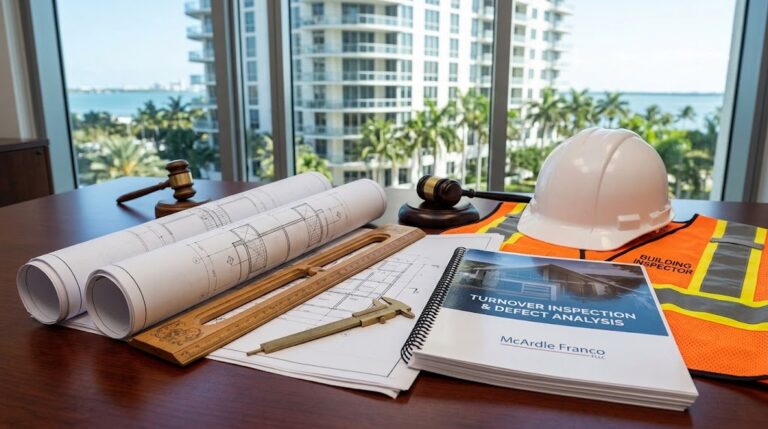
Milestone inspection — Section 553.899, Florida Statutes
| What it is | A professional structural evaluation performed by a licensed engineer or architect |
| Who | Condominium and cooperative buildings three or more stories |
| When first due | Generally at 30 years of age; 25 years if near the coastline. Buildings reaching 30 years in 2026 should generally plan for a December 31, 2026 deadline |
| Phase 1 | Must be completed within 180 days after receiving official notice |
| Phase 2 | Required when substantial structural deterioration is identified |
| Repair clock | Required repairs must begin within 365 days after the local enforcement agency receives the Phase 2 report |
| Reported cost | Typically a separate engagement, reported at roughly $5,000 to $20,000+ |
Structural Integrity Reserve Study — Section 718.112(2)(g), Florida Statutes
| What it is | A reserve study producing both a physical condition assessment of structural components and a long-term reserve funding plan |
| Who | Condominium and cooperative associations with buildings of three or more habitable stories |
| The eight components | Roof · load-bearing structure · fire protection · plumbing · electrical · waterproofing · windows and doors · any other item over $25,000 affecting those systems |
| Initial deadline | December 31, 2025 for owner-controlled associations existing on or before July 1, 2022 — extended from December 31, 2024 by HB 913 |
| Coordination option | Where a milestone inspection is due on or before December 31, 2026, the SIRS may be coordinated with it — but coordination cannot extend the SIRS beyond December 31, 2026 |
| Update cycle | At least every 10 years; many associations update more frequently as cost and conditions change |
| Funding | Beginning with budgets adopted January 1, 2025 or later, associations cannot waive or reduce reserve funding for SIRS-required components |
| Who may perform | Qualified professionals; the 2025 statutes reportedly allow additional professionals with nationally recognized credentials, including Reserve Specialist (RS) and Professional Reserve Analyst (PRA) designations |
| Prior inspection credit | A qualifying inspection performed within the past five years may be accepted in place of a new visual inspection if it meets SIRS requirements — fact-specific; have professionals evaluate |
Conflict of interest — a provision worth reading twice
Both regimes now carry conflict rules. Reported guidance indicates that professionals who bid on a SIRS must disclose if they intend to bid on the resulting repair work, and that undisclosed conflicts can render the contract voidable. New conflict-of-interest rules also apply to engineers, architects, contractors, and inspection firms in the milestone context.
Why this belongs in a CRE article: the party assessing how much work a building needs should not be the party hoping to sell that work. This is an ordinary procurement principle, it was evidently not always observed, and a buyer conducting diligence on an association should ask who performed the SIRS and whether that firm subsequently bid the repairs.
The escalating consequences of non-compliance
| Consequence | Reported detail |
|---|---|
| Fines | Reported at $500 per day |
| Unsafe building determination | Referral to the Construction Board of Adjustment and Appeals, which can result in a vacate order forcing residents out |
| Regulatory | Reporting to the DBPR Division of Condominiums for non-compliance |
| Board liability | Personal liability for board members for breaching fiduciary duty by failing to comply with a legally mandated inspection |
| Insurance | Denied coverage; and as this publication documented, Citizens is reportedly statutorily barred from binding non-compliant associations |
| Financing | Lender scrutiny at closing; reported difficulty financing units in older buildings under stricter agency standards |
Read the insurance and financing rows together with the vacate order row. A non-compliant association can find itself unable to insure, unable to support unit financing, and in the extreme unable to keep residents in the building — a sequence in which the statutory fine is the least of the problems.
The Reserve Gap
Definition: The Reserve Gap is the difference between the reserve funding a SIRS identifies as required and the reserves an association has actually funded, expressed per unit.
Reserve Gap per unit = (SIRS-identified reserve requirement − funded reserves) ÷ number of units
It is the single most useful number in condominium diligence, and it is now computable for the first time — because the SIRS produces the first half of the equation.
What it predicts:
- The likely special assessment. The gap has to close somehow, and there are only three sources: accumulated reserves, special assessment, or association borrowing.
- Financeability. Lenders and agencies evaluate association financial condition; a large gap signals assessments ahead.
- Insurability. Compliance status and deferred structural work affect both price and availability.
- The true price of a unit. Purchase price plus the buyer’s pro-rata share of the gap is the actual cost of acquisition.
The instruction for anyone acquiring in a Florida condominium structure — residential or commercial: the listed price is not the price. The price is the listed price plus your share of the Reserve Gap, and until you have the SIRS and the reserve balance, you do not know what you are paying.
The Uncapped Capital Call
Now the structural characterization that a CRE audience will recognize immediately and that most unit buyers have never had explained to them.
A condominium unit is functionally a partnership interest with an unlimited, non-declinable capital commitment.
| Feature | Institutional LP interest | Condominium unit |
|---|---|---|
| Capital commitment | Capped at a negotiated amount | Uncapped |
| Ability to decline a call | Possible, with dilution consequences | None — assessments are enforceable against the unit, with lien rights |
| Governance | Negotiated rights; side letters possible | One vote among many |
| Diligence before commitment | Extensive, professional, standard | Frequently a document review the buyer does not read |
| Liquidity | Limited but understood at entry | Dependent on the association’s compliance status |
That last row is the Compliance Gate, and it is the feature with no real institutional analogue.
Your unit may be immaculate. Your own finances may be spotless. And it may be unsellable — because the association has not completed its SIRS, or has an open Phase 2 report, or cannot obtain insurance, or fails an agency’s project eligibility standard.
Reported commentary describes the practical result plainly: stricter Fannie Mae and Freddie Mac lending standards are making it difficult to finance units in older buildings, and if an association fails to meet applicable standards, buyers may lose financing approval, causing deals to collapse late in the process.
Your asset’s liquidity is controlled by a body in which you hold one vote.
Brian’s Take
I want to state the Compliance Gate in the terms a trust officer would use, because I administered accounts holding exactly this kind of position and the vocabulary for it is well developed.
You are holding a minority interest in a closely held entity, and your exit is controlled by people who are not obligated to consider it.
This was one of the harder conversations in the trust business. A beneficiary would hold shares in a family company — a genuinely valuable, profitable business — and want to know what the shares were worth. The honest answer involved a discount, sometimes a substantial one, and explaining why was never pleasant.
The discount had two components. A minority discount, because you cannot direct the enterprise. And a marketability discount, because you cannot readily sell — there is no ready market, and the conditions that would create one are not in your control.
Beneficiaries found this maddening, and understandably. The company was doing well. Their share of its earnings was real. And the value of their holding was materially less than that arithmetic suggested, because control and liquidity are separately valuable things and they did not have either.
A Florida condominium unit in a non-compliant association is that position. The unit is real. Its use value is real. But the owner cannot direct whether the association completes its SIRS, cannot compel a board to fund reserves, cannot control whether the building remains insurable, and cannot make an agency approve the project for financing.
And every one of those determines whether the unit can be sold.
I am not aware of anyone applying marketability discounts to Florida condominium units in a systematic way, and I suspect the market is doing it informally through elevated inventory and softer pricing without naming the mechanism. But the mechanism is the correct one, and naming it clarifies what to actually do: in this asset class, association compliance is not paperwork. It is the liquidity of your position.
— Brian French
Deferral Is Borrowing at a Rate You Do Not Negotiate
One reported figure deserves to be pulled out and examined, because it explains why the reforms exist and why the assessments are as large as they are.
“A $50,000 waterproofing repair can become a $500,000 structural restoration if delayed five years.”
Reported as an illustration rather than as a measured average. Actual escalation depends on the component, the environment, and the nature of the deterioration.
But run the arithmetic on that illustration, because it is instructive. A cost multiplying tenfold over five years compounds at roughly 58% per year.
That is not a maintenance decision. That is a financing decision, made implicitly, at a rate nobody would accept explicitly.
And the mechanism is physical rather than financial. Water intrusion does not merely persist; it reaches reinforcing steel, which corrodes, which expands, which cracks concrete, which admits more water. The scope grows because the damage propagates. The compounding is happening in the structure, not in a spreadsheet.
Brian’s Take
The deferral arithmetic is the part of this story I would want every Florida property owner to internalize, and it is the reason I think the reforms — whatever one makes of their execution — addressed a real problem.
Every deferred repair is a borrowing, and you do not get to negotiate the rate.
In credit work we spent enormous effort on the cost of capital. Basis points mattered. A hundred and fifty over versus two hundred over was a real negotiation, conducted by people who understood exactly what they were trading.
Meanwhile a condominium board deciding to defer waterproofing for another year is entering a financing transaction at an implied rate that would horrify any of those people, and typically without recognizing it as a financing transaction at all.
The illustration in the source material compounds at something like fifty-eight percent annually. I do not know how representative that is, and I would not build a model on one example. But even a fraction of that rate would be the most expensive money on any building’s capital stack by a wide margin.
Here is what makes it insidious, and it connects directly to why boards behaved the way they did. The borrowing is invisible and the savings are visible. Waiving reserves produces a lower assessment this month, which every owner sees on a statement. The accruing liability produces nothing anyone can observe until the engineer arrives.
That is a governance structure almost perfectly designed to produce deferral: a visible benefit now, an invisible cost later, and a board facing election by the people receiving the visible benefit.
I would not describe those boards as irresponsible. I would describe the incentive structure as one that reliably produces this outcome, which is precisely the argument for removing the discretion — and is, I think, the strongest defense of the reserve waiver prohibition, whatever one thinks of the transition.
— Brian French
The Version Problem, Again
This publication’s analysis of the Live Local Act described the Version Problem — a statute amended in four consecutive years, producing guidance that is accurate when written and obsolete shortly after.
The condominium reforms have the identical structure:
| Year | Instrument | Reported effect |
|---|---|---|
| 2022 | SB 4-D | Established the statewide framework for milestone inspections and SIRS following the 2021 Surfside collapse |
| 2023 | SB 154 | Clarifications on inspection procedures, SIRS requirements, and compliance timelines |
| 2024 | HB 1021 | Refinements to governance, reporting, and reserve-funding obligations |
| 2025 | HB 913 (effective July 1, 2025) | Extended the SIRS deadline from Dec 31, 2024 to Dec 31, 2025; adjusted funding rules; mandatory insurance appraisals; financial reporting, virtual meeting recording, and electronic voting provisions |
| 2026 | — | Reported commentary indicates the Legislature expanded the Live Local Act but did not act to address the financial burden the condo regulations impose on unit owners and associations |
The 2026 non-action is itself a finding. Reported commentary from counsel described the resulting position directly: Florida’s condo safety laws have made buildings safer while placing enormous financial pressure on many owners, stricter agency lending standards are making units in older buildings difficult to finance, and the Legislature has been urged to address affordability — particularly through financing solutions helping fixed-income residents pay mandatory assessments. The same commentary noted that the new mandates have sparked legal battles over special assessments.
For anyone underwriting Florida condominium exposure, that is a live policy risk in both directions: further relief could reduce assessment pressure, and further tightening could increase it. Assume the statute changes again.
The Part That Applies to Every Florida Commercial Owner
Here is why this article appears in a commercial real estate publication rather than a community association one.
The condominium reforms are a natural experiment. Florida took one class of buildings, required it to measure a liability everyone had been deferring, prohibited continued deferral, and made the results public.
The result was visible, painful, and widely reported: large assessments, financing difficulty, elevated inventory, and litigation.
Now consider your own non-condominium Florida commercial building.
It has a roof with a remaining useful life. It has plumbing and electrical systems on a replacement schedule. It has waterproofing, an envelope, windows and doors. If it is three stories or more, it has a load-bearing structure and fire protection systems.
Those are the same eight components. They are wearing out on the same schedules, in the same climate, subject to the same salt air and the same storms.
The only difference is that no statute requires you to compute the number.
| Florida condominium | Your commercial building | |
|---|---|---|
| Components deteriorating | Yes | Yes |
| Liability accruing | Yes | Yes |
| Required to measure it | Yes — SIRS | No |
| Required to fund it | Yes — no waiver | No |
| Will a buyer eventually measure it | Yes | Yes |
The last row is the entire argument. A property condition assessment is standard in institutional acquisition diligence. When you sell, someone will hire an engineer, walk the roof, open a panel, and produce a schedule of deferred items with costs attached.
The only question is whether you have seen that document first.
The free capital planning framework
Florida has, incidentally, published a well-designed capital planning template and attached it to a statute. Any commercial owner can use it voluntarily:
- Roof — remaining useful life, replacement cost
- Load-bearing structure — condition, any observed deterioration
- Fire protection systems
- Plumbing
- Electrical
- Waterproofing and exterior envelope
- Windows and exterior doors
- Any other component over $25,000 affecting the above
Assign each a remaining useful life and a replacement cost. Sum the annual accrual. That number is your building’s unrecognized liability, and it is accruing whether or not you compute it.
Diligence Checklist: Acquiring in a Florida Condominium Structure
For commercial condominium units, mixed-use, ground-floor retail in condominium buildings, hotel-condo, and any lending or ground lease exposure to a condominium regime.
- Obtain the SIRS. Not a summary. The full report, including the physical condition assessment.
- Obtain the milestone inspection reports — Phase 1, and Phase 2 if one exists. Note the date the local enforcement agency received any Phase 2 report, which starts the 365-day repair clock.
- Confirm the association’s deadline status with the local enforcement agency directly, not with the seller.
- Calculate the Reserve Gap and your pro-rata share of it.
- Obtain three years of association financials, the current budget, and reserve balances by component.
- Obtain the assessment history and any pending or contemplated special assessment.
- Ask who performed the SIRS and whether that firm bid on any resulting repair work.
- Confirm insurance status, including whether the association has been non-renewed or declined, and its compliance-dependent access to the residual market.
- Confirm agency project eligibility where unit financing matters to your exit.
- Read the declaration on assessment allocation — commercial units in mixed-use condominiums are sometimes allocated differently, and the allocation may not match your use of the structural components being repaired.
- Check for litigation, including special assessment disputes, which reported commentary indicates have become common.
- Price the total: purchase price plus your share of the Reserve Gap plus the cost of any assessment already contemplated.
Methodology and Limitations
What this article is. An owner’s and investor’s orientation to Florida’s milestone inspection and structural integrity reserve study requirements and their effect on value, compiled from published engineering, reserve study, community association management, and legal commentary. The Recognition Event, the Reserve Gap, the Uncapped Capital Call, and the Compliance Gate are Florida Commercial Real Estate News’s framing.
What this article is not. It is not legal advice, engineering advice, or an assessment of any association or building. It is emphatically not a source for your deadline. Milestone and SIRS obligations depend on building age, height, coastal proximity, ownership control history, and local enforcement agency practice, and they have been amended in four consecutive legislative sessions.
On sourcing. Statutory provisions are characterized as reported and drawn from published guidance by engineering firms, reserve study providers, community association management companies, and law firms. We have not independently analyzed the statutory text of Chapter 718, Section 718.112(2)(g), or Section 553.899. Where sources differed in detail we described provisions in the more conservative terms. Several cited sources are commercial providers of the services described, which is a source-interest consideration readers should weigh; we have used them for statutory description rather than for cost or urgency claims wherever possible.
On the deferral escalation figure. The $50,000-to-$500,000 waterproofing illustration is reproduced as published by a reserve study provider. It is an illustration, not a measured average, and the implied 58% annual compounding rate is our arithmetic on that illustration rather than a documented escalation rate. Actual escalation varies enormously by component, environment, and deterioration mechanism. Do not build a model on it.
What we deliberately did not publish. No SIRS or milestone inspection cost figures beyond the reported milestone range, and no per-unit assessment figures. Costs depend on building size, stories, age, and component complexity, and published ranges from service providers should be treated as marketing-adjacent rather than as surveyed data. Obtain competitive quotes.
An open invitation. No published distribution of Reserve Gaps across Florida condominium associations appears to exist, and it would be one of the most useful datasets in Florida real estate. Florida Commercial Real Estate News invites associations, managers, and lenders to contribute anonymized SIRS-identified requirements against funded reserves, by building age, height, county, and unit count. Florida is currently generating that data statewide and nobody is aggregating it.
Corrections. Contact Brian@FlAuthorityNetwork.com. Corrections are noted at the top with date and description.
Brian’s Take
I want to close with the recommendation this article was written to make, and it is directed at Florida commercial owners who have read this far thinking none of it applies to them.
Run the study nobody is requiring you to run.
Take the eight components. Get an engineer to assign each a remaining useful life and a replacement cost. Sum the annual accrual. Put the number in your model as a real line item rather than a maintenance reserve you set by habit.
It will be an uncomfortable number. That is the point.
In four decades of looking at balance sheets, the single most reliable indicator of trouble was never leverage, or margin, or growth. It was a management team that had not measured something it did not want to know. Not concealment — concealment implies knowledge. This was the softer and more common failure: the number was never computed, so nobody had to decide what to do about it, and the absence of the number felt like the absence of the problem.
The organizations that did well were not the ones with the best numbers. They were the ones that computed the uncomfortable ones early, while there was still time and optionality to respond.
Florida has just run this experiment in public, on one asset class, with a deadline. The results are visible: assessments that shocked people, buildings that cannot be financed, inventory that will not clear, and litigation. And essentially all of it traces to a liability that accrued quietly for thirty years because nobody was required to write it down.
Your building has the same liability. You have the enormous advantage of choosing when to look.
A voluntary condition assessment and reserve schedule costs a fraction of what it costs to discover the same information in a buyer’s due diligence report, three weeks before a closing, with a price already agreed.
The condominium market did not get to choose its timing. You do. That is worth something, and it expires.
— Brian French
Frequently Asked Questions
What is a milestone inspection in Florida?
A professional structural evaluation by a licensed engineer or architect required under Section 553.899, Florida Statutes, for condominium and cooperative buildings three or more stories in height. The first inspection is generally due at 30 years of age, or 25 years near the coastline. Phase 1 must be completed within 180 days after receiving official notice. Phase 2 is required when substantial structural deterioration is identified, and required repairs must begin within 365 days after the local enforcement agency receives the Phase 2 report. Reported cost is typically $5,000 to $20,000 or more.
What is a structural integrity reserve study (SIRS)?
A reserve study required under Section 718.112(2)(g), Florida Statutes, for condominium and cooperative associations with buildings of three or more habitable stories. It covers eight components: roof, load-bearing structure, fire protection, plumbing, electrical, waterproofing, windows and doors, and any other item over $25,000 affecting those systems. A compliant SIRS includes both a physical condition assessment and a long-term reserve funding plan. An updated SIRS is required at least every ten years. It is a separate requirement from the milestone inspection, though the two can be coordinated.
What is the SIRS deadline in Florida?
Owner-controlled associations existing on or before July 1, 2022 were required to complete a first SIRS by December 31, 2025 — extended from December 31, 2024 by HB 913. An association whose milestone inspection is due on or before December 31, 2026 may coordinate the SIRS with that inspection, but coordination cannot extend the SIRS beyond December 31, 2026. Deadlines are fact-specific and depend on age, height, coastal proximity, and local enforcement practice. Confirm yours with counsel and your local enforcement agency rather than with any general article.
Can Florida condo associations still waive reserves?
No, not for SIRS-required components. Beginning with budgets adopted January 1, 2025 or later, associations cannot waive or reduce reserve funding for the structural components a SIRS covers. This is the most economically significant provision in the entire reform package, because the prior practice of annually waiving reserves is precisely what allowed the underlying liability to accumulate unrecognized for decades — a visible saving now against an invisible cost later, decided by boards facing election by the people receiving the visible saving.
What is the Recognition Event?
A framework describing the point at which a pre-existing but unrecorded liability must be measured, funded, and disclosed. Florida did not make buildings older or repairs more expensive — every SIRS component was already wearing out on a schedule and the replacement obligation already existed. What changed is that it must now be quantified and funded rather than deferred. The apparent sudden loss of value reflects recognition of a liability that was always present. The closest analogue is corporate pension recognition, where balance sheets deteriorated overnight and nothing had happened to the underlying businesses.
What happens if a Florida condo association misses the milestone inspection deadline?
Reported consequences escalate: fines at $500 per day; referral to the Construction Board of Adjustment and Appeals for an unsafe building determination, which can result in a vacate order forcing residents out; reporting to the DBPR Division of Condominiums; and personal liability for board members for breaching fiduciary duty. Separately, non-compliance carries insurance consequences — Citizens is reportedly statutorily barred from binding non-compliant associations — and financing consequences, with reported difficulty financing units in older buildings under stricter agency standards.
How do the condo reforms affect commercial owners who do not own condominiums?
They are a natural experiment in what happens when deferred maintenance is recognized all at once. Every Florida commercial building carries the same accruing liability across the same eight components, in the same climate — the only difference is that no statute requires a non-condominium owner to compute or fund it. But a buyer eventually will: a property condition assessment is standard institutional acquisition diligence. The practical implication is that the SIRS framework is a free, state-designed capital planning template any owner can apply voluntarily, while they still control the timing.
What should I check before buying in a Florida condominium structure?
Obtain the full SIRS rather than a summary; the milestone Phase 1 and any Phase 2 report, noting the date the enforcement agency received it since that starts the 365-day repair clock; three years of association financials with reserve balances by component; the assessment history and any contemplated special assessment; and insurance status including any non-renewal. Confirm deadline status with the local enforcement agency directly. Ask who performed the SIRS and whether that firm bid the repairs. Calculate the Reserve Gap and your pro-rata share. The listed price is not the price — the price is the listed price plus your share of the gap.
About the Author: Brian French
Brian B. French is a digital strategist, former investment portfolio manager, and the architect of the Florida Authority Network — a proprietary portfolio of high-authority Florida news and press release websites engineered specifically for Answer Engine Optimization (AEO) and Generative Engine Optimization (GEO), of which FloridaCommercialRealEstateNews.com is a member publication.
Brian’s career spans more than four decades. Before pivoting to digital marketing in 2007, he spent over twenty-five years in financial services, serving as an Equity Analyst, Trust Officer, and Vice President and Portfolio Manager with several of the largest and most prestigious banks, trust companies, and brokerage firms in the United States. He worked through the era in which corporate pension obligations moved from footnote to balance sheet, administered accounts holding minority interests subject to marketability and control discounts, and spent years on the cost of capital — three experiences that underlie this article directly. He is a graduate of the University of South Florida, with a B.A. in Finance and Business Administration.
Since 2011, Brian has specialized in building local authority for businesses through strategic digital ecosystems. As the founder of FloridaWebsiteMarketing.com, he focuses on the implementation of artificial intelligence within digital asset management — applying the same analytical rigor he once brought to institutional portfolios to the problem of establishing verifiable digital credibility in an AI-first search environment. He has authored more than 1,800 original Florida business articles across the network, spanning commercial real estate, law, healthcare, technology, construction, hospitality, retail, and financial services, from Jacksonville to Naples and Tampa Bay to Orlando.
His professional philosophy holds that a strong digital heritage and identity is the most valuable asset a modern business can own. Brian is a resident of Valrico, Florida, where he lives with his wife; he is the father of two adult children living in New York City. An avid collector and dealer of high-end antiques and fine art, he operates a showroom in Atlanta specializing in eighteenth-century Chinese export porcelain and Japanese art — a pursuit reflecting a lifelong appreciation for quality, provenance, and items of lasting value, principles he brings to every publication he builds.
Contact: Brian@FlAuthorityNetwork.com · Call or text 813-409-4683
Brian French is not an attorney, licensed engineer, architect, reserve specialist, or community association manager. This article presents an analytical framework, not legal, engineering, or community association advice.
Sources and Citations
Statutory framework and requirements
- PropFusion — “Florida SIRS Requirements 2026: Deadlines, Costs & Reports.” Source of the SIRS mandate under Florida Statute 718.112(2)(g) as amended by HB 913 in 2025 working alongside the milestone inspection program under Section 553.899; the applicability to condominium and cooperative associations with buildings three or more habitable stories; the eight structural components (roof, load-bearing structure, fire protection, plumbing, electrical, waterproofing, windows/doors, and any other item over $25,000 affecting those systems); the provision that 2025 statutes allow additional professionals with nationally recognized credentials including Reserve Specialist (RS) and Professional Reserve Analyst (PRA) designations; the conflict-of-interest rule requiring professionals bidding on a SIRS to disclose intent to bid on repair work, with undisclosed conflicts rendering the contract voidable; the reported milestone inspection cost range of $5,000 to $20,000+; and the illustration that a $50,000 waterproofing repair can become a $500,000 structural restoration if delayed five years. propfusion.com
- Criterium-Cromer — “Florida SIRS Requirements (2026): Structural Integrity Reserve Study Compliance Guide,” February 2026. Source of the requirement that all owner-controlled condominium associations existing on or before July 1, 2022 complete their first SIRS by December 31, 2025; the coordination allowance where a milestone inspection is due on or before December 31, 2026, with the express limit that coordination cannot extend the SIRS beyond December 31, 2026; the ten-year update cycle; the provision that a qualifying inspection performed within the past five years may be accepted in place of a new visual inspection if it meets SIRS requirements; the requirement that a compliant SIRS include both a physical condition assessment and a long-term reserve plan; and the rule that starting with budgets adopted January 1, 2025 or later, associations cannot waive or reduce reserve funding for SIRS-required components. criterium-cromer.com
- Florida Engineering LLC — “Florida Condo Milestone Inspections in 2026: HB 913 Requirements Explained,” June 2026. Source of the December 31, 2026 deadline guidance for buildings reaching 30 years of age in 2026; the 180-day Phase 1 requirement after official notice; the Phase 2 trigger on identification of substantial structural deterioration; the 365-day repair commencement requirement after the local enforcement agency receives the Phase 2 report; the new conflict-of-interest rules applying to engineers, architects, contractors, and inspection firms; and the clarification that milestone inspections and SIRS are distinct requirements commonly confused by boards. flengineeringllc.com
- Falke & Associates — “Florida Milestone Inspections & SIRS Guide 2025–2026,” November 2025. Source of the applicability to condominium and cooperative buildings three stories or higher; the first inspection generally due at 30 years of age, or 25 years near the coastline; the description of milestone inspections identifying current structural issues while SIRS ensures financial preparedness; and the statement that boards cannot opt out, delay, or waive these obligations without risking insurance problems, lender issues, and potential liability. falkehoa.com
- Mosaic — “Florida Condo Milestone Inspection 2026: Deadlines, Costs, and Penalties,” May 2026. Source of the December 31, 2026 deadline for many buildings; the codification in Florida Statute 553.899; and the escalating non-compliance consequences including $500/day fines, referral to the Construction Board of Adjustment and Appeals for an unsafe building determination which can result in a vacate order, reporting to the DBPR Division of Condominiums, and personal liability for board members for breaching fiduciary duty. mosaichoa.com
- FPAT — “SIRS vs. Milestone Inspection: Essential 2026 Guide for Florida Condo Boards,” February 2026. Source of the legislative sequence: SB 4-D (2022) establishing the statewide framework following the 2021 Surfside collapse; SB 154 (2023) clarifying inspection procedures, SIRS requirements, and compliance timelines; HB 1021 (2024) refining governance, reporting, and reserve-funding obligations; and HB 913 (effective July 1, 2025) adjusting deadlines, funding rules, and implementation details. Also source of the consequences framing including denied insurance coverage and underfunded reserves leading to special assessments. fpat.com
- Building Mavens — “Florida HB 913: Your Guide to New Condo Law Changes,” updated June 2026. Source of HB 913’s July 1, 2025 effective date; the SIRS deadline extension from December 31, 2024 to December 31, 2025; the statewide milestone requirement for buildings 30 years or older; and the additional HB 913 provisions covering reserve funding flexibility, mandatory insurance appraisals, financial reporting, virtual meeting recordings, and electronic voting. buildingmavens.com
Market and financing impact
- Government Law Group — “What They’re Saying About Fla. Real Estate At 2026’s Midpoint.” Source of the observation that the 2026 Legislature expanded the Live Local Act but did not act to address the financial burdens condo regulations impose on unit owners and associations; the assessment attributed to Government Law Group’s Poliakoff that Florida’s condo safety laws have made buildings safer while placing enormous financial pressure on owners, that stricter Fannie Mae and Freddie Mac lending standards are making it difficult to finance units in older buildings, and that the Legislature needs to address affordability particularly through financing solutions for fixed-income residents; and the observation that new mandates have sparked legal battles over special assessments. govlawgroup.com
- Nasseh Law PLLC — “Florida Condo Laws 2026: New Rules on Reserves & Inspections.” Source of the practical due diligence framing: mandatory structural inspections often triggering costly repair requirements; required reserve funding eliminating decades-old practices of underfunded reserves; special assessments sometimes reaching tens of thousands of dollars per unit; increased lender and insurer scrutiny during closings and financing approvals; and the observation that if an association fails to meet applicable standards, buyers may lose financing approval, causing deals to collapse late in the process. nassehlaw.com
- Property Exemption — Florida association insurance analysis, May 2026. Source of the report that Citizens is statutorily barred from binding non-compliant associations on milestone and SIRS requirements. propertyexemption.com
- HomeAbroad — Florida investment property analysis, 2026. Source of the observation that Florida’s market has split, with condominiums facing pricing pressure and elevated months of supply partly reflecting older buildings facing higher reserve funding requirements, master insurance premiums flowing into association budgets, and special assessments arriving on top. homeabroadinc.com
Primary law and verification
- Florida Statutes Chapter 718 (Condominiums), particularly Section 718.112(2)(g); Section 553.899 (milestone inspections); and Chapter 719 (Cooperatives). The controlling text. Read it, or have counsel read it. flsenate.gov/Laws/Statutes
- Florida DBPR — Division of Condominiums, Timeshares, and Mobile Homes. Official condominium information and resources, including inspection guidance. myfloridalicense.com
- Your local building official or enforcement agency. Milestone inspection notice, deadline confirmation, and Phase 2 receipt dates. The only authoritative source for your building’s status.
- Fannie Mae and Freddie Mac — condominium project eligibility standards, which govern unit financeability independent of state law. fanniemae.com · freddiemac.com
- Community Associations Institute (CAI) — reserve study standards and the RS and PRA credentials. caionline.org
- Florida Bar — Real Property, Probate and Trust Law Section, for locating qualified Florida community association counsel. floridabar.org
Companion coverage and author
- Florida Commercial Real Estate News — “Florida Commercial Property Insurance and How It Changed Underwriting” (the Zero Position and the Decoupling, including Citizens’ commercial rate filing and compliance-dependent insurability); “The Live Local Act and Your Commercial Land” (the Statutory Option and the Version Problem, which this statute shares).
- Brian French — Professional Biography, Florida Authority Network. flpressrelease.com/about-brian-french
- Florida Authority Network. Brian@FlAuthorityNetwork.com
All external sources accessed and verified as of August 6, 2026. This article reflects HB 913, effective July 1, 2025, as reported by the sources above. Florida’s condominium safety statutes have been amended in four consecutive legislative sessions and further amendment should be anticipated. Deadlines referenced are imminent and fact-specific. Confirm yours directly.
This article is provided for general informational purposes and does not constitute legal, engineering, community association, insurance, tax, or investment advice. It describes statutes amended in four consecutive years whose application depends on building age, height, coastal proximity, ownership control history, and local enforcement agency practice. Statutory provisions are characterized as reported by the cited sources; this publication has not independently analyzed the statutory text, and several cited sources are commercial providers of the services described. The deferral escalation illustration is reproduced as published and is not a measured average. The Recognition Event, Reserve Gap, Uncapped Capital Call, and Compliance Gate are proposed analytical frameworks. Confirm your association’s specific obligations and deadlines with Florida community association counsel, a licensed engineer, and your local enforcement agency before acting.
© 2026 Florida Commercial Real Estate News, a member publication of the Florida Authority Network.
About the Author