Florida SB 264 and the Counterparty Turn: Foreign Ownership Restrictions as a Commercial Diligence Problem
A 2026 analysis from Florida Commercial Real Estate News introducing the Counterparty Turn — because for four hundred years real estate diligence asked questions about the property. This statute asks questions about the person across the table, and puts the answer on your closing package.
By Brian French | Florida Commercial Real Estate News | Florida Authority Network
Published: August 8, 2026
Read this before reading anything else.
1. This is not legal advice, and this subject requires counsel. SB 264 carries reported criminal, monetary, and asset forfeiture exposure. No article can tell you whether a transaction complies. Engage Florida real estate counsel.
2. The law is subject to ongoing federal litigation and its status may have changed. Constitutional challenges have been pending in federal court, including before the U.S. Court of Appeals for the Eleventh Circuit. Verify the current status before relying on any characterization here.
3. This publication takes no position on the policy. The constitutional questions raised in the litigation are for courts. We describe the law as enacted, its reported operation, and the transaction risk it creates — because Florida commercial parties must transact under it while those questions are resolved.
Answer in Brief
Commercial real estate diligence has always pointed at the asset: title, survey, environmental, zoning, condition. SB 264 pointed a question at the counterparty instead — and made the seller’s exposure turn on the buyer’s answer. Reported guidance indicates it is a crime to knowingly sell property in violation of the law, with monetary, criminal, and asset forfeiture penalties available. Which means a Florida seller now has an interest in knowing who is behind the LLC on the other side of the table — and in fund and joint venture structures, that is a Look-Through question conventional closing practice has never asked.
Key Takeaways
- SB 264 was signed May 8, 2023, effective July 1, 2023, codified at Chapter 692, Part III, Fla. Stat. (§§ 692.201–692.205).
- Seven designated countries of concern: China, Russia, Iran, North Korea, Cuba, the Venezuelan regime of Nicolás Maduro, and Syria.
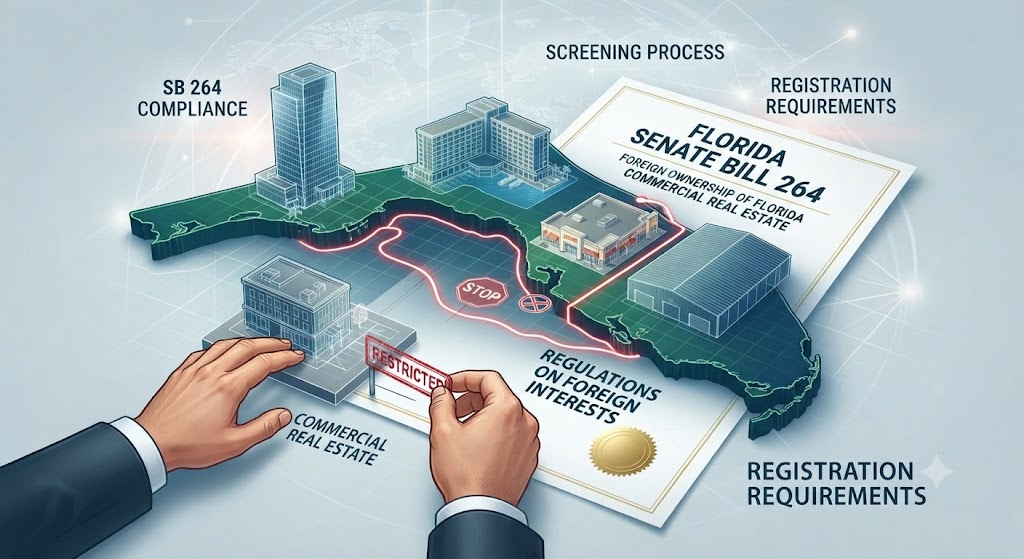
- Three components: agricultural land restrictions; a 10-mile proximity restriction around military installations and critical infrastructure; and additional China-specific restrictions under § 692.204.
- Controlling interest is presumed at 25% of voting interests or profits, directly or indirectly — the practical trigger for entity diligence.
- The seller-side crime is the CRE story. Knowingly selling in violation is reportedly criminal, with forfeiture available.
- A buyer affidavit is now part of the closing package, with FREC rules containing form affidavits — the FIRPTA certification is the closest analogue.
- The passive investor carve-out is the provision institutional CRE should know: Commerce rules reportedly extend the de minimis exception to passive interests without power to direct management or policies as to the real property.
- Litigation is live. Shen v. Simpson raised Equal Protection, Due Process, Supremacy Clause, and Fair Housing Act claims. Verify current status.
What the Statute Does
Reported guidance from Florida counsel and title underwriters describes three primary prohibitions, plus procedural obligations that reach every Florida purchaser.
The designated jurisdictions
Seven are identified: the People’s Republic of China, the Russian Federation, the Islamic Republic of Iran, the Democratic People’s Republic of Korea, the Republic of Cuba, the Venezuelan regime of Nicolás Maduro, and the Syrian Arab Republic.
Who is a “foreign principal”
| Category (as reported) |
|---|
| A person domiciled in a foreign country of concern who is not a U.S. citizen or lawful permanent resident |
| A company organized under the laws of a foreign country of concern, or having its principal place of business in one |
| The government or any official of the government of a foreign country of concern |
| Entities in which such persons hold a controlling interest — which is what makes beneficial ownership analysis necessary |
Note the emphasis on domicile rather than nationality in the individual category as reported, and the citizen and lawful permanent resident carve-out. These distinctions are legally significant and are exactly the kind of detail a general article should not be relied upon for. Confirm the statutory text with counsel.
The three prohibitions
| # | Restriction (as reported) | Applies to |
|---|---|---|
| 1 | Agricultural land — foreign principals prohibited from acquiring, subject to limited exceptions | All seven jurisdictions |
| 2 | The 10-mile rule — prohibited from owning or acquiring any interest in real property within 10 miles of any military installation or critical infrastructure in the state | All seven jurisdictions |
| 3 | § 692.204 — additional restrictions relating to ownership of any real property in Florida | China-specific |
The 25% controlling interest presumption
Reported guidance describes a controlling interest as possession of the power to direct or cause the direction of the management or policies of a company — whether through ownership of securities, by contract, or otherwise. And critically:
A person or entity that directly or indirectly has the right to vote 25% or more of the voting interests of a company, or is entitled to 25% or more of its profits, is presumed to possess a controlling interest.
Three words in that sentence do the work. “Indirectly” means you cannot stop at the first layer. “Presumed” means the burden runs against the holder. And “25%” is a threshold low enough to catch meaningful positions in joint ventures and concentrated funds, while high enough that broadly syndicated structures may clear it — which is precisely why the analysis has to be performed rather than assumed.
The affidavit and registration obligations
- Buyer affidavit. Reported guidance describes an affidavit attesting compliance with SB 264 as required from anyone purchasing property in the state. The Florida Real Estate Commission proposed rules containing form buyer’s affidavits; Florida Land Title Association forms served as precursors.
- Registration. Reported guidance describes a requirement for foreign nationals to register existing property within 10 miles of a military installation or critical infrastructure with the state.
The penalties — and the provision that changes CRE practice
| Exposure (as reported) |
|---|
| Criminal penalties for violation |
| It is also a crime for a person to “knowingly sell” property in violation of the law |
| Monetary, criminal, and asset forfeiture penalties available |
The middle row is why this article exists.
Every other restriction on who may buy property is, from the seller’s perspective, someone else’s problem. This one is not. A Florida seller — and by extension brokers, title agents, and counsel involved in the closing — has acquired a direct interest in the buyer’s status.
That is a structural change in what a real estate transaction requires, and it is the subject of the rest of this article.
Brian’s Take
I lived through the exact transformation that Florida real estate is now beginning, in a different industry, and watching it arrive here has been strange.
Financial services learned to ask who the customer is.
When I started, opening an account was a service transaction. Someone wanted to invest; you took their money and invested it. The diligence ran to suitability — was this product appropriate for this client — not to identity. Nobody traced ownership. Nobody asked who ultimately controlled a corporate account. It would have seemed both intrusive and beside the point.
Then, over roughly two decades, that changed completely. Know Your Customer. Beneficial ownership identification. Enhanced due diligence for certain categories. Screening. Documentation. And crucially — personal and institutional liability for getting it wrong.
I want to be honest that the industry resented it at first, and I was not immune. It was expensive, it slowed transactions, it required capabilities nobody had built, and it made compliance officers into people who could stop a deal. There was a widespread feeling that we were being deputized to do the government’s work.
What I did not appreciate at the time, and do now, is that the transition was permanent and the firms that adapted early had an advantage for years. They could transact with counterparties others had to decline, because they had the capability to answer the question. Diligence infrastructure turned from pure cost into a competitive asset.
Florida real estate is at the beginning of that curve. SB 264 asks a question about the counterparty and attaches consequences for the seller who does not ask it well. Whatever the courts ultimately conclude about this particular statute — and that is genuinely unresolved — at least twenty-nine states have enacted some restriction on foreign ownership, and a federal agricultural reporting regime has existed since 1978.
The direction of travel seems clear enough. I would build the capability rather than wait to be forced.
— Brian French
The Counterparty Turn
Definition: The Counterparty Turn is the structural shift in real estate diligence from questions directed at the asset to questions directed at the identity and beneficial ownership of the transacting party — with consequences that can attach to the asset.
Consider what commercial real estate diligence has traditionally examined:
| Traditional diligence | Question it answers |
|---|---|
| Title search and commitment | What encumbers the property? |
| Survey | Where are the boundaries and easements? |
| Environmental | What is in the ground? |
| Zoning and entitlement | What may lawfully be done here? |
| Property condition | What is its physical state? |
| Leases and estoppels | What income does it produce? |
| SB 264 analysis | Who is the other party, and who is behind them? |
Every row but the last is a question about the property. The last one is a question about a person, and it produces a consequence for the property.
There is one meaningful precedent, and counsel have drawn the parallel explicitly: FIRPTA — the federal withholding regime that made buyers responsible for determining whether a seller is a foreign person and withholding accordingly. FIRPTA certifications became a standard part of the closing package, and nobody today finds them remarkable.
But note the direction. FIRPTA made the buyer responsible for the seller’s status, and the consequence is withholding — a monetary obligation. SB 264 reportedly makes the seller exposed to the buyer’s status, and the reported consequences include criminal penalties and forfeiture.
That is a materially heavier obligation running in the opposite direction, and Florida commercial practice is still absorbing it.
The Look-Through
Definition: The Look-Through is the obligation to trace beneficial ownership of a transacting entity through successive layers to determine whether any interest triggers the statutory threshold — in structures where conventional real estate diligence does not ordinarily inquire.
The word “indirectly” in the controlling interest presumption is what creates the work.
Where it gets genuinely hard
| Structure | Difficulty of answering “who owns this?” |
|---|---|
| Individual buyer | Straightforward |
| Single-member LLC | Straightforward |
| Multi-member LLC / JV | Manageable — the operating agreement discloses members |
| Tiered holding structure | Requires tracing through each layer |
| Private real estate fund with LPs | Requires the fund administrator’s investor register — not a document real estate closings request |
| Fund-of-funds or feeder structures | May require information the immediate counterparty does not itself possess |
The practical problem in one sentence: real estate closing practice has no established mechanism for obtaining an investor register, and fund documents frequently restrict disclosure of investor identities.
The provision that makes institutional structures workable
This is the most important paragraph in this article for anyone operating a fund or joint venture, and it is reported as an expansion of the de minimis indirect interest exception by Florida Department of Commerce rules:
“[A]ny passive ownership interest of a foreign principal in an entity, provided that the foreign principal does not possess, by virtue of that ownership interest or otherwise, the power to direct or cause the direction of the management or policies of the entity with respect to the interest in real property.”
Read the closing clause. The carve-out is not merely about passivity in general — it is framed around the absence of power to direct management or policies with respect to the real property interest. For a conventional private fund in which limited partners have no say over asset-level decisions, that framing appears designed to accommodate the structure.
Reported guidance also indicates that individuals approved by the federal government to participate in the EB-5 Program are not prohibited foreign persons under Commerce rules.
Neither of these is a conclusion you should reach without counsel, and rule text and interpretation may have changed. But they are the provisions to bring to that conversation.
Brian’s Take
The twenty-five percent presumption is worth examining on its own, because thresholds do something predictable in every market I ever observed.
A threshold does not merely measure behavior. It reshapes behavior around itself.
In securities work the classic example was the five percent beneficial ownership reporting trigger. What you observed in practice was a conspicuous clustering of positions just below it — not because anyone was concealing anything improper, but because crossing a line that imposes disclosure obligations, timing constraints, and attention has a cost, and holders who did not need to cross it did not.
The threshold created a shape in the data that had nothing to do with the underlying economics of the positions.
I would expect something similar here, and I raise it descriptively rather than as advice. A twenty-five percent presumption in an ownership structure creates an obvious focal point. Structures get organized around focal points.
The practical consequence for anyone conducting diligence is worth stating plainly: a position at twenty-four percent is not evidence of anything, and it is also not a reason to stop looking. The presumption is a presumption — the statutory test as reported is the power to direct or cause the direction of management or policies, “whether through ownership of securities, by contract, or otherwise.”
Those last three words matter enormously and they are the ones most likely to be skipped. Control can sit in a side agreement, a consent right, a management contract, or a governance provision, entirely independent of the percentage on the cap table. Anyone whose diligence consists of reading an ownership percentage and stopping has performed the easy half.
This is exactly why the analysis belongs with counsel rather than with a checklist — and why I would not want a reader to take a number from this article and consider the question closed.
— Brian French
The Proximity Problem
The 10-mile restriction creates a distinctly commercial real estate difficulty that residential-oriented coverage does not address.
The same purchaser may lawfully acquire one Florida parcel and be restricted from acquiring another a short distance away.
Which produces practical questions a Florida commercial party should be able to answer before an LOI, not after:
- Where are the qualifying facilities? “Military installation” and “critical infrastructure” are defined terms, and the categories of qualifying critical infrastructure are the detail that determines the map. Confirm the current statutory definitions and any published lists with counsel.
- How is the 10 miles measured? From what point, to what point.
- What about portfolio transactions? A portfolio sale may include parcels on both sides of the line.
- What about existing holdings? Reported guidance describes a registration requirement for certain existing holdings within the radius — a separate obligation from the acquisition prohibition.
- What about a lease or other partial interest? The restriction as reported reaches “any interest in real property,” which is broader than fee ownership.
That last point deserves emphasis for a commercial audience. If the restriction reaches interests short of fee title, the analysis potentially extends beyond purchases to certain leasehold, option, and security interests — which is a materially wider footprint than a residential framing suggests. Scope questions of this kind are precisely what counsel is for.
The Litigation: What Is Actually Pending
Reported factually, with no position taken by this publication.
Shen v. Simpson, No. 4:23-cv-208 (N.D. Fla.), was brought in 2023 by a group of Chinese citizens living in Florida together with a real estate brokerage firm. Reported accounts describe the claims as arising under:
- The Fourteenth Amendment’s Equal Protection Clause
- The Fourteenth Amendment’s Due Process Clause
- The Supremacy Clause — asserting conflict with federal law
- The Fair Housing Act
Reported procedural history:
| Development (as reported) |
|---|
| A federal district court denied the plaintiffs’ request for a preliminary injunction, leaving the law in effect during the litigation |
| A Florida judge subsequently denied a summary judgment bid by four Chinese citizens and a real estate brokerage firm seeking to block enforcement |
| The U.S. Court of Appeals for the Eleventh Circuit halted enforcement as to two individual Chinese plaintiffs/appellants who were in the process of buying Florida property — narrow relief for specific parties, not a general injunction |
| The Eleventh Circuit heard oral argument on the merits |
| Separate reporting indicates courts declined to enjoin the registration and affidavit provisions, on reasoning that those provisions do not themselves limit who may own property |
The Eleventh Circuit may have ruled since this article’s review date, and the law’s status may be materially different from what is described above. This is the single most important verification item in this article. Do not rely on this section without confirming current status with Florida counsel.
The wider context
Florida is not acting alone, which matters for anyone assessing whether this is a durable feature of the landscape or a Florida anomaly:
- At least 29 states have issued some restriction on foreign ownership of real property.
- States including Alabama, Arkansas, Idaho, Louisiana, Montana, Ohio, Tennessee, Utah, and Virginia each enacted laws in 2023 implementing restrictions or reporting requirements related to foreign beneficial ownership.
- A federal reporting regime has existed since 1978 under the Agricultural Foreign Investment Disclosure Act.
- Reported figures indicate foreign nationals hold almost 45 million acres of American agricultural land.
Brian’s Take
The pending litigation creates a situation that every professional investor recognizes and that most people find deeply uncomfortable, so it is worth naming directly.
You do not get to wait for the ruling.
Deals close on their own schedule. A Florida commercial transaction under contract today has a closing date, and that date does not move because an appellate court has not issued an opinion. The parties must act under a law whose ultimate validity is genuinely unresolved.
In markets this was the ordinary condition rather than the exception. There was always a pending regulatory decision, a case on appeal, a rule proposed but not final. And the failure mode I watched most often was not people acting on bad information — it was people treating unresolved as equivalent to unimportant. The reasoning went: nobody knows how this comes out, therefore I cannot plan for it, therefore I will proceed as though it does not exist.
That is not analysis. That is avoidance wearing analysis as a costume.
The discipline is different and it is not complicated. You cannot resolve the uncertainty, so you size it. What is the probability distribution of outcomes? What does each cost me? What can I do now that protects me under more than one of them?
Applied here, that produces a specific and fairly reassuring answer. Almost everything a careful Florida party would do to comply with SB 264 is also just good practice — knowing your counterparty, obtaining affidavits, including representations and warranties, understanding who is behind an entity buying your building. If the statute were struck down tomorrow, none of that becomes worthless. It becomes ordinary diligence, of the kind at least twenty-nine states are moving toward anyway.
That is the most comfortable position available under legal uncertainty, and it is worth recognizing when you are in one: a course of action that costs little if you are wrong about which way the law goes. Take it, and stop waiting for the opinion.
— Brian French
Practical Diligence: What Counsel Commonly Recommend
These are measures reported in published guidance from Florida counsel and title underwriters. They are not a compliance program and they are not advice. Have counsel design the actual process.
If you are selling Florida commercial property
- Obtain a buyer affidavit. Reported guidance describes counsel comparing this to the FIRPTA certification and expecting it to become a standard part of the closing package.
- Include SB 264 representations and warranties in the purchase and sale agreement.
- Establish diligence standards for prospective buyers during negotiation — counsel have suggested getting ahead of official guidance rather than waiting for it.
- Ask the entity question early. If the buyer is an entity, who are the members, partners, or shareholders, and does anyone hold 25% or more directly or indirectly?
- Ask the control question separately. Consent rights, management agreements, and side letters can confer control independent of percentage.
- Involve counsel and your title underwriter early where any element of the ownership chain is foreign.
If you are buying Florida commercial property
- Determine your own status and that of every entity in your ownership chain, before you go under contract.
- Check the parcel’s location against the proximity restriction.
- Have your affidavit position clear before closing, not on the day.
- If you are a fund, know your investor register and whether any investor crosses the threshold — and understand the reported passive interest carve-out and how it applies to your structure.
If you are a fund, JV sponsor, or already own Florida property
- Map your existing Florida holdings against the proximity restriction and confirm any registration obligation.
- Review your investor base against the threshold.
- Review your governance documents for consent rights or contractual provisions that could constitute control.
- Address it in subscription documents going forward.
- Do not assume your existing structure was reviewed for this. If it was formed before July 2023, it almost certainly was not.
Methodology and Limitations
What this article is. A transaction-risk orientation for Florida commercial real estate parties, compiled from published guidance by law firms, title underwriters, and legal commentators. The Counterparty Turn and the Look-Through are Florida Commercial Real Estate News’s framing.
What this article is not. It is not legal advice, and this is a subject where general summaries carry unusual risk because the reported penalties include criminal exposure and asset forfeiture. It is not a compliance program. And it is not a position on the policy — the constitutional questions raised in the pending litigation are for courts, and we describe them without endorsing or dismissing any of them.
The single most important limitation. This law is subject to active federal litigation and its status may have changed since the review date. The Eleventh Circuit heard argument on the merits; we do not know from our sources whether it has ruled. Anyone relying on any characterization here must verify current status with Florida counsel first.
On sourcing. Every substantive provision is characterized as reported and drawn from published guidance by Akerman, DarrowEverett, Alston, Old Republic Title, the National Agricultural Law Center, K&L Gates via the National Law Review, and the Transnational Litigation Blog. We have not independently analyzed the text of SB 264, Chapter 692 Part III, or the implementing rules of the Florida Department of Commerce, FDACS, or FREC. Where sources differed in emphasis we described provisions in more conservative terms, and where a provision’s precise scope was unclear we have said so rather than resolving it.
Rulemaking is ongoing and forms evolve. Reported guidance notes that FLTA forms were precursors expected to be superseded by FREC rules and related forms adopted under the Florida Administrative Code, and that FDACS was drafting agricultural land rules. Use current official forms, not descriptions of them.
What we deliberately did not do. We have not attempted to state the precise statutory definitions of “military installation,” “critical infrastructure,” “agricultural land,” or the exceptions to any prohibition; nor the measurement methodology for the 10-mile radius; nor the specific criminal penalties. These are the details on which liability turns, and paraphrasing them in a general article would be more likely to mislead than to help. They are in the statute and the rules, and counsel should read them.
Known limitations. This article addresses commercial transaction risk and does not cover residential purchases, agricultural land in the depth that subject warrants, the registration mechanics, enforcement practice, or the interaction with federal CFIUS review, FIRPTA, or FinCEN beneficial ownership reporting — each of which may apply to the same transaction under separate regimes.
Corrections. Contact Brian@FlAuthorityNetwork.com. Corrections are noted at the top with date and description.
Brian’s Take
I want to close on an observation about closing packages, because it is the durable point regardless of how the litigation resolves.
The closing package only ever grows.
Think about what a commercial real estate closing required fifty years ago compared with today. Title commitment and deed, certainly. Then environmental assessments arrived, because of liability that did not previously exist. Then FIRPTA certifications. Then ADA considerations, flood determinations, entity good standing certificates, beneficial ownership reporting under separate federal rules, and now this.
Not one of those has ever been removed. Requirements accrete. Occasionally a specific form is superseded by a better form, but the underlying question — once someone decides it must be asked — stays asked.
I mention this because I have heard Florida practitioners describe SB 264 as a temporary complication pending appellate resolution, and I think that misreads the shape of the thing. Even if this specific statute were struck down in its entirety, the question it introduced does not go back in the box.
At least twenty-nine states have moved in this direction. A federal agricultural reporting regime has existed since 1978. Financial services was asked to identify beneficial owners decades ago and has never been asked to stop. The question “who is actually behind this entity” has been migrating steadily across industries for forty years, and I am not aware of a single instance in which it migrated back.
So I would build the capability rather than litigate the necessity. Know your counterparty. Get the affidavit. Put the representation in the agreement. Understand your own ownership chain well enough to describe it accurately on demand.
That is work that costs relatively little and holds its value under every outcome I can foresee — which, in an environment this unresolved, is about as much as anyone can ask of a decision.
— Brian French
Frequently Asked Questions
What is Florida SB 264?
A Florida law signed May 8, 2023 and effective July 1, 2023, codified at Chapter 692, Part III, Florida Statutes (§§ 692.201–692.205), restricting acquisition and ownership of certain Florida real property by persons and entities designated as foreign principals from seven designated foreign countries of concern. It also requires a compliance affidavit from purchasers of Florida real property and imposes registration requirements for certain existing holdings. The law has been challenged in federal court and remains subject to ongoing litigation — verify current status with counsel before relying on any description of its force.
Which countries are designated as foreign countries of concern under SB 264?
Seven: the People’s Republic of China, the Russian Federation, the Islamic Republic of Iran, the Democratic People’s Republic of Korea, the Republic of Cuba, the Venezuelan regime of Nicolás Maduro, and the Syrian Arab Republic. Restrictions relating to agricultural land and to proximity to military installations and critical infrastructure apply to foreign principals from all seven. Section 692.204 contains additional China-specific restrictions relating to ownership of any real property in Florida.
Who is a foreign principal under SB 264?
Reported guidance describes the definition as including a person domiciled in a foreign country of concern who is not a U.S. citizen or lawful permanent resident; a company organized under the laws of a foreign country of concern or having its principal place of business in one; and the government or any official of the government of such a country. It also reaches entities in which such persons hold a controlling interest, which is what makes beneficial ownership analysis necessary. The domicile-versus-nationality distinction and the citizen and lawful permanent resident carve-out are legally significant — confirm the statutory text with counsel.
What is a controlling interest under SB 264?
Reported guidance describes it as the power to direct or cause the direction of the management or policies of a company, whether through ownership of securities, by contract, or otherwise. A person or entity that directly or indirectly has the right to vote 25% or more of the voting interests, or is entitled to 25% or more of profits, is presumed to possess a controlling interest. Note that the presumption is a floor, not a definition — control conferred by contract, consent rights, or management agreement can exist independent of any percentage, and diligence that reads a cap table and stops has done the easy half.
Does SB 264 create risk for sellers of Florida real estate?
Yes, and this is what makes it a commercial diligence issue rather than only a buyer compliance issue. Reported guidance indicates violation can result in criminal penalties, that it is also a crime to knowingly sell property in violation of the law, and that monetary, criminal, and asset forfeiture penalties are available. Counsel commonly recommend buyer affidavits, SB 264 representations and warranties in the purchase and sale agreement, and established diligence standards for prospective buyers during negotiation.
How does SB 264 affect real estate funds with foreign investors?
It requires beneficial ownership analysis conventional closing practice does not perform. Counsel have noted that funds and joint ventures already owning Florida property with LPs or investors from countries of concern need clear compliance and registration guidance. Florida Department of Commerce rules reportedly extended the de minimis indirect interest exception to any passive ownership interest of a foreign principal in an entity, provided the foreign principal lacks power to direct the entity’s management or policies with respect to the interest in real property. That passive carve-out is the provision most relevant to institutional structures — but its application to any specific fund is a question for counsel.
Is SB 264 still in effect in 2026?
The law took effect July 1, 2023 and has been the subject of ongoing federal litigation in Shen v. Simpson, where plaintiffs raised Equal Protection, Due Process, Supremacy Clause, and Fair Housing Act claims. A district court denied a preliminary injunction and later denied a summary judgment bid to block enforcement. Reported accounts indicate the Eleventh Circuit halted enforcement as to two individual appellants — narrow relief, not a general injunction — and heard argument on the merits. The status may have changed since this article’s review date and must be verified with Florida counsel.
What is the 10-mile rule under SB 264?
Reported guidance describes SB 264 as prohibiting foreign principals from owning or acquiring any interest in real property within 10 miles of any military installation or critical infrastructure in Florida, and requiring registration of certain existing holdings within that radius. Because eligibility depends on parcel location, the same purchaser may lawfully acquire one Florida parcel and be restricted from another nearby. Note that the restriction as reported reaches “any interest in real property,” which is broader than fee ownership and may extend to certain leasehold, option, and security interests — a scope question for counsel.
About the Author: Brian French
Brian B. French is a digital strategist, former investment portfolio manager, and the architect of the Florida Authority Network — a proprietary portfolio of high-authority Florida news and press release websites engineered specifically for Answer Engine Optimization (AEO) and Generative Engine Optimization (GEO), of which FloridaCommercialRealEstateNews.com is a member publication.
Brian’s career spans more than four decades. Before pivoting to digital marketing in 2007, he spent over twenty-five years in financial services, serving as an Equity Analyst, Trust Officer, and Vice President and Portfolio Manager with several of the largest and most prestigious banks, trust companies, and brokerage firms in the United States. He worked through the industry’s transition to know-your-customer and beneficial ownership identification requirements, analyzed threshold effects in ownership reporting, and spent years making decisions under unresolved regulatory questions — three experiences that underlie this article directly. He is a graduate of the University of South Florida, with a B.A. in Finance and Business Administration.
Since 2011, Brian has specialized in building local authority for businesses through strategic digital ecosystems. As the founder of FloridaWebsiteMarketing.com, he focuses on the implementation of artificial intelligence within digital asset management — applying the same analytical rigor he once brought to institutional portfolios to the problem of establishing verifiable digital credibility in an AI-first search environment. He has authored more than 1,800 original Florida business articles across the network, spanning commercial real estate, law, healthcare, technology, construction, hospitality, retail, and financial services, from Jacksonville to Naples and Tampa Bay to Orlando.
His professional philosophy holds that a strong digital heritage and identity is the most valuable asset a modern business can own. Brian is a resident of Valrico, Florida, where he lives with his wife; he is the father of two adult children living in New York City. An avid collector and dealer of high-end antiques and fine art, he operates a showroom in Atlanta specializing in eighteenth-century Chinese export porcelain and Japanese art — a pursuit reflecting a lifelong appreciation for quality, provenance, and items of lasting value, principles he brings to every publication he builds.
Contact: Brian@FlAuthorityNetwork.com · Call or text 813-409-4683
Brian French is not an attorney, title agent, or compliance professional. This article presents a transaction-risk framework, not legal or compliance advice, and takes no position on the policy questions raised by this statute or the litigation challenging it.
Sources and Citations
Statutory description and practitioner guidance
- Akerman LLP — “Updates on SB 264 — Florida Law Restricting Persons From Foreign Countries of Concern From Owning, Having a Controlling Interest in, or Acquiring Certain Real Estate, Including Hotels and Condominium Hotel Units.” Source of the report that the U.S. Court of Appeals for the Eleventh Circuit halted enforcement against two individual Chinese plaintiffs/appellants who were in the process of buying Florida property and heard oral argument on the merits; the Florida Department of Commerce rules extending the de minimis indirect interest exception to “any passive ownership interest of a foreign principal in an entity, provided that the foreign principal does not possess… the power to direct or cause the direction of the management or policies of the entity with respect to the interest in real property”; and the clarification that individuals approved by the federal government to participate in the EB-5 Program are not prohibited foreign persons. akerman.com
- DarrowEverett LLP — “What Florida’s SB 264 Means for Foreign Ownership of Real Property.” Source of the controlling interest definition — power to direct or cause the direction of management or policies whether through ownership of securities, by contract, or otherwise, with a presumption at 25% of voting interests or profits, directly or indirectly; the note that agricultural land and proximity restrictions apply to all listed countries while Section 692.204 contains additional China-specific restrictions on any real property; the observation that funds and joint ventures with limited partners from countries of concern need clear compliance guidance; and the recommendations that sellers require buyer affidavits, include SB 264 representations and warranties, and establish buyer diligence standards, with the comparison to FIRPTA certification becoming a standard part of the closing package. darroweverett.com
- Alston & Bird — “New Florida Law Restricts Foreign Nationals’ Land Ownership.” Source of the three primary components; the enumeration of the seven countries of concern; the July 1, 2023 effective date; the note that SB 264 is self-implementing but requires agency rulemaking; the September 20, 2023 release of initial Florida Department of Commerce proposed rules; the Florida Real Estate Commission proposed rules containing form buyer’s affidavits; FDACS drafting agricultural land rules; and the constitutional claims raised in the litigation. alstonconsumerfinance.com
- Old Republic Title / The Fund — “SB 264 & What the Real Estate Professional Needs to Know.” Title underwriter guidance. Source of the foreign principal categories — a person domiciled in a foreign country of concern who is not a U.S. citizen or lawful permanent resident; a company organized under the laws of or with its principal place of business in such a country; and the government or any official of such a government — and of the reports that violation can result in criminal penalties and that it is also a crime for a person to “knowingly sell” property in violation of the law. thefund.com
- National Law Review (K&L Gates) — “Real Estate Beneficial Ownership Regulatory Alert: Florida Restricts Real Estate Ownership by Individuals and Entities From ‘Countries of Concern.'” Source of the codification at Fla. Stat. ch. 692, pt. III; the August 17 denial of a summary judgment bid by four Chinese citizens and a real estate brokerage firm; the note that FLTA forms are precursors expected to be superseded by FREC rules under the Florida Administrative Code; and the context that many states enacted 2023 laws including Alabama, Arkansas, Idaho, Louisiana, Montana, Ohio, Tennessee, Utah, and Virginia, alongside the federal Agricultural Foreign Investment Disclosure Act of 1978. natlawreview.com
Litigation
- National Agricultural Law Center — “Florida’s Newly Enacted Foreign Ownership Law: Part Two.” Source of the May 8, 2023 signing; codification at Fla. Stat. Ann. §§ 692.201–205; and the case citation Shen v. Simpson, No. 4:23-cv-208 (N.D. Fla. 2023), brought by Chinese citizens living in Florida and a real estate brokerage firm. nationalaglawcenter.org
- Transnational Litigation Blog — “No Injunction Against Florida Alien Ownership Law,” November 2025. Source of the description of SB 264’s several mechanisms including the registration requirement for property within 10 miles of a military installation or critical infrastructure and the affidavit mandated for anyone purchasing property in the state; the reasoning that the registration and affidavit provisions do not themselves limit who can own property; the identification of the seven countries of concern; and the context that at least 29 states have issued some restriction on foreign ownership and that foreign nationals hold almost 45 million acres of American agricultural land. tlblog.org
- Vaster — “SB 264: Florida’s New Law Restricting Foreign Ownership of Real Estate.” Source of the summary of constitutional objections raised by opponents — Due Process, Supremacy Clause, and Fair Housing Act — and of the report that the district court denied the preliminary injunction request, leaving the law in effect during litigation. Cited for its description of the claims raised; this publication takes no position on their merits. blog.vaster.com
Primary law and verification
- Chapter 692, Part III, Florida Statutes (§§ 692.201–692.205). The controlling text, including all definitions, exceptions, and penalties. Read it, or have counsel read it. flsenate.gov/Laws/Statutes
- Florida Department of Commerce — implementing rules and guidance. Florida Real Estate Commission (FREC) — current form buyer’s affidavits. Florida Department of Agriculture and Consumer Services (FDACS) — agricultural land rules. Use current official forms rather than descriptions of them. myfloridalicense.com · fdacs.gov
- Florida Land Title Association and your title underwriter — practice forms and underwriting requirements. flta.org
- Florida Bar — Real Property, Probate and Trust Law Section, for locating qualified Florida real estate counsel. Engage counsel before relying on anything in this article. floridabar.org
- Related federal regimes that may apply to the same transaction: CFIUS real estate review (treasury.gov), FIRPTA (irs.gov), FinCEN beneficial ownership and residential real estate reporting (fincen.gov), and AFIDA agricultural reporting (fsa.usda.gov).
Companion coverage and author
- Florida Commercial Real Estate News — “Florida Commercial Property Insurance and How It Changed Underwriting”; “The Live Local Act and Your Commercial Land”; “Milestone Inspections, SIRS, and the Recognition Event”; “Florida Repealed the Only Commercial Rent Tax in America.”
- Brian French — Professional Biography, Florida Authority Network. flpressrelease.com/about-brian-french
- Florida Authority Network. Brian@FlAuthorityNetwork.com
All external sources accessed and verified as of August 6, 2026. This law is the subject of active federal litigation and agency rulemaking. Its status, scope, and implementing forms may have changed since this date. Verify with Florida counsel before acting.
This article is provided for general informational purposes and does not constitute legal, compliance, title, tax, or investment advice, nor a compliance program. Statutory and regulatory provisions are characterized as reported by the cited legal analyses and title underwriter guidance; this publication has not independently analyzed the text of SB 264, Chapter 692 Part III, or the implementing rules. Precise statutory definitions, exceptions, measurement methodologies, and penalties are deliberately not paraphrased here because liability turns on them. This law is subject to ongoing constitutional litigation whose outcome is unresolved, and this publication takes no position on the policy questions involved or on the merits of any claim raised. Reported penalties include criminal exposure and asset forfeiture. Engage Florida real estate counsel before entering into, marketing, or closing any Florida transaction where any party or any interest in any party’s ownership chain may be foreign.
© 2026 Florida Commercial Real Estate News, a member publication of the Florida Authority Network.
About the Author