By Brian French | FloridaCommercialRealEstateNews.com | October 8, 2026
Quick Answer
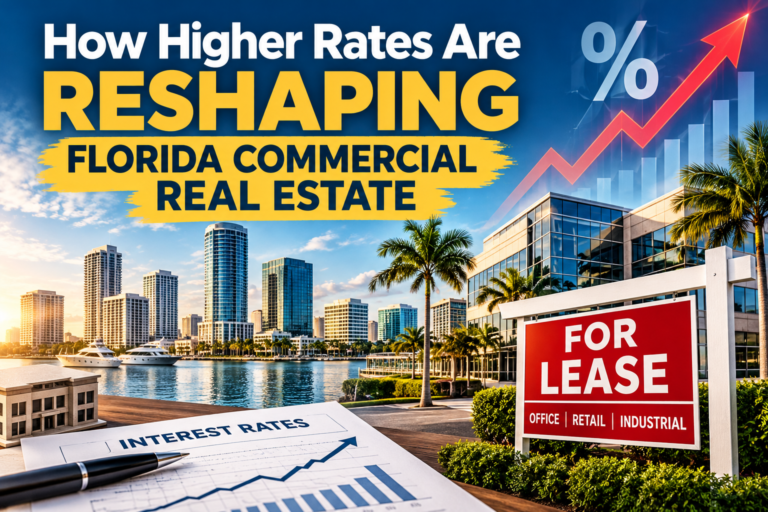
Higher rates are pushing Florida commercial property values down and making refinancing harder. Buildings bought or financed cheaply in 2020–2021 now face loans at nearly double the old rate. Industrial and retail are holding up. Suburban office and oversupplied apartment markets like Fort Myers are under the most pressure.
Key Takeaways
- Rates: The Fed raised its benchmark to 3.75%–4% in September 2026, and the 10-year Treasury, which prices most commercial loans, has moved above 5%.
- Refinancing wall: Many Florida loans written at roughly 3%–4% in 2020–2021 are maturing into a much higher rate environment.
- Distress: U.S. CMBS delinquencies rose to 7.7% in September 2026, with office and multifamily driving the increase.
- Office: Tampa Bay office vacancy sits at 13.5% with cap rates at 8.6%.
- Industrial: Tampa Bay industrial remains healthy, with vacancy at 6.7% and 3.5 million SF under construction.
- Multifamily: Fort Myers apartment vacancy is 16.8%, and rents are down about 5% from a year ago.
Why Rates Matter More for Commercial Than Residential
Homebuyers mostly lock in 30-year fixed loans. Commercial property owners don’t. Most commercial mortgages run 5 to 10 years, many with floating rates or balloon payments. That means rate increases hit commercial real estate in waves, as each loan comes due and must be refinanced at whatever the market charges that day.
Higher rates hurt commercial property in two ways at once:
- Higher debt costs. The same loan balance costs more each year in interest, shrinking cash flow.
- Lower values. Investors demand higher returns (cap rates) when safe Treasuries pay more. When cap rates rise and income stays flat, the property is worth less.
The combination is what creates the “refinancing gap”: the new loan an owner can get is smaller than the old loan they need to pay off.
As FlFinancialNews.com reported this week, the Fed’s September 16 hike was the first since 2023, and long-term Treasury yields have risen far more than the Fed’s quarter-point move. That long-term yield is what commercial lenders price off.
The Florida Refinancing Wall
Florida’s commercial real estate boom of 2020–2022 was financed with cheap debt. Those loans are now maturing.
According to Daniel A. Kaskel of Miami law firm Sachs Sax Caplan Kaskel & Schner, many of these loans were underwritten in 2020–2021 at roughly 3% to 4%. Nationally, Trepp data shows $76.6 billion in CMBS loans hitting hard maturity in 2026 with no extension options left, and nearly 40% of that volume matures in the fourth quarter. Roughly one-third of those loans have debt yields at or below 8%, a sign they will struggle to refinance at today’s rates.
The early South Florida signs are already visible:
- An Edgewater flex-office building sold for $2 million less than its 2019 purchase price.
- A Boynton Beach apartment complex was handed back to its lender in lieu of foreclosure.
- An apartment complex in Princeton sold at a 24% discount to its 2021 price.
The Refinancing Gap, Illustrated
FloridaCommercialRealEstateNews.com modeled a typical 2021 Florida apartment deal facing a 2026 refinance. Net operating income is held flat to isolate the rate effect.
| Item | 2021 | 2026 |
|---|---|---|
| Net operating income | $1.35M | $1.35M |
| Cap rate | 4.5% | 6.0% |
| Property value | $30.0M | $22.5M |
| Loan (65% LTV) | $19.5M | $14.6M |
| Interest rate | 3.75% | ~7.0% |
| Annual interest | $731K | $1.02M |
Source: FloridaCommercialRealEstateNews.com estimate. Interest-only for illustration.
The value falls 25% without any change in the building’s income. The owner must bring roughly $4.9 million in new equity to the closing table just to refinance. And even with the smaller loan, annual interest rises about 40%. Debt coverage falls from about 1.85x to 1.32x, close to the minimum many lenders will accept.
This is the core mechanism behind distress in Florida right now. The buildings are often fine. The capital structures are not.
National Distress Is Rising
KBRA’s September 2026 CMBS loan performance report shows the 30-day-plus delinquency rate rising 9 basis points to 7.7%, or $25.8 billion. Office and multifamily delinquencies both increased and drove the rise. The office distress rate stands at 17.6%, and the multifamily distress rate rose 40 basis points during the month. The retail distress rate fell to 9.6%.
Florida is not immune, but its strong population growth and job market give it more cushion than the Midwest or West Coast. The pressure in Florida is concentrated in specific property types and specific markets.
Sector-by-Sector Breakdown
Office: Split Between Trophy and Suburban
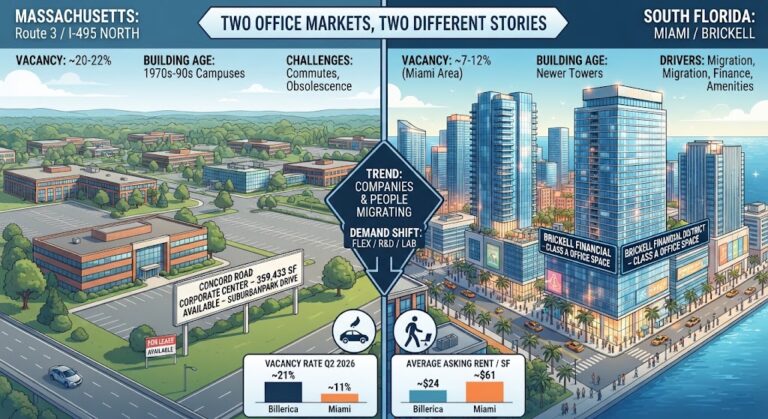
Florida office is two markets. Class A towers in Brickell, downtown West Palm Beach and Tampa’s Water Street district continue to attract tenants relocating from the Northeast. Older suburban office is struggling.
Kaskel estimates South Florida trophy office trades at cap rates below 5.5%, while suburban office trades at 8% or higher. That gap reflects how differently investors view the two.
In Tampa Bay, Lee & Associates reports the following for Q2 2026:
| Tampa Bay Office | Q2 2026 |
|---|---|
| Vacancy | 13.5% |
| Asking rent | $35.78/SF |
| 12-month absorption | -29,909 SF |
| Under construction | 140,409 SF |
| Cap rate | 8.6% |
The largest sale of the quarter was 400 N. Ashley Drive, a 589,778 SF Class A tower that traded for $94 million, or about $159 per SF. That price per foot is well below replacement cost for a downtown high-rise, a clear sign of how higher rates have repriced office.
The positive: almost nothing new is being built. With only about 140,000 SF under construction, existing buildings face little new competition, which should support occupancy over time.
Industrial: Still Florida’s Strongest Sector
Florida industrial is benefiting from port growth, population-driven distribution demand, and nearshoring. Higher rates have slowed it but not stopped it.
| Tampa Bay Industrial | Q2 2026 |
|---|---|
| Vacancy | 6.7% |
| NNN asking rent | $11.45/SF |
| 12-month absorption | 2.7M SF |
| Under construction | 3.5M SF |
| Cap rate | 7.43% |
Lee & Associates describes the market as fundamentally healthy despite slower leasing. Vacancy ticked up from 6.41% to 6.70% because of new deliveries, not lost tenants. Developers are still building, which signals confidence that demand will hold.
Watch the price: the average Tampa Bay industrial sale price fell from $139 per SF in Q1 to $121 per SF in Q2. That decline is a rate effect, as buyers adjust what they will pay to account for higher financing costs.
Multifamily: A Tale of Oversupply
Florida’s apartment sector has a supply problem layered on top of the rate problem. Developers who started projects in 2022 with cheap construction loans are now delivering units into a softer market, with permanent financing costing far more than they planned.
Southwest Florida is the clearest example:
| Fort Myers Multifamily | Q2 2026 |
|---|---|
| Vacancy | 16.8% |
| Asking rent | $1,705/unit |
| Rent vs. a year ago | -5.3% |
| Under construction | 3,788 units |
| Cap rate | 6.40% |
Fort Myers cap rates jumped from 5.99% in Q1 to 6.40% in Q2, a sharp repricing in a single quarter. Lee & Associates notes owners are offering concessions to attract and keep tenants, and that developers are now questioning their exit assumptions. The market, in its words, favors disciplined, equity-rich buyers.
There is real progress underneath: trailing 12-month absorption more than doubled, to 2,820 units, and the construction pipeline is shrinking. The oversupply is being absorbed. The question for owners is whether they can survive long enough on today’s rates for the market to catch up.
Kaskel puts well-located South Florida multifamily at about a 5% cap rate, meaning core urban apartments remain far more valuable than suburban or Southwest Florida product.
Retail: The Quiet Winner
Florida retail has had almost no new speculative construction for a decade. Combined with population growth and tourism, that keeps vacancy low and rents rising. Kaskel estimates South Florida retail cap rates near 6%, and higher rates have done little to dent demand for well-located grocery-anchored centers.
Rate Impact by Sector
| Sector | Rate Sensitivity | Florida Outlook |
|---|---|---|
| Suburban office | Very high | Weak |
| Trophy office | Moderate | Stable |
| Multifamily | High | Mixed |
| Industrial | Moderate | Strong |
| Retail | Low | Strong |
Source: FloridaCommercialRealEstateNews.com analysis.
Who Wins and Who Loses
Losers:
- Owners who bought in 2021 with high leverage and short-term or floating-rate debt
- Merchant developers delivering apartments into oversupplied markets
- Suburban office owners with near-term maturities
- Regional banks with heavy CRE loan concentrations
Winners:
- Cash-rich buyers and private equity funds hunting discounted assets
- Private credit and debt funds filling the gap left by cautious banks
- Owners of low-leverage, long-term fixed-rate properties
- Tenants in oversupplied markets, who can negotiate concessions
Brian’s Take
Having managed money through prior credit cycles, I would describe Florida commercial real estate as entering a capital structure correction, not a demand collapse. The difference matters.
In 2008, tenants disappeared. In 2026, tenants are mostly still here. Florida’s population and employment growth are real. What has changed is the cost of money. A building that worked at 3.75% debt may not work at 7%, even if every unit and suite is leased.
That makes this cycle more selective. The distress will hit specific owners with specific loan maturities, not entire markets. Expect the fourth quarter of 2026 and the first half of 2027 to bring more discounted sales, deed-in-lieu transfers, and loan modifications, especially in suburban office and Southwest Florida multifamily.
My advice for Florida owners: know your maturity date, model your refinance at 7% or higher, and start lender conversations 12 to 18 months early. For buyers with cash: the best Florida buying opportunity since 2011 may be forming right now, but it will be found one deal at a time.
The number to watch is the 10-year Treasury. If it settles back toward 4%, much of the refinancing gap closes on its own. If it stays above 5%, the pressure continues into 2027.
Frequently Asked Questions
How do higher interest rates affect commercial real estate values?
Higher rates push investors to demand higher returns, called cap rates. When cap rates rise and income stays flat, property values fall. In our example, a move from a 4.5% to a 6.0% cap rate cuts a property’s value by 25%.
What is the commercial real estate refinancing wall?
It refers to the large volume of commercial loans made at low rates in 2020–2021 that are now maturing. Owners must refinance at much higher rates, often into smaller loans, forcing them to add equity, sell or hand the property back to the lender.
Which Florida commercial property types are hurt most by higher rates?
Suburban office and multifamily in oversupplied markets face the most pressure. Industrial and retail are holding up best because of strong demand and limited new supply.
What is the office vacancy rate in Tampa?
Tampa Bay office vacancy was 13.5% in Q2 2026, according to Lee & Associates, with asking rents of $35.78 per SF.
Why is Fort Myers apartment vacancy so high?
A wave of new apartment construction has outpaced demand. Vacancy reached 16.8% in Q2 2026, and owners are offering concessions. Absorption is improving and new construction is slowing.
Is now a good time to buy Florida commercial real estate?
For well-capitalized buyers, falling prices and motivated sellers are creating opportunities, especially in multifamily and office. Buyers relying on heavy leverage face high borrowing costs. This is not investment advice; consult a qualified advisor.
What is the CMBS delinquency rate in 2026?
KBRA reported a 7.7% U.S. CMBS delinquency rate in September 2026, up 9 basis points from August, driven by office and multifamily loans.
Sources and Further Reading
- Sachs Sax Caplan Kaskel & Schner — “South Florida’s 2026 Refinancing Wall: What Property Owners Need to Do Now” (August 25, 2026): https://ssclawfirm.com/news-events/in-the-news/south-florida-s-2026-refinancing-wall-what-property-owners-need-to-do-now
- KBRA — “CMBS Loan Performance Trends: September 2026”: https://www.kbra.com/publications/jXhmdtGY
- Lee & Associates — Tampa Bay Office Market Report, Q2 2026: https://www.lee-associates.com/wp-content/uploads/2026/07/2026-Q2-Tampa-Bay-FL-Office.pdf
- Lee & Associates — Tampa Bay Industrial Market Report, Q2 2026: https://www.lee-associates.com/wp-content/uploads/2026/07/2026-Q2-Tampa-Bay-FL-Industrial.pdf
- Lee & Associates — Fort Myers Multifamily Market Report, Q2 2026: https://www.lee-associates.com/wp-content/uploads/2026/07/2026-Q2-Fort-Myers-FL-Multifamily.pdf
FloridaCommercialRealEstateNews.com is part of the Florida Authority Network. Refinancing illustrations are FloridaCommercialRealEstateNews.com estimates and are not investment advice.
About the Author