By Brian French | October 4, 2026
Quick Answer
AI agents could help Florida commercial real estate developers screen sites for Live Local Act eligibility and flood risk, read due diligence documents, run underwriting in hours instead of days, track permit deadlines under state law, model hurricane and insurance scenarios, and manage leasing after delivery. The technology is real, but most firms are still piloting it, and human review remains essential.
From Chatbots to Agents
A chatbot answers questions. An AI agent carries out multi-step work: it reads documents, pulls data from connected systems, runs analysis, drafts outputs, and flags decisions for a human to approve.
That distinction matters for developers. Florida commercial development is a long chain of document-heavy tasks across site selection, entitlements, permitting, financing, insurance, construction, and leasing. Each link involves reading, cross-checking, and calculating, which is exactly the work agents are designed to handle.
Where the Industry Stands Today
| Indicator | Finding |
|---|---|
| CRE investors and owners piloting AI | 88% |
| Firms achieving all AI program goals | 5% |
| Real estate firms with agentic AI in some live workflows | Almost half |
| Real estate workforce feeling adequately trained on AI | 33% |
Sources: JLL 2025 Global Real Estate Technology Survey; Deloitte 2027 Commercial Real Estate Outlook.
The story is rapid experimentation with uneven results. JLL found 88% of investors, owners, and landlords piloting AI, typically pursuing five use cases at once, yet only 5% had achieved all their program goals. Deloitte’s latest outlook reports that almost half of real estate organizations surveyed already have agentic AI running in some live production workflows, while warning that agents without proper governance risk acting in ways that are biased or non-compliant with internal policies.
Gartner projects that by 2028, about a third of enterprise applications will incorporate agentic AI, up from less than 1% in 2024.
Why Florida Is a Strong Test Case
Florida developers face a combination of conditions that make agents especially valuable:
- Fast-changing rules: The Live Local Act has been amended four times since 2023, the Florida Building Code’s 9th Edition takes effect December 31, 2026, and a property tax amendment is on the November ballot.
- Climate and insurance risk: Flood zones, storm surge, wind ratings, and insurance availability shape nearly every deal.
- Statutory permit deadlines: Florida law sets review clocks and fee reductions that reward developers who track them closely.
- Volume of jurisdictions: Florida has 67 counties and more than 400 municipalities, each with its own zoning and permitting processes.
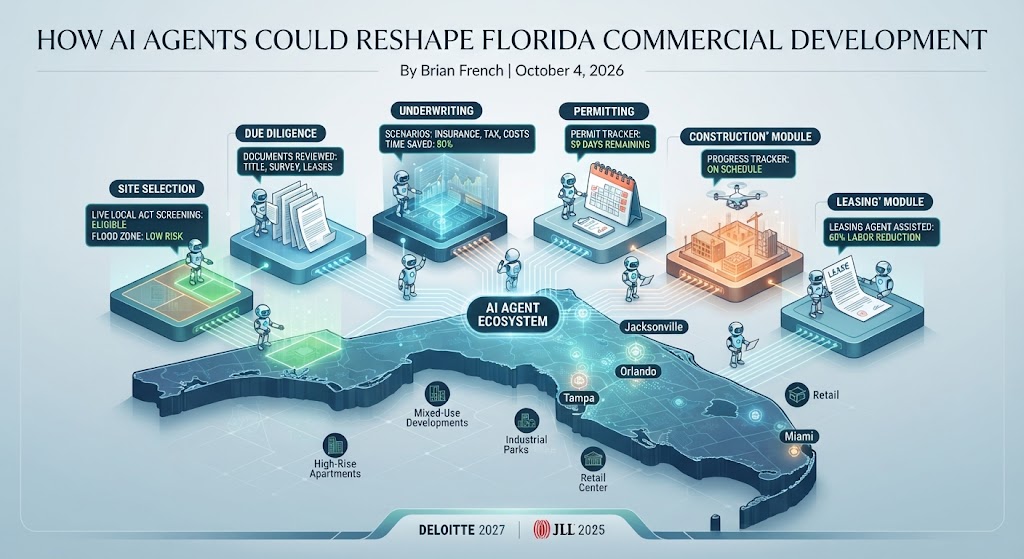
The Development Lifecycle: Where Agents Could Help
1. Site Selection and Live Local Screening
The 2026 Live Local Act amendments under HB 1389 took effect July 1, 2026, expanding eligible sites, tightening height protections, and adding new exclusions. Counties and municipalities must authorize qualifying multifamily and mixed-use residential projects in areas zoned commercial, industrial, or mixed use. Qualifying projects must set aside at least 40% of units as affordable for 30 years.
What an agent could do: Scan parcel databases across multiple counties, flag commercial and industrial parcels likely to qualify for Live Local treatment, check exclusions such as the new limits on agricultural land, overlay FEMA flood zones, and rank sites by acquisition potential. A human team would then verify the shortlist with land-use counsel.
2. Due Diligence Document Review
Development deals generate stacks of title commitments, surveys, environmental reports, leases, estoppels, and zoning letters.
What an agent could do: Read every document, extract key terms, flag inconsistencies between the survey and title, identify encumbrances, and produce a diligence summary with citations to source pages. One specialized tool already claims to extract 215 or more commercial real estate data terms at 99% accuracy with a 5-to-10-minute turnaround.
3. Underwriting and Scenario Modeling
Speed is the most dramatic change. One industry executive said underwriting a mixed-use deal once took an analyst more than a week, while an agentic AI system can now run the full analysis in about 90 minutes, with about 20 minutes of analyst review.
What an agent could do for Florida deals: Run scenarios on insurance premiums, property tax outcomes, construction costs, interest rates, and rent growth. For example, an agent could model a project’s tax burden under both outcomes of Florida’s Amendment 3, which would lower the non-homestead assessment cap from 10% to 5% starting in 2027 if approved by voters.
4. Entitlements and Permitting
Florida law requires local governments to act on permit applications for signs and nonresidential buildings under 25,000 square feet within 60 business days of a complete application, and to reduce permit fees by 10% for each business day they miss the deadline, subject to exceptions.
What an agent could do: Assemble permit packages against each jurisdiction’s checklist, flag missing items before submittal, track statutory clocks, draft responses to reviewer comments within the 10-business-day correction window, and alert the team when a jurisdiction misses a deadline that triggers fee reductions.
Code transition: With the 9th Edition Florida Building Code taking effect December 31, 2026, an agent could also track which projects must be submitted before the cutoff to remain under the 8th Edition.
5. Hurricane, Flood, and Insurance Planning
What an agent could do: Compile flood zone data, elevation requirements, wind design standards, and insurance quotes; compare carrier terms; and draft hurricane preparedness plans for construction sites. During storm season, an agent could monitor forecasts and prepare site-securing checklists and notices to contractors and lenders, pending human approval.
6. Construction Monitoring
What an agent could do: Reconcile pay applications against the schedule of values, track change orders, compare progress reports with lender draw requirements, and flag budget overruns early. Paired with site photos and drone imagery, agents could help identify schedule slippage.
7. Leasing and Asset Management
Lease abstraction is one of the most mature AI uses in commercial real estate. JLL has reported a 60% reduction in lease-abstraction labor and more than $1 million in recovered escalation clauses in one example.
What an agent could do: Draft marketing materials, qualify tenant inquiries, abstract signed leases, track renewal options and escalations, and monitor tenant payment patterns, with a human leasing team approving deals and communications.
A Day in the Life: An Illustrative Scenario
The following is a hypothetical example of how agents might work together, not a description of an existing product.
A Tampa-based developer evaluates a vacant strip center in Hillsborough County for a mixed-use Live Local project. Overnight, a site agent confirms the commercial zoning and flood designation, a diligence agent reviews the title commitment and Phase I report, and an underwriting agent runs scenarios for 186 units with ground-floor retail under different insurance and tax assumptions. By morning, the developer’s team reviews a decision memo with flagged risks and source citations, then decides whether to submit a letter of intent. The judgment stays human; the preparation is automated.
The Risks Developers Must Manage
| Risk | Why It Matters | Mitigation |
|---|---|---|
| Errors in legal interpretation | Live Local and zoning rules are complex and changing | Require attorney review of eligibility conclusions |
| Outdated data | Codes, rates, and maps change often | Verify sources and dates on every output |
| Overreliance on speed | Faster underwriting can mean faster mistakes | Require human sign-off on investment decisions |
| Data security | Agents need access to sensitive deal data | Limit permissions, audit activity |
| Governance gaps | Agents may act outside company policy | Define approval rules before deployment |
The data foundation is often the real constraint. JLL found 81% of companies reporting at least three existing systems that are not generating expected results, and 88% budgeting to upgrade legacy technology.
A Practical Roadmap for Florida Developers
Next 6 Months
- Clean up data. Organize deal files, leases, and underwriting templates in consistent formats.
- Pilot low-risk tasks. Start with document summarization and lease abstraction.
- Set approval rules. Decide which outputs require human review before use.
6 to 18 Months
- Automate permit tracking. Use agents to monitor statutory clocks and submittal checklists.
- Add scenario modeling. Run insurance, tax, and cost scenarios on every deal.
- Measure results. Track hours saved, errors caught, and deal speed.
18 Months and Beyond
- Connect agents across the lifecycle. Link site selection, diligence, underwriting, and asset management into one workflow.
- Build institutional knowledge. Train agents on your firm’s past deals, lessons, and standards.
Brian’s Take
Commercial real estate development has always rewarded speed and information. The developer who identifies a site first, understands its risks fastest, and gets permits soonest usually wins. AI agents compress all three. A process that once took a week of analyst time can increasingly be prepared overnight, freeing experienced people to focus on judgment, relationships, and negotiation.
From an investment standpoint, Florida may be one of the best places in the country to see this play out. The Live Local Act’s repeated amendments, the statewide building code change, hurricane and insurance complexity, and a potential property tax shift create exactly the kind of fast-moving, document-heavy environment where agents add the most value. Firms that can screen more sites and model more scenarios will see opportunities competitors miss.
But the survey data is a warning. Most firms are piloting AI, and very few are meeting their goals. The winners will not be the ones with the most tools; they will be the ones with clean data, clear approval rules, and leaders who treat agents as analysts that still need supervision. In Florida development, where a misread zoning rule or flood map can sink a project, the human sign-off is not optional.
Frequently Asked Questions
How could AI agents help a commercial real estate developer in Florida?
Agents could screen sites for Live Local Act eligibility and flood risk, review due diligence documents, run underwriting and scenario models, assemble permit packages and track statutory deadlines, plan for hurricanes and insurance, monitor construction, and manage leases.
Are commercial real estate firms already using AI agents?
Yes, increasingly. Deloitte reports that almost half of real estate organizations surveyed have agentic AI in some live workflows, while JLL found 88% of investors and owners piloting AI but only 5% achieving all their goals.
Can AI agents determine Live Local Act eligibility?
They can screen parcels and flag likely candidates, but eligibility depends on complex and recently amended rules. Final determinations should be reviewed by land-use counsel.
How fast can AI underwrite a commercial real estate deal?
One industry executive reported that a mixed-use underwriting analysis that once took more than a week can now be run by an agentic system in about 90 minutes, plus about 20 minutes of analyst review.
What are the biggest risks of using AI agents in development?
Errors in legal or zoning interpretation, outdated data, overreliance on speed, data security, and governance gaps. Human review of key decisions remains essential.
What changes in Florida make AI agents more useful in 2026 and 2027?
The 2026 Live Local Act amendments, the 9th Edition Florida Building Code effective December 31, 2026, permit review deadlines under state law, and the November 2026 property tax amendment all create fast-changing conditions that agents can help track and model.
Sources and Further Reading
- 2027 Commercial Real Estate Outlook — Deloitte: https://www.deloitte.com/us/en/insights/industry/financial-services/financial-services-industry-outlooks/commercial-real-estate-outlook.html
- Real Estate’s AI Reality Check — JLL: https://www.jll.com/en-us/newsroom/real-estates-ai-reality-check-companies-piloting-only-achieved-all-ai-goals
- Global Real Estate Technology Survey — JLL: https://www.jll.com/en-us/insights/global-real-estate-cre-technology-survey
- Agentic AI’s Impact on Commercial Real Estate Goes Beyond Time Saved — Commercial Observer: https://commercialobserver.com/2026/05/agentic-ai-commercial-real-estate-advantages/
- AI in Commercial Real Estate: 2026 Use Cases — Perspective AI: https://getperspective.ai/blog/ai-in-commercial-real-estate-2026-use-cases-for-brokers-owners-and-property-managers
- How AI Agents Are Automating Real Estate Workflows — BuildMVPFast: https://www.buildmvpfast.com/blog/ai-agents-real-estate-workflow-automation-2026
- Live Local 4.0: 2026 Updates to Florida’s Live Local Act — Holland & Knight: https://www.hklaw.com/en/insights/publications/2026/07/2026-updates-to-floridas-live-local-act
- Florida HB 1389 (2026): The Latest Evolution of the Live Local Act — Becker: https://beckerlawyers.com/florida-hb-1389-2026-the-latest-evolution-of-the-live-local-act/
- Legislature Approves Revisions to Live Local Act — Florida Politics: https://floridapolitics.com/archives/784680-legislature-approves-revisions-to-live-local-act-designed-to-grow-affordable-housing-options/
- 2026 Community & Urban Affairs Passed Bills — Florida Association of Counties: https://www.fl-counties.com/2026-community-urban-affairs-passed-bills/
- Section 553.792, Building Permit Application to Local Government — Florida Senate: https://www.flsenate.gov/laws/statutes/2024/553.792
- 2026 Florida Building Code, Residential, Ninth Edition — ICC: https://codes.iccsafe.org/content/FLRC2026V1.0
- Florida Voters to Decide Expanded Homestead Tax Exemption Amendment — Ballotpedia: https://news.ballotpedia.org/2026/06/03/florida-voters-to-decide-expanded-homestead-tax-exemption-amendment-in-november
About the Author