By Brian French | Florida Authority Network
Quick Answer: Two Florida laws are reshaping commercial real estate: the 2023 Live Local Act, which opens commercial and industrial land to qualifying workforce housing, and post-Surfside condo safety rules requiring milestone inspections and reserve studies. FloridaCommercialRealEstateNews.com tracks both as ongoing business stories.
Policy Is Now a Core CRE Variable
In Florida commercial real estate, location, financing, and demand have always driven decisions. Over the past few years, state policy has joined that list in a big way.
Two pieces of legislation stand out. One changes what can be built on commercial land. The other changes the economics of owning and maintaining multistory condominium buildings. Together, they influence developers, lenders, brokers, investors, property managers, contractors, and local governments across the state.
FloridaCommercialRealEstateNews.com, part of the Florida Authority Network, treats these laws not as one-time headlines but as long-running business stories whose effects will play out project by project, county by county, for years.
| Snapshot | Detail |
|---|---|
| Site | FL Commercial RE News |
| Network | Florida Authority Network |
| Focus | Florida CRE business |
| Analyst | Brian French |
| Key laws | Live Local, SB 4-D |
The Live Local Act
Florida’s Live Local Act (SB 102), signed in 2023, is one of the most significant housing and land-use laws the state has passed in decades.
What It Does
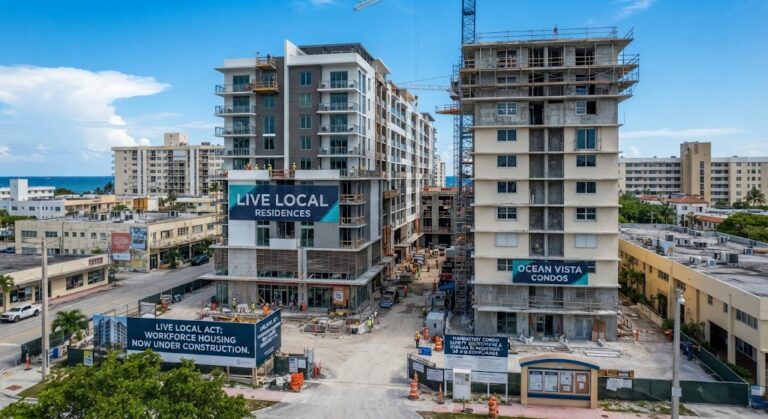
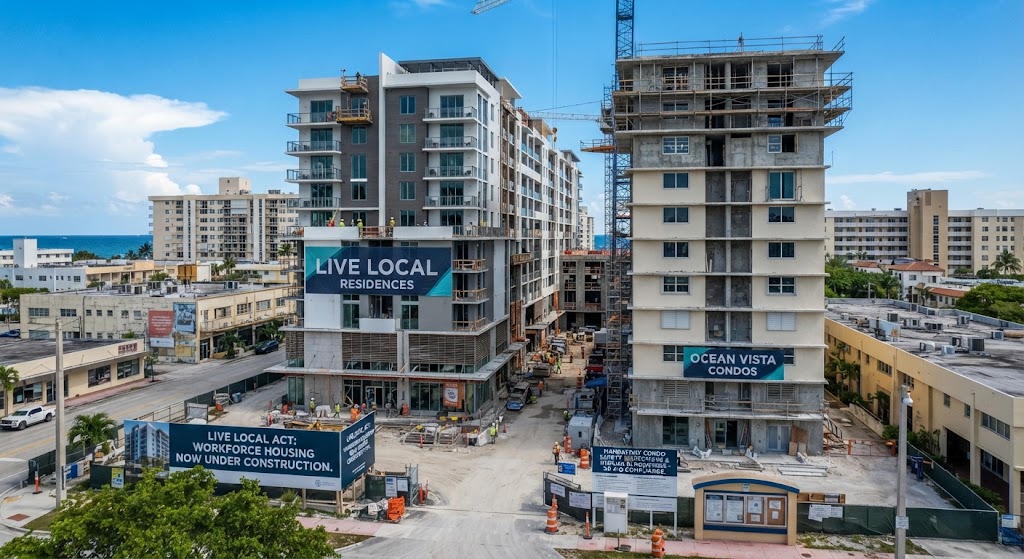
At its core, the law allows qualifying multifamily developments that include a substantial share of affordable or workforce units to be built on land zoned commercial, industrial, or mixed-use, without needing a rezoning or a comprehensive plan change. Qualifying projects can generally be approved administratively and can use density and height levels tied to what’s allowed nearby in the jurisdiction.
The law also created property tax incentives for qualifying affordable units and expanded funding for state housing programs. Lawmakers revisited and refined parts of the act in 2024, addressing issues such as height limits near certain areas and how local governments apply the rules.
Why It Matters to CRE
For commercial real estate, the Live Local Act changes the math on a wide range of properties:
- Underused retail centers may become candidates for mixed-income residential redevelopment.
- Older office and industrial sites can be evaluated for housing instead of only commercial reuse.
- Land values for certain commercial parcels may reflect new residential potential.
- Local governments must work within state preemption on qualifying projects.
Each of those shifts creates deals, disputes, and debates, and each is worth covering carefully at the local level.
| Live Local Feature | CRE Effect |
|---|---|
| Use on commercial land | New redevelopment options |
| Administrative approval | Faster entitlement path |
| Density/height tie-in | Higher yield potential |
| Tax incentives | Better project economics |
Post-Surfside Condo Safety Rules
The June 2021 collapse of Champlain Towers South in Surfside was a tragedy that changed how Florida regulates condominium buildings.
What Changed
In 2022, the Legislature passed SB 4-D, which created new requirements for condominium and cooperative buildings three stories or taller. The key elements include:
- Milestone inspections: structural inspections when buildings reach a certain age, with follow-up inspections on a recurring schedule.
- Structural integrity reserve studies (SIRS): studies of major structural components, such as roofs, load-bearing walls, and foundations, used to set required reserves.
- Limits on waiving reserves: associations can no longer simply vote to skip funding reserves for key structural items.
Lawmakers adjusted these rules in later sessions, refining deadlines, inspection standards, and association obligations. Anyone covering this area needs to check current statutes rather than relying on the original 2022 version.
Why It Matters to CRE
These rules reach well beyond residential owners:
- Special assessments have risen sharply in some older buildings, putting pressure on sale prices.
- Engineering and construction firms have seen strong demand for inspections and repairs.
- Lenders and insurers pay closer attention to inspection and reserve status.
- Investors and developers are evaluating older condo buildings for buyouts, terminations, or redevelopment.
In coastal markets with large stocks of older condo towers, the effects ripple into land values, construction pipelines, and redevelopment strategy.
How FloridaCommercialRealEstateNews.com Covers These Stories
Big policy changes generate plenty of statewide commentary. What’s harder to find is consistent, local, factual tracking of what’s actually happening on the ground. The site’s coverage approach focuses on:
- Project-level reporting. Specific Live Local proposals, redevelopments, and condo repair or termination situations, described with public facts.
- Local context. How a county or city is applying the rules, and where conflicts or approvals emerge.
- Public records. Information drawn from property appraiser data, permit filings, planning agendas, and official notices.
- Plain explanation. What the rule actually requires, stated clearly and dated.
- Labeled analysis. Interpretation appears in “Brian’s Take,” separate from reporting.
The People Who Need This Coverage
| Reader | Why It Matters |
|---|---|
| Developers | Site selection options |
| Brokers | Deal opportunities |
| Lenders | Risk assessment |
| Condo boards | Compliance context |
| Contractors | Demand signals |
| Local officials | Peer comparisons |
Where FAN Fits for CRE Companies
Commercial real estate is a relationship business, and credibility matters. When a developer, brokerage, contractor, engineer, or property manager is researched today, that research increasingly includes AI assistants.
A firm with detailed, independent coverage on a Florida-focused commercial real estate site is easier for those systems to understand accurately. Through the Florida Authority Network, a CRE company can also be covered on the regional business site for its market, such as MiamiBusinessNews.com or TampaBayBusinessNews.com, placing it in both the industry conversation and the local business conversation.
Firms with transactions, groundbreakings, or new hires to announce can also use FAN’s Florida press-release brands, giving those announcements a dedicated, Florida-focused home.
Reading the Ground Truth: Public Data for Florida CRE
Policy debates generate opinions. Public records generate facts. Some of the most useful commercial real estate information in Florida is publicly available, if you know where to look and are willing to assemble it.
| Source | What It Shows |
|---|---|
| Property appraisers | Ownership, values, sales |
| Building permits | Construction activity |
| Planning agendas | Proposed projects |
| Clerk of court | Deeds, liens, lawsuits |
| Sunbiz | Entity ownership |
| DBPR condo records | Association filings |
County property appraisers publish ownership, assessed values, and sale histories for every parcel. Tracking sales over time reveals which property types and submarkets are changing hands and at what prices.
Building permits are one of the best early signals of activity. A permit for a major renovation, demolition, or new construction often appears months before a project becomes visible. Census Bureau permit data provides a regional overview, while county and city permit portals show project-level detail.
Planning and zoning agendas reveal what developers intend to build, including Live Local proposals that may be approved administratively rather than through public hearings. For those projects, local government notices and records requests may be the main public window into what’s coming.
Clerk of court records include deeds, mortgages, liens, and litigation. A wave of liens or foreclosure filings tied to a property type can signal stress well before it reaches headlines.
Florida’s Sunbiz database helps identify the people and companies behind the limited liability companies that typically own commercial property.
Condo association filings and notices, including information tied to milestone inspections and reserve studies, can show which older buildings face major repair costs.
No single source tells the whole story. Assembled carefully, they reveal patterns that matter to developers, lenders, and investors. That kind of assembly, public facts combined with analyst judgment, is how the Florida Authority Network approaches commercial real estate coverage. Over time, consistently tracked data points like permits and sales can also become the foundation for original market indicators specific to Florida submarkets.
What to Watch Next
Several questions will shape Florida commercial real estate coverage over the next few years:
- How many Live Local projects actually break ground, and where?
- Will local governments and developers continue to clash over how the law applies?
- How many older condo buildings will choose major repairs versus sale or termination?
- How will inspection and reserve requirements affect lending and insurance in coastal markets?
- Which redevelopment patterns, such as retail-to-residential, become common?
Insurance belongs on that list too. Rising premiums for commercial and condominium properties have become a major factor in Florida deal underwriting, and they interact directly with both laws. A Live Local project’s financing depends partly on expected insurance costs, and older condo buildings facing major repairs often face insurance pressure at the same time. Coverage that connects policy, insurance, and financing gives readers a far more accurate picture than any one of those topics alone.
Each answer will arrive project by project. Tracking those patterns over time is where consistent coverage becomes valuable.
Brian’s Take
In my money management years, I learned that the most important changes in a market are often the slow ones. A single headline about a new law rarely moves things. What moves things is the steady accumulation of decisions that follow.
That’s how I see both the Live Local Act and Florida’s condo safety reforms. The bills themselves were big news. But the real story is happening now, in planning meetings, association board votes, loan committees, and engineering reports.
Live Local, in particular, has turned some ordinary commercial parcels into something more interesting. A dated strip center with a big parking lot isn’t just a retail asset anymore. On the condo side, I think we’ll see more older buildings reach difficult decisions about repair costs versus selling to a developer.
Neither trend is good or bad on its own. Both are worth tracking carefully, with facts first. That’s what this site is for.
Frequently Asked Questions
What is the Live Local Act?
A 2023 Florida law that allows qualifying affordable and workforce multifamily housing on commercial, industrial, or mixed-use land without rezoning, plus related tax incentives.
Did the Live Local Act change after 2023?
Yes. Lawmakers refined parts of the act in 2024. Always check the current statute for project decisions.
What is SB 4-D?
A 2022 Florida law, passed after the Surfside collapse, requiring milestone inspections and structural reserve studies for many condominium buildings.
What is a structural integrity reserve study?
A study of key structural components used to determine how much a condo association must keep in reserves for repairs and replacements.
Why do condo rules affect commercial real estate?
They influence special assessments, sale prices, lending, insurance, contractor demand, and redevelopment opportunities.
How can a CRE company be featured?
Call 813-409-4683 to discuss coverage on FloridaCommercialRealEstateNews.com and across the Florida Authority Network.
Sources and Further Reading
- Florida Senate, SB 102 (2023), Housing (Live Local Act) — https://www.flsenate.gov/Session/Bill/2023/102
- Florida Senate, SB 328 (2024), Affordable Housing — https://www.flsenate.gov/Session/Bill/2024/328
- Florida Housing Finance Corporation, Live Local Act — https://www.floridahousing.org/live-local-act
- Florida Senate, SB 4-D (2022 Special Session D), Building Safety — https://www.flsenate.gov/Session/Bill/2022D/4D
- Florida DBPR, Division of Florida Condominiums, Timeshares, and Mobile Homes — https://www2.myfloridalicense.com/condos-timeshares-mobile-homes/
- Florida Authority Network article archive on Authory — https://authory.com/FloridaAuthorityNetwork
About the Author