By Brian French | October 9, 2026
Quick Answer: Office markets in Massachusetts’ suburban tech corridors, including Billerica on the I-495 North / Route 3 belt, still have roughly one in five square feet vacant. South Florida has some of the tightest office vacancy in the country. The gap comes from where people and companies are moving, how old the buildings are, and what tenants want now. Tampa shows that Florida is not uniformly strong, though.
Two Office Markets, Two Different Stories
National office conditions are finally leveling off. Cushman & Wakefield reported national office vacancy at 20.1% in Q2 2026, down 10 basis points year over year, and the eighth straight quarter of essentially flat vacancy. Vacancy improved on both a quarterly and annual basis in 49 of the 92 markets the firm tracks.
That national average hides a wide range. Two regions show how wide: the aging corporate office parks north of Boston, and the newer, amenity-heavy towers of South Florida.
The Billerica Story: A Corridor Built for Another Era
Billerica sits on the Route 3 / I-495 North corridor. A generation ago, that belt was one of the country’s main technology office corridors, with large suburban campuses, surface parking and long commutes from the Boston suburbs. Many of those buildings now fit poorly with how companies use office space.
The numbers show that:
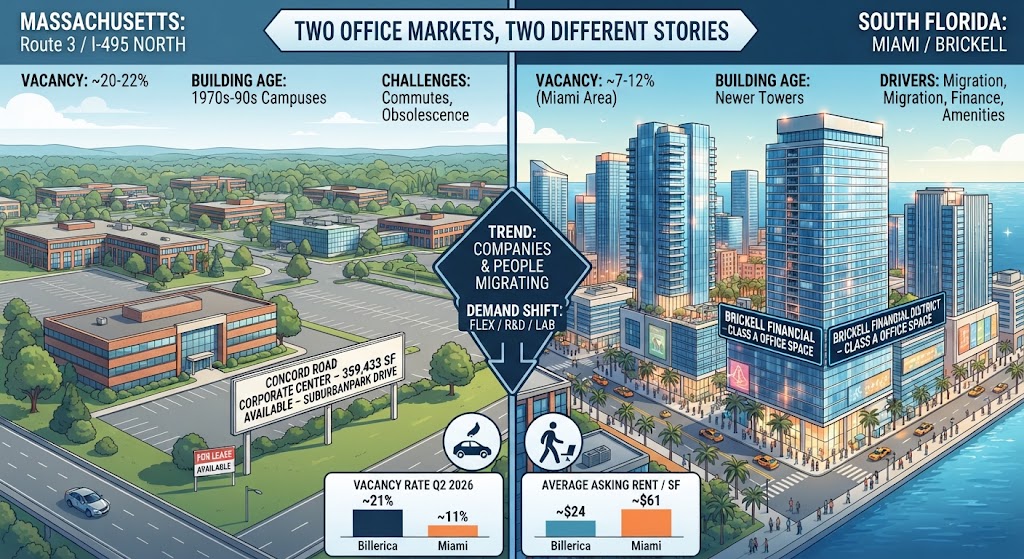
- Newmark research cited at the time of one Billerica campus sale put the northern I-495 corridor at a 20.7% office vacancy rate across nearly 19 million square feet of inventory, with Class A asking rents of $24.02 per square foot.
- That sale was the 362,550-square-foot Class A Concord Road Corporate Center, a recently renovated three-building campus, which sold to local landlord KS Partners for $12.5 million, or about $34 per square foot. That price tells you how far suburban office values have fallen.
- The property is still being marketed. A July 2026 listing shows the 359,433-square-foot campus for lease as a corporate office facility in Billerica’s Pinehurst neighborhood.
- Some listings have been on the market for years. One Billerica flex/office building on Suburban Park Drive was listed at $12.50 per square foot NNN and had been on the market 1,326 days.
Greater Boston Suburbs: Stabilizing, Not Recovering
The wider suburban Boston market is improving slowly. CBRE reported Q2 2026 suburban net absorption of positive 326,682 square feet, with leasing rising to about 1.77 million square feet, and vacancy edging down from 21.6% to 21.5%. CBRE described the market as stabilizing with growing momentum, but still shaped by tenant leverage and selective demand.
There have been some notable deals. Boston Dynamics signed the largest new lease outside downtown Boston in five years in the 128 Central submarket, and IBM’s renewal in 495 North was Greater Boston’s largest renewal of 2026 so far. Still, vacancy in the 128 Belt rose 50 basis points in the quarter to 18.1%.
The more useful signal for the Billerica area may be outside the office sector. Lee & Associates lists an 88,000-square-foot industrial project in North Billerica among Greater Boston’s industrial construction pipeline. Demand in the corridor is moving toward flex, lab and light industrial uses rather than traditional corporate office.
Florida: A Tight Market With Real Exceptions
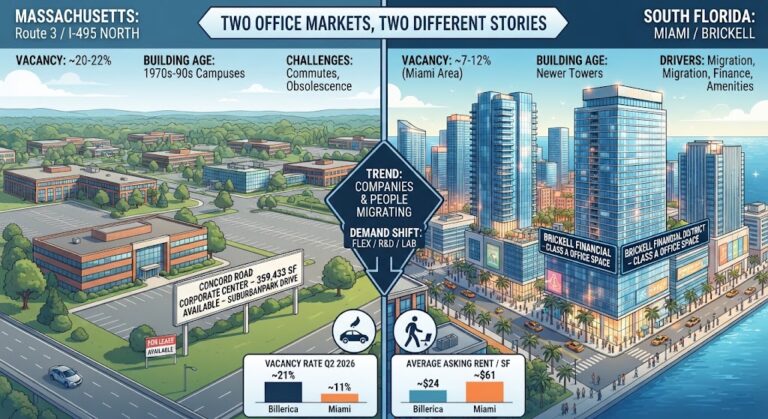
South Florida looks very different. Miami-area office vacancy fell to 11.6% in July 2026, down from 13.81% a year earlier, ranking second lowest among the nation’s largest markets in Yardi Matrix data analyzed by Miami Realtors. Brickell office vacancy was just 7.3%, and rents there are rising.
Landlords have pricing power. Average Miami-area office asking rents rose 7.1% year over year to $61.0 per square foot. Florida Realtors notes that Miami keeps attracting higher-end office tenants and financial firms, and that demand is concentrating in newer, amenity-rich buildings.
Tampa is a necessary caveat to the “Florida is booming” story. Lee & Associates puts vacancy at 13.5% in Tampa’s core submarkets (Downtown, South Tampa and Westshore), up from 10.6% a year earlier. CBRE measures the full metro and is more cautious: it reported negative net absorption in Q2 that pushed total Tampa office vacancy back toward 20%. Florida’s advantage is real, but it is concentrated in specific submarkets and building classes.
Note: vacancy figures come from different sources (Yardi Matrix, CBRE, Cushman & Wakefield, Lee & Associates) using different methods, so compare trends rather than exact decimals.
Side by Side
| Metric | Billerica / Boston Suburbs | South Florida |
|---|---|---|
| Vacancy | ~18–22% | ~7–12% (Miami area) |
| Rent trend | Flat to modest gains | Rising sharply |
| Typical stock | 1970s–90s campuses | Newer towers |
| Demand driver | Selective RTO, lab/flex | Migration, finance firms |
| Pricing signal | ~$34/SF campus sale | ~$61/SF avg. asking rent |
| Outlook | Repositioning | Growth, with soft spots |
What’s Driving the Gap
1. Population and business migration. Florida has spent the past several years adding residents, wealth and corporate relocations. A growing labor pool and new companies arriving create new office demand. Massachusetts has deep talent but mostly needs to keep the tenants it already has.
2. Building age. Much of the I-495 / Route 3 inventory dates from the 1970s through the 1990s. Buildings like that struggle when tenants want natural light, collaborative floor plans and amenities. In South Florida, much of the demand is going to recently built Class A towers.
3. Commute patterns. Suburban Boston campuses were built around car commutes along the beltways. Hybrid work makes those long drives harder to justify. Urban-core Florida submarkets like Brickell put the office close to where employees live and spend time.
4. Supply discipline. Nationally, the construction pipeline is only 19.7 million square feet, about 0.4% of total inventory, and inventory is shrinking as obsolete buildings are converted or repositioned. That helps both regions. It helps Florida more, because demand there is growing into a fixed supply.
The Future of Office Demand: NE vs. Florida
Northeast suburbs: Expect continued sorting. Well-located, renovated buildings near Route 128 will pick up tenants as return-to-office policies get stricter. Older corridor campuses farther out, including parts of Billerica, will probably keep turning into flex, lab, light industrial, data or residential uses. For many of these properties, the realistic future is a different use, not a new office tenant.
Florida: The near-term outlook is strongest in core South Florida, where low vacancy and rising rents may eventually justify new construction. The risks are rising occupancy costs, insurance and property tax pressure, and the possibility that migration slows. Tampa’s softer numbers show that a Florida address alone does not guarantee demand. Quality and location still matter.
Brian’s Take
From an investment point of view, this is a story about asset obsolescence more than geography. A Billerica office campus selling for roughly $34 a foot is not a bargain if the market has moved away from that product. A Brickell tower asking $61 or more may still be underpriced if the tenant pipeline keeps growing.
Florida’s advantage is real, but investors and tenants should not treat it as a statewide guarantee. The winning formula in both regions is the same: new or meaningfully renovated space, in walkable or well-connected locations, in markets where people want to live. Florida has more of that combination right now. The Northeast’s suburban corridors need to reposition, and the owners who accept that soonest will lose the least.
FAQ
Why is so much office space in Billerica vacant?
Much of the corridor’s stock is older suburban campus space built for a car-commuting, pre-hybrid workforce. Northern I-495 vacancy has run near 20%.
What is Miami’s office vacancy rate?
About 11.6% in July 2026 per Yardi Matrix data, with Brickell near 7%.
Is every Florida office market strong?
No. Tampa’s vacancy has risen over the past year, and some submarkets are softer than South Florida.
What happens to empty suburban office parks?
Many are being repositioned as flex, lab, industrial or residential space instead of being re-leased as offices.
Is the national office market recovering?
It is stabilizing. National vacancy is about 20% and has been flat for two years, with improvement spreading to more markets.
Sources and Further Reading
- Cushman & Wakefield Q2 2026 U.S. Office Marketbeat (via Barchart)
- Banker & Tradesman – Billerica Office Park Trades for $12.5M
- CommercialCafe – Concord Road Corporate Center, Billerica
- Crexi – 8 Suburban Park Drive, Billerica
- CBRE – Boston Suburban Office Figures Q2 2026
- Cushman & Wakefield – Boston Office MarketBeat Q2 2026
- Lee & Associates – Boston Industrial Q2 2026
- Miami Realtors – South Florida Office Insights, August 2026
About the Author