FloridaCommercialRealEstateNews.com | Florida Authority Network Market Coverage | By Brian French | October 13, 2026
Independent market analysis for Florida business owners. This article is general information, not legal or financial advice.
Quick Answer
Florida retail rents almost never fall by much, even when the economy is unstable. Statewide vacancy sits near 3% to 5%, very little new retail space is being built, the population keeps growing, and landlords would rather offer free rent than lower the rent on the lease, because the face rent sets the value of their property. Rents have fallen before, in 2009–2010 and in Broward this year, but the declines were small, short, and showed up mostly as concessions. For a small business waiting for “bargain” rent, the cost of waiting is usually larger than the discount it is waiting for.
Key Takeaways
- Retail vacancy in most Florida metros is between 3% and 5%, at or below the roughly 5% national rate.
- During the Great Recession, Florida asking rents fell only about 3% to 4% a year in markets like Miami and Orlando. Effective rents fell more, about 5% to 6%.
- Landlords protect face rents because property value, loan terms, and refinancing all depend on them. They discount through free months and build-out money instead.
- A business that waits two years for a 15% rent drop that does not arrive will likely pay more, not less, and lose two years of revenue.
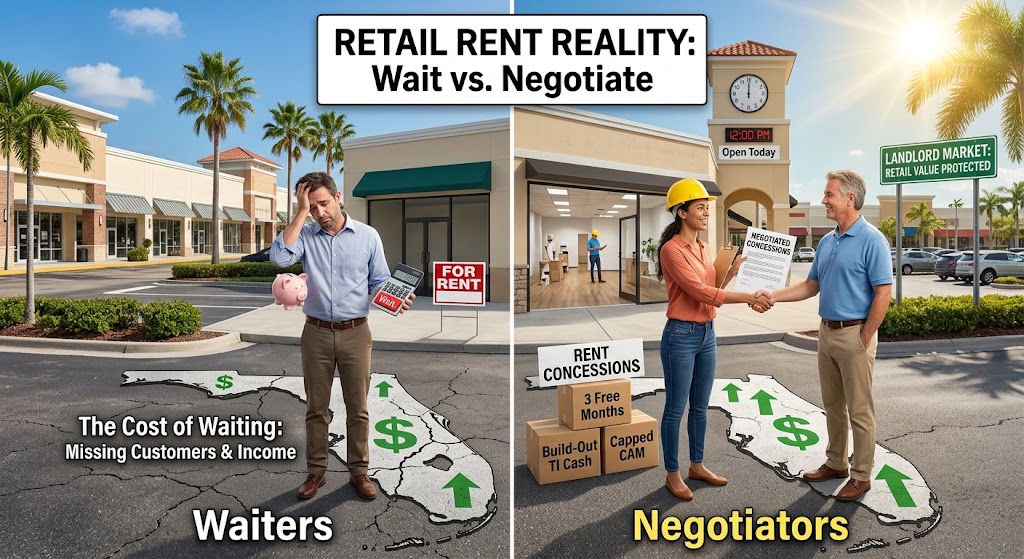
- The better approach is to negotiate concessions now, not to wait for lower asking rents.
Florida Retail Rents and Vacancy, 2026
| Market | Vacancy | Asking Rent | Rent Trend | Source |
|---|---|---|---|---|
| South Florida (region) | 3.5% | $36.50/SF | +2.8% YoY | Matthews Q2 |
| Miami-Dade | 3.0% | $42.50/SF | +2.6% QoQ | Colliers Q2 |
| Palm Beach | 4.0% | — | +7.1% YoY | Colliers / Matthews Q2 |
| Broward | 4.3% | $27.67/SF | –3.4% YoY | Colliers Q2 |
| Tampa | 3.7% | $26.81/SF | +1.1% YoY | Matthews Q1 |
| Jacksonville | 4.9% | $26.12/SF | +2.0% YoY | Matthews Q1 |
| Brevard | 4.2% | $18.58/SF | +2.2% YoY | Matthews Q1 |
Brokers measure rent on different bases (NNN vs. gross, building types included), so compare trends within a source, not dollar figures across sources.
The Short Answer to “Do Florida Retail Rents Ever Go Down?”
They do, but rarely, modestly, and briefly.
The best test is the 2008–2010 crash, the worst Florida real estate collapse in modern history. In early 2009, Marcus & Millichap projected that Miami-Dade asking retail rents would fall 4.1% that year to $23.59 per square foot, with effective rents down 5.6%. That was during a year in which the county was expected to lose 43,000 jobs and retail spending was forecast to drop about 10%.
Orlando was similar. The firm forecast 2010 asking rents falling 3.1% to $16.82 per square foot and effective rents 5.2%, which brought effective rents back to 2005 levels. In 2009, Orlando shopping centers built since 2007 had vacancy above 20%, far higher than the overall market.
The pattern was the same everywhere. Even in a severe recession, asking rents dropped only by single digits a year. Most of the real discount came through concessions, and the steepest cuts were in new or poorly located centers, not established ones.
The recovery came quickly. By 2010, CBRE reported positive net absorption across retail, office, and industrial in Miami-Dade, Broward, Palm Beach, and Southwest Florida. By 2013, JLL reported Miami-Dade retail vacancy back around 4%.
A recent example is Broward County. Colliers reported Broward asking rents down 3.4% year over year to $27.67 per square foot in Q2 2026, with vacancy at 4.3%. That decline is real, but it is a small dip in a tight market, not a correction that would give small tenants significant savings.
Five Reasons Florida Retail Rents Stay High
1. Almost no new retail is being built
Rents follow supply, and Florida is building very little new retail. In Q2 2026, South Florida delivered only 28,400 square feet of new retail space, with about 683,000 square feet under construction across Miami-Dade, Broward, and Palm Beach. Matthews concluded that new construction is unlikely to change market conditions in the near term.
The same is true elsewhere. In Fort Lauderdale, high construction costs and difficult financing limit development, which supports existing centers. In Tampa, construction is limited by costs and entitlement timelines and is concentrated in fast-growing suburbs.
New retail now costs far more to build than older centers lease for. Until rents rise high enough to justify new construction, there is no new supply to push rents down. Florida has been in that position for most of the past decade.
2. Population growth keeps demand steady
Florida keeps adding residents, and each new household needs groceries, haircuts, dental care, dry cleaning, pet care, fitness, and takeout. That everyday spending supports retail demand through economic cycles. Matthews cites steady population growth and strong demographics as the reasons South Florida occupancy and rents remain healthy despite higher rates and slower consumer spending.
3. Landlords protect face rent
This is the reason most small business owners never hear about.
A shopping center’s value is its net operating income divided by a cap rate. If a landlord lowers the rent on a new lease from $32 to $26 per square foot, that lower rent becomes evidence of the property’s value for appraisers, lenders, and buyers. In a 60,000-square-foot center, a $6 drop in market rent, capitalized at 6.5%, can cut the property’s value by several million dollars, and that can violate loan covenants or prevent a refinancing.
So landlords keep the face rent where it is and discount in other ways:
- Free rent (three to six months is common in softer markets)
- Larger tenant-improvement allowances to build out the space
- Landlord-performed work such as HVAC, storefront, or restroom upgrades
- Reduced or capped common-area maintenance charges in the first years
This explains the gap in the 2009 data, where effective rents fell faster than asking rents. The asking rent stays visible, and the discount is hidden in the lease terms. A tenant waiting for the listed rent to drop is watching a number landlords work hard to keep from moving.
4. Existing leases have fixed increases
Most Florida retail leases include annual increases of about 3%. When the economy slows, those increases continue, so existing rent rolls keep rising during downturns. That supports landlords’ valuations and reduces the pressure to cut rents for new tenants.
5. Demand from service and medical tenants holds up
Florida’s retail centers are increasingly occupied by tenants whose demand does not depend on discretionary spending: medical and dental clinics, urgent care, fitness, beauty, pet services, restaurants, and other services. Tenants like these fill space vacated by struggling apparel and big-box retailers, which keeps vacancy low through slowdowns. Even when bankruptcies return space to the market, as in Tampa in early 2026, vacancy moved only slightly, to about 3.7%.
Florida Compared with the U.S.
| Measure | Florida Metros | U.S. Average |
|---|---|---|
| Retail vacancy | ~3%–5% | ~5.0% |
| Rent growth (2026) | ~1%–7% by metro | Low-1% range |
| New construction | Minimal, cost-constrained | Mostly single-tenant |
Marcus & Millichap places Florida among the nation’s top retail performers, citing tight vacancy, accelerating rent growth, and limited supply. It forecasts Fort Lauderdale asking rents rising 2.8% in 2026 and expects little new development in West Palm Beach, similar to Miami and Fort Lauderdale. Nationally, the firm expects vacancy near 5% and rent growth in the low single digits.
How Waiting Hurts Small Businesses
Many small business owners in Florida follow the same plan: rents are too high, the economy looks uncertain, so they will wait for a recession and sign a cheaper lease then. It feels prudent. In Florida, it usually costs money.
Illustrative FAN Wait-or-Sign Model
A small business seeking 2,000 SF of neighborhood retail space at $30/SF NNN. FAN calculation for illustration only.
| Scenario | Rent After 2 Years | Annual Rent (2,000 SF) | vs. Signing Today |
|---|---|---|---|
| Sign today | $30.00/SF | $60,000 | — |
| Wait; rents grow 2.5%/yr | $31.52/SF | $63,038 | +$3,038/yr |
| Wait; 2009-style decline (–4%) | $28.80/SF | $57,600 | –$2,400/yr |
| Wait; hoped-for “bargain” (–15%) | $25.50/SF | $51,000 | –$9,000/yr |
The 15% scenario, which is what most owners are waiting for, has not occurred for Florida neighborhood retail asking rents in any single year of the past two decades, including the worst year of the 2009 recession. The realistic outcomes are the first two rows, and the difference between them is a few thousand dollars a year in either direction.
The cost of waiting is much larger:
Two years of lost revenue. A small restaurant, salon, clinic, or shop doing even $400,000 a year in sales gives up about $800,000 of revenue, and the profit on it, to save perhaps $2,400 a year in rent in a recession scenario.
The best spaces go first. With vacancy at 3% to 5%, good end-caps, second-generation restaurant spaces with grease traps, and spots next to grocery anchors lease quickly. The spaces that become cheaper in a downturn are usually the weakest.
Concessions disappear as conditions tighten. Free rent and build-out money are most generous when a landlord has a vacancy now. In a recovering market, they shrink before asking rents rise.
Fixed increases still apply. A business that waits and signs at a slightly lower rent still faces 3% annual increases from that point. The discount fades over the lease term.
Competitors get established. In a small trade area, the first business to open builds the customer base. A competitor who signs while you wait may make your eventual location less valuable.
How to Get Better Terms Now
The way to save money in a Florida retail market is to negotiate the parts of the lease landlords will move on. They rarely lower face rent, but they will often give on other terms.
What to ask for
| Lever | What to Ask For |
|---|---|
| Free rent | 2–6 months, depending on term and space |
| Build-out money | Higher TI allowance or landlord-performed work |
| CAM protection | Cap on yearly increases in controllable CAM |
| Lease term | Shorter initial term with renewal options |
| Personal guaranty | Limited or reducing after on-time payment |
| Exclusive use | Protection from a direct competitor in the center |
| Co-tenancy | Rent relief if the anchor tenant leaves |
Where small businesses find better rent
Second-generation space. A former restaurant with a hood and grease trap, or a former salon with plumbing in place, can save tens of thousands of dollars in build-out, which matters more than a few dollars a foot in rent.
Older centers and second-tier locations. Class B neighborhood centers one turn off a main road usually rent for much less than new or grocery-anchored centers and offer more concessions.
Markets where rents are flat or falling. Broward’s 3.4% asking-rent decline in Q2 2026 gives tenants there more leverage than in Palm Beach, where rents grew 7.1%. Tenants in softer submarkets should press for larger concessions.
Sublease space. When a tenant leaves before its lease ends, sublease space often comes with lower rent, shorter remaining terms, and existing improvements.
Check that you are not paying a repealed tax
Florida recently cut costs for every commercial tenant. As of October 1, 2025, the state repealed its 2% sales tax on commercial rent and all local surtaxes, and the repeal covers both base rent and common-area charges. CoStar estimates the repeal will save tenants about $900 million a year statewide. Florida had taxed business rent since 1969 and was the only state to do so.
Small business tenants should check their invoices. Rent for periods beginning October 1, 2025, should not include sales tax, and tenants who were overcharged may be entitled to a refund.
When a Florida Rent Decline Might Actually Happen
To be fair to people who want to wait, three conditions would make a meaningful rent decline more likely:
A severe recession with large job losses. The 2009 declines followed losses of tens of thousands of jobs per county and double-digit drops in retail spending. A mild slowdown does not create those conditions.
A wave of new construction. If high rents eventually attract significant development in a submarket, new supply could reduce rents there. That is not happening now; Florida’s pipelines remain small.
Distressed sales. If high interest rates force overleveraged owners to sell, new owners with a lower cost basis can afford lower rents. That opportunity is specific to individual properties, not marketwide, and tenants find it through brokers, not by watching averages.
None of these can be timed reliably, which is why waiting does not work as a plan.
Brian’s Take: Negotiate Now Instead of Waiting
I spent years as a money manager watching investors wait for the perfect entry price, and most of them waited too long. Small business owners in Florida retail make the same mistake. The data from our worst real estate crash shows asking rents fell only 3% or 4% a year, even when Miami was losing tens of thousands of jobs. That’s the best-case scenario for someone waiting, and it isn’t worth two years of lost revenue.
The point most owners miss is that landlords don’t lower face rent because their property value and their loan depend on it. They will give you free months, build-out money, CAM caps, and a better guaranty. So stop watching asking rents and start negotiating concessions. In a market with 4% vacancy, the tenant who shows up now with a strong business plan and a good credit file gets the concessions.
If you’re in Broward, where rents slipped this year, push hard. If you’re in Palm Beach or Miami-Dade, the good spaces will be gone before any downturn arrives. Either way, the best time to sign a lease is when your business is ready, not when you think rents have bottomed.
— Brian
Frequently Asked Questions
Do commercial retail rents ever go down in Florida?
Yes, but rarely and modestly. During the 2009–2010 recession, asking rents in Miami-Dade and Orlando fell about 3% to 4% a year, with effective rents down about 5% to 6%. In Q2 2026, Broward asking rents were down 3.4% year over year.
Why are Florida retail rents so high?
Vacancy is low, little new retail is being built because construction costs exceed what most locations can support, population growth keeps demand steady, and service and medical tenants backfill vacant space.
Why don’t landlords lower rent when the economy slows?
A lower face rent reduces the property’s appraised value and can affect loans and refinancing. Landlords usually offer free rent, larger build-out allowances, or other concessions instead.
Should a small business wait for a recession to sign a retail lease?
In most Florida markets, no. Historical declines have been small, the best spaces lease quickly, and the revenue lost while waiting typically outweighs any rent savings. Negotiating concessions now is usually the better strategy.
What is Florida’s retail vacancy rate in 2026?
Most metros are between about 3% and 5%. Miami-Dade was about 3.0% in Q2 2026, Tampa about 3.7% in Q1, Broward about 4.3%, and Jacksonville about 4.9%.
Does Florida still charge sales tax on commercial rent?
No. Florida repealed the state sales tax on commercial rent and all local surtaxes effective October 1, 2025. Tenants should confirm their invoices no longer include it.
How can a small business lower its effective rent in Florida?
Negotiate free rent, a larger tenant-improvement allowance, caps on CAM increases, a limited personal guaranty, and a shorter initial term with options. Consider second-generation space and Class B centers, where concessions are larger.
Florida Authority Network publishes independent, long-form business coverage across 35 Florida news sites. For information on FAN market coverage and business profiles, call 813-409-4683.
Sources and Further Reading
- Matthews Real Estate Investment Services — South Florida Retail Market Report, Q2 2026
- Commercial Observer — “South Florida Retail Markets Show Sub-5% Vacancy,” July 2026 (Colliers Q2 2026 data)
- Matthews — Tampa, FL Retail Market Report, Q1 2026
- Matthews — Jacksonville, FL Retail Market Report, Q1 2026
- Matthews — Fort Lauderdale, FL Retail Market Report, Q1 2026
- Matthews — Brevard County, FL Retail Market Report, Q1 2026
- Marcus & Millichap — Research Brief: Retail Outlook, March 2026
- REBusinessOnline — “Miami Retail Sector Stymied by Decrease in Spending,” 2009 (Marcus & Millichap)
- REBusinessOnline — “Vacancy on the Rise,” Orlando retail, 2010 (Marcus & Millichap)
- GlobeSt.com — “Florida Market Makes Strides in 2010,” February 2011
- GlobeSt.com — “JLL’s Lambert Breaks Down FL Retail,” May 2013
- TaxCloud — “Florida Ends Sales Tax on Commercial Leases in 2025”
- Avalara — “Florida Repeals Sales Tax on Commercial Rent”
- Shutts & Bowen — “Florida Repeals Sales Tax on Commercial Leases”
About the Author